|
“Inconceivable, bhikkhus, is the beginning of this samsara.
A first point is not known of beings roaming and wandering the round of
rebirth,
hindered by ignorance and fettered by craving.”
“Which do you think, bhikkhus, is more:
the stream of tears that you have shed as you roamed
and wandered on through this long course,
weeping and wailing because of being united with the
disagreeable and separated from the agreeable
– this or the water in the four great oceans?
The stream of tears that you have shed as you roamed and wandered
on through this long course
… this alone is greater than the water in the four great oceans …
For such a long time, bhikkhus,
you have experienced suffering, anguish, and disaster, and
swelled the cemeteries.”
(S.15.3 “Assu Sutta”)
...
Furthermore:
“There will come a time when the mighty ocean will
dry up, vanish and be no more.
There will come a time when the mighty earth will
be devoured by fire, perish and be no more.
But yet there will be no end to the suffering
of beings roaming and wandering this round of rebirth,
hindered by ignorance and fettered by craving.”
(S.22.99 “Gaddulabaddha Sutta”)
...
“Through many a birth I wandered in samsara,
Seeking, but not finding the builder of this house.
Painful it is to be born again and again.”
“O house-builder! You are seen.
You shall build no house again.
All your rafters are broken.
Your ridgepole is shattered.”
“My mind has attained the unconditioned.
Achieved is the end of craving.”
[Builder: craving; House: body (the five aggregates);
Rafters: defilements; Ridgepole:
ignorance]
(Dh.153-154 “Udana Vatthu”)
...
And what, bhikkhus, is
craving?
There are these six
classes of craving:
craving for
forms (sights),
craving for sounds,
craving for odours,
craving for tastes,
craving for tactile objects,
craving for mental constructions.
This is called craving.
...
“Monks, there are four (modes of) clinging.
Which four?
Sensuality clinging,
view clinging,
habit-&-practice clinging, and
doctrines-of-the-self clinging.”
(MN 11)
...
And what are the five aggregates?
...
And what are the defilements (kilesa) ?
-
Lobha (greed/lust/passion/wanting/sensual desire/likes),
-
Dosa (hatred/aversion/anger/not-wanting/ill-will/dislikes), and
-
Moha (delusion/confusion/deception/cloudiness/dullness/wrongknowing/not
knowing).
...
And what is ignorance?
Not knowing:
(SN 12.2)
...
and the way to the end of the stress of
ignorance (avijja), craving (tanha), clinging (upadana), sankhara, kamma
[5 causes of rebirth]
“And what is
the middle way realized by the Tathagata that
— producing vision, producing knowledge —
leads to calm, to direct knowledge, to self-awakening, to unbinding?
Precisely this
Middle Noble Eightfold Path:
right view, right thought,
right speech, right action,
right livelihood,
right effort, right mindfulness, right concentration.”
Dukkha Nirodha Gamini Patipada Ariya Sacca
[The Fourth: Noble Truth of the Path leading to the Cessation of
Suffering]
(SN
56:11)
...
Avoiding the two extremes, the Middle Path
Bhikkhus, these two extremes should not be
followed by one gone forth (into the homeless life). What two? That which
is this pursuit of sensual happiness in sense
pleasures, which is low, vulgar, the way of the ordinary person, ignoble,
not connected to the goal; and that which is this pursuit of
self-mortification, which is painful,
ignoble, not connected to the goal. Bhikkhus, without veering towards
either of these two extremes, the One Who Moves in Reality has awakened to
the middle path, which gives rise to vision,
which gives rise to knowledge, which leads to peace, to higher knowledge,
to full awakening, to Nibbāna.
(Dhammacakkappavattana
Sutta)
...
Fetters or binders or
saṃyojanā
The Five Lower Fetters:
1. Personality (Self) View 2.
Skeptical Doubt 3. Attachment to Habits & Practices
4. Sensual Desire 5.
Ill-Will
The Five Higher Fetters:
6. Craving for Fine-Material
Existence 7. Craving for Immaterial Existence 8. Conceit
9. Restlessness 10. Ignorance
These ten fetters have been
our master since the beginning of samsara.
When the first three are shattered, the Stream Entry is attained.
Release is assured at the most 7 rebirths.
...
Sole dominion over the earth,
going to heaven,
lordship over all worlds:
the
fruit of
stream-entry
excels them.
(Dhp 178)
...
Comparing dukkha remaining in a
Stream-enterer (Sotapanna)
with dukkha of ordinary beings (puthujana)
"What do you think, monks? Which is greater:
the little bit of dust I have picked up with the tip of my fingernail, or
the great earth?"
"The great earth is far greater, lord. The
little bit of dust the Blessed One has picked up with the tip of his
fingernail is next to nothing. It's not a hundredth, a thousandth, a one
hundred-thousandth — this little bit of dust the Blessed One has picked up
with the tip of his fingernail — when compared with the great earth."
"In the same way, monks, for a disciple of the
noble ones who is consummate in view, an individual who has broken through
[to stream-entry], the suffering & stress that is totally ended &
extinguished is far greater. That which remains in the state of having at
most seven remaining lifetimes is next to nothing: it's not a hundredth, a
thousandth, a one hundred-thousandth, when compared with the previous mass
of suffering. That's how great the benefit is of breaking through to the
Dhamma, monks. That's how great the benefit is of obtaining the Dhamma
eye."
(Nakhasikha Sutta: The Tip of the Fingernail,
SN 13.1)
...
This precious human birth
"Monks, suppose that this great earth were totally covered with water, and
a man were to toss a yoke with a single hole there. A wind from the east
would push it west, a wind from the west would push it east. A wind from
the north would push it south, a wind from the south would push it north.
And suppose a blind sea-turtle were there. It would come to the surface
once every one hundred years. Now what do you think: would that blind
sea-turtle, coming to the surface once every one hundred years, stick his
neck into the yoke with a single hole?"
"It would be a sheer coincidence, lord, that the blind sea-turtle, coming
to the surface once every one hundred years, would stick his neck into the
yoke with a single hole."
"It's likewise a sheer coincidence that one obtains the human state.
It's likewise a sheer coincidence that a Tathagata, worthy &
rightly self-awakened, arises in the world.
It's likewise a sheer coincidence that a doctrine & discipline
expounded by a Tathagata appears in the world."
"Now, this human state has been obtained.
A Tathagata, worthy & rightly self-awakened, has arisen in the world.
A Doctrine & Discipline expounded by a Tathagata appears in the
world."
(Samyutta Nikaya 56.48 "Chiggala
Sutta")
So do not waste this precious human birth
...
The Escape
The Buddha once said about Nibbana:
There is that,
which is unborn, uncreated, unformed & unconstructed !
If, Bhikkhus, there was not this unborn, uncreated, unformed and
unconstructed,
no escape from what is born, created, formed & constructed could ever be
realized...
But since there indeed exists that,
which is utterly unborn, uncreated, unformed and unconstructed,
the escape from this born, created, formed & constructed state can
therefore indeed be realized, explained and made known right here and now
!
...
Who knows by
tomorrow, one may still be living or dead.
Thus reflecting, without procrastinating tomorrow or the day
after,
One should incessantly exert right away on this very day.
(Uparipan Bhaddekanatta Sutta 226)
...
For the sake of others' welfare, however great,
let one not neglect one's own welfare.
Clearly perceiving one's own welfare, let one be intent on one's own goal.
(Dhammapada
166)
Go
forth! The Vinaya, a whole basket is meant for one's own welfare.
...
Monks, strive with heedfulness.
Rare is it that Buddhas arise in the world.
Rare is it that [one] obtains a human [birth].
Rare is it to have the good fortune of [being in the right] time
[and place to come in contact with the Dhamma].
Rare it is that [one] is endowed with faith.
Rare is [it that there is the opportunity to take] the Going forth.
Rare is [it that there is the opportunity for] listening to the Dhamma.
Thus the Blessed One exhorted daily, thus the Well-fared One exhorted
daily.
(Sugatovāda)
Due to
the strong paramis of the past, is this successful meeting with the
rare Buddha's Dhamma within this infinitesimal period of samsaric's incalculable period of time.
Having obtained a male body
as a treasured pre-requisite to be a Bhikkhu, training of the upasampada
sila can only become possible, go forth! Experience the way of life that's geared for one's own
welfare and goal.
...
"Confined is the household life, a path of dust; the going
forth is open and spacious.
Not easy is it living in a house to lead the
religious life absolutely fulfilled and purified, as polished as mother of
pearl.
Suppose I were to shave off my hair and beard, clothe myself in
ochre robes and go forth from homelife into homelessness."
(Heritage of the Sangha, ch.19)
...
Maranasati
: Mindfulness on Death
(Ajahn Brahm)
...
Days Fly
Past
(Thanissaro Bhikkhu)
...
I teach one thing and one thing only:
that is, suffering and the end of suffering.
...
Birth is perpetual suffering.
...
Birth is suffering; aging is suffering; sickness is suffering; death is
suffering; sorrow, lamentation, pain, grief, and despair are suffering;
association with the unpleasant is suffering; separation from the pleasant
is suffering; not to get what one wants is suffering;
in brief,
the five aggregates of clinging are
suffering.
This is
Dukkha Ariya Sacca.
[The First: Noble Truth of Suffering]
...
True happiness consists in eliminating the false view of 'I'.
...
Blissful is solitude for
one who is content, learned and who sees the Dhamma.
More blissful is harmlessness towards all beings without any exception.
Even more blissful is freedom from all sensual craving whatsoever.
Yet, the supreme bliss is the elimination of this abysmal conceit “I am”!’
That is truly the ultimate bliss.
(Udana – Inspiration: 2-1)
...
An ascetic called Mogharaja had asked The Buddha
how he should look upon the world, in order to escape death.
Let one look on the world as void (suññato),
Mogharaja, always mindful;
Giving up the self-view
(ego), one may thus outrun
death;
Who looks upon the world in this way, the king of
death does not see.
...
Having
searched in all directions with the mind, one cannot find anyone anywhere
whom one loves more than oneself. In this same way do all beings in all
directions love themselves more than anyone else, therefore, one who
desires his own welfare should not harm others.
(Mallikà Sutta)
...
Develop the mind of equilibrium.
You will always be getting praise and blame,
but do not let either affect the poise of the mind:
follow the calmness, the absence of pride.
(Sutta Nipata)
...
The 8 Worldly
Conditions :
gain & loss, fame
& disgrace, praise &
blame, pleasure & pain
These things of humans are impermanent,
not perpetual, they are changing things, the wise know this.
And reflect on the changing nature of things,
not intoxicated with the agreeable, nor averse with the disagreeable.
Agreeability and disagreeability turned out are no more.
Knowing the state that lacks interest and grief.
Thoroughly knows that state of going beyond being.
Staying above these worldly conditions,
unperturbedly still.
...
Pay no attention to the faults of others,
things done or left undone.
Consider only what by oneself is done or left undone.
...
However, if one were to admonish another
one must
ever realize within oneself five qualities
before doing so thus:
"In due season (Timely) will I speak, not out of season.
In truth will I speak, not in falsehood.
Gently will I speak, not harshly.
To his profit will I speak, not to his loss.
With kind intent will I speak, not with ill-intent."
...
Your worst enemy cannot harm you as much
as your own unguarded thoughts.
...
In what is seen, there should be just the
seen;
In what is heard, there should be just the heard;
In what is sensed, there should be just the sensed;
In what is thought, there should be just the thought.
(Bahiya Sutta)
...
"Where neither solidity, fluidity, heat nor motion find any footing,
there
no sun, moon nor star ever shines.
There is neither any light, yet nor is
there any darkness !
When the Noble, through stilling of all constructions,
through quieting of
all mental formations (sankhara),
directly experiences this,
then is he freed from
both form & formlessness,
then is he released from both pleasure and all pain ..."
(Udana – Inspiration: I - 10)
...
"Practice jhana, monks.
Don't be heedless. Don't later fall into regret.
This is our message to you."
(MN 106,
SN 35.145, SN 47.10)
...
Ceasings, stillings & calmings
"And I have also taught the step-by-step cessation of fabrications
(sankhara).
When one has attained the first jhana, speech
has ceased.
When one has attained the second jhana, initial
application & sustained application have ceased.
When one has attained the third jhana, rapture
has ceased.
When one has attained the fourth jhana, in-and-out
breathing has ceased.
When one has attained the dimension of the infinitude of
space, the
perception of forms
has ceased.
When one has attained the dimension of the infinitude of consciousness,
the
perception of the dimension of the infinitude of space
has ceased.
When one has attained the dimension of nothingness, the
perception of the dimension of the infinitude of consciousness
has ceased.
When one has attained the dimension of neither-perception nor
non-perception, the
perception of the dimension of nothingness
has ceased.
When one has attained the cessation of perception & feeling,
perception & feeling have ceased.
When a monk's effluents have ended, passion has
ceased, aversion has ceased, delusion has ceased."
"Then,
monk, I have also taught the step-by-step stilling of fabrications.
When one has attained the first jhāna, speech has been stilled.
When
one has attained the second jhāna, directed thought &
sustained thought have
been stilled.
When one has attained the third jhāna, rapture has been
stilled.
When one has attained the fourth jhāna, in-and-out breathing
has been stilled.
When one has attained the dimension of the infinitude of space, the perception of
forms has been stilled.
When one has attained the dimension of the
infinitude of consciousness, the perception of the dimension of the
infinitude of space has been stilled.
When one has attained the
dimension of nothingness, the perception of the dimension of the
infinitude of consciousness has been stilled.
When one has attained
the dimension of neither-perception nor non-perception, the perception
of the dimension of nothingness has been stilled.
When one has
attained the cessation of perception & feeling, perception & feeling
have been stilled.
When a monk's effluents have ended,
passion has
been stilled, aversion has been stilled,
delusion has been stilled.
"There
are these six calmings.
When one has attained the first jhāna, speech has been calmed.
When
one has attained the second jhāna, directed thought & evaluation have
been calmed.
When one has attained the third jhāna, rapture has been
calmed.
When one has attained the fourth jhāna, in-and-out breathing
has been calmed.
When one has attained the cessation of perception &
feeling, perception & feeling have been calmed.
When a monk's
effluents have ended,
passion has been calmed,
aversion has been
calmed, delusion has been calmed."
(Rahogata Sutta)
...
As
Jambukhadika, the wanderer,
was sitting there he said to Ven. Sariputta:
"'Stress, stress,' it is said, my friend Sariputta. Which type of stress
[are they referring to]?"
"There
are these three forms of stressfulness, my friend:
the stressfulness of painful
feeling [dukkha-dukkha],
the stressfulness of construction [sankhāra-dukkha],
the stressfulness of change [viparināma-dukkha].
These are the three forms of stressfulness."
SN 38.14
[Note: Sankhāra - mental construction/formation/fabrication, conditioned phenomena,
cause & effect, volitional formation, kamma]
...
He should not kill a living being, nor cause
it to be killed, nor should he incite another to kill.
Do not injure any being, either strong or weak in the world.
(Sutta Nipata II,14)
...
Conquer the angry man by love.
Conquer the ill-natured man by goodness.
Conquer the miser with generosity.
Conquer the liar with truth.
(The Dhammapada)
...
"If beings knew, as I
know, the results of sharing gifts (dana/offering/generosity), they would not enjoy their gifts without sharing them with
others, nor would the taint of stinginess obsess the heart and stay there.
even if it were their last and final bit of food, they would not enjoy its
use without sharing it,
if there were anyone to receive it."
(Itivuttaka 18)
...
"Monks, even if bandits were to savagely sever you, limb by limb, with a
double-handled saw, even then, whoever of you harbors ill will at heart
would not be upholding my Teaching.
Monks, even in such a situation you should train yourselves thus:
'Neither shall our minds be affected by this, nor for this matter shall we
give vent to evil words, but we shall remain full of concern and pity,
with a mind of love, and we shall not give in to hatred. On the contrary,
we shall live projecting thoughts of universal love to those very persons,
making them as well as the whole world the object of our thoughts of
universal love - thoughts that have grown great, exalted and measureless.
We shall dwell radiating these thoughts which are void of hostility and
ill will.'
It is in this way, monks, that you should train yourselves."
"Monks, if you should keep this instruction on the Parable of the Saw
constantly in mind, do you see any mode of speech, subtle or gross, that
you could not endure?"
"No, Lord."
(Kakacupama
Sutta)
...
Anger will never disappear so long as thoughts of resentment are cherished
in the mind.
Anger will disappear just as soon as thoughts of resentment are forgotten
[cease].
...
Just as a mother would protect with her life
her own son, her only son,
so one should cultivate an unbounded mind towards all beings,
and loving-kindness towards all the world.
One should cultivate an unbounded mind, above, below and across,
without obstruction, without enmity, without rivalry.
Standing, or going, or seated, or lying down, as long as one is free from
drowsiness,
one should practice this mindfulness.
This, they say, is the holy state here.
(Sutta Nipata)
...
Thousands of candles can be lit from a single
candle,
and the life of the candle will not be shortened.
Happiness never decreases by being shared.
...
Let your love flow outward through the
universe,
To its height, its depth, its broad extent,
A limitless love, without hatred or enmity.
Then as you stand or walk,
Sit or lie down,
As long as you are awake,
Strive for this with a one-pointed mind;
Your life will bring heaven to earth.
(Sutta Nipata)
...
The fool thinks he has won a battle when he
bullies with harsh speech,
but knowing how to be forbearing alone makes one victorious.
(Samyutta Nikaya I, 163)
...
One day Ananda, who had been thinking deeply
about things for a while,
turned to the Buddha and exclaimed:
"Lord, I've been thinking - spiritual friendship (kalyanamitta) is at least half of the
spiritual life!"
The Buddha replied: "Say not so, Ananda, say not so.
Spiritual friendship (kalyanamitta) is the whole of the spiritual life!"
(Samyutta Nikaya, Verse 2)
...
In Aryans' Discipline, to build a friendship
is to build wealth,
To maintain a friendship is to maintain wealth and
To end a friendship is to end wealth.
(Cakkavatti Sutta, Patika Vagga, Dighanikaya)
...
Solitude is happiness for one who is content,
who has heard the Dhamma and clearly sees.
Non-affliction is happiness in the world - harmlessness towards all living
beings.
(Udana – Inspiration : 1 - 10)
...
Make an island of yourself,
make yourself your refuge;
there is no other refuge.
Make truth your island,
make truth your refuge;
there is no other refuge.
(Digha Nikaya, 16)
...
These teachings are like a raft, to be
abandoned once you have crossed the flood.
Since you should abandon even good states of mind generated by these
teachings,
How much more so should you abandon bad states of mind!
...
The Noble Eightfold Path as a raft...in the
Similes of the Vipers.
...
Free from Fear
by Release from all Anxiety
The young deity Subrahma once asked the
Buddha:
"Always frightened is this Mind!
Always troubled is this Mind!
Always agitated is this Mind!
About present problems...
About future problems...
If there is a release from this worry & anxiety,
please then explain it to me right now!"
Whereupon the Blessed Buddha simply declared:
"I see no other real safety for any living being,
except from control of the senses,
except from the relinquishment of all,
except from awakening into Enlightenment!"
...
7 Factors of
Enlightenment
When the mind is sluggish, it
is not the proper time for cultivating the following
factors of enlightenment:
tranquility, concentration, and equanimity,
because a sluggish mind can hardly be aroused by them.
When
the mind is sluggish, it is the proper time for cultivating the
following
factors of enlightenment:
investigation of phenomena (dhammavicaya), energy (viriya) and rapture (piti),
because a sluggish mind can easily be aroused by them.
When the mind is restless, it
is not the proper time for cultivating the following
factors of
enlightenment:
investigation of the phenomena, energy and rapture,
because
an agitated mind can hardly be quietened by them.
When
the mind is restless, it is the proper time for cultivating the
following
factors of enlightenment:
tranquility (pasaddhi), concentration (samadhi) and equanimity (upekkha),
because an agitated mind can easily be quietened by them.
"But as for
mindfulness (sati), monks, I declare that it
is always useful."
(SN 46:53)
...
"When, monks, a
monk lives and practices like this, it occasionally happens that, through
a
lapse of mindfulness,
evil and unskilled states arise, memories and thoughts
(sara-sankappaa)
pertaining to the fetters.
His
mindfulness is aroused only slowly,
but then he
soon
abandons that state, drives it out, abolishes it, puts an end to it.
Just as if, monks, a man were to let fall two or three
drops of water into an iron pot that had been heated all day, those few
drops would soon be wiped out and vanish — in the same way it occasionally
happens to a monk living and practicing like this... but he soon puts an
end to it.
(Dukkhadhammaa
Sutta
SN 35.203)
...
"I don't envision a single thing that is as quick to reverse itself as the
mind -
so much so that there is no feasible simile for how quick to reverse
itself it is."
(AN 1.48)
...
A brahmin once asked The Blessed One:
"Are you a God?"
"No, brahmin" said The Blessed One.
"Are you a saint?"
"No, brahmin" said The Blessed One.
"Are you a magician?"
"No, brahmin" said The Blessed One.
"What are you then?"
"I am awake. See the truth, and you will see me."
...
Do not pursue the past.
Do not lose yourself in the future.
The past no longer is.
The future has not yet come.
Looking deeply at life as it is.
In the very here and now, the practitioner dwells in stability and
freedom.
We must be diligent today.
To wait until tomorrow is too late.
Death comes unexpectedly.
How can we bargain with it?
The sage calls a person who knows how to dwell in mindfulness night and
day,
'one who knows the better way to live alone.'
(Bhaddekaratta Sutta)
...
What is this
world condition?
Form (Body) is the world condition.
And with form goes feeling, perception, mental
fabrications, consciousness,
and all the
activities throughout the world.
The arising of form and the ceasing of form--everything that has been
heard, sensed, and known, sought after and reached by the mind--all this
is the embodied world, to be penetrated and realized.
(Khandha Sutta, Samyutta Nikaya)
...
"Form, monks, is not self (anatta).
If form were the self, this form would not lend itself to dis-ease. It
would be possible [to say] with regard to form, 'Let this form be thus.
Let this form not be thus.' But precisely because form is not self, form
lends itself to dis-ease. And it is not possible [to say] with regard to
form, 'Let this form be thus. Let this form not be thus.'
"Feeling is not self...
"Perception is not self...
"[Mental] fabrications are not self...
"Consciousness is not self.
(The Five Aggregates - Form [Rupa], Feeling [Vedana], Perception
[Sanna],
Mental Fabrication [Sankhara], Consciousness [Vinnana])
.........................................................
"What do you think, monks — is form
constant or inconstant?"
"Inconstant (anicca), lord."
"And is that which is inconstant easeful
or stressful?"
"Stressful (dukkha), lord."
"And is it fitting to regard what is
inconstant, stressful, subject to change as: 'This is mine. This is my
self. This is what I am'?"
"No, lord."
"...Is feeling constant or inconstant?"
"Inconstant, lord."...
"...Is perception constant or inconstant?"
"Inconstant, lord."...
"...Are fabrications constant or
inconstant?"
"Inconstant, lord."...
"What do you think, monks — is
consciousness constant or inconstant?"
"Inconstant, lord."
"And is that which is inconstant easeful
or stressful?"
"Stressful, lord."
"And is it fitting to regard what is
inconstant, stressful, subject to change as: 'This is mine. This is my
self. This is what I am'?"
"No, lord."
"Thus, monks, any form whatsoever that is
past, future, or present; internal or external; blatant or subtle;
common or sublime; far or near: every form is to be seen as it
actually is with right discernment as: 'This is not mine. This is not
my self. This is not what I am.'
"Any feeling whatsoever...
Any perception whatsoever...
Any fabrications whatsoever...
Any consciousness whatsoever...
that is past, future, or present; internal
or external; gross or subtle; common or sublime; far or near: every
consciousness is to be seen as it actually is with right discernment
as: 'This is not mine. This is not my self. This is not what I am.'
"Seeing thus, the well-instructed disciple
of the noble ones grows disenchanted with form, disenchanted with
feeling, disenchanted with perception, disenchanted with fabrication,
disenchanted with consciousness. Disenchanted, he becomes
dispassionate. Through dispassion, he is fully released. With full
release, there is the knowledge, 'Fully released.' He discerns that 'Birth
is ended, the holy life fulfilled, the task done. There is nothing
further for this world.'"
That is what the Blessed One said.
Gratified, the group of five monks delighted at his words.
And while this explanation was
being given, the hearts of the group of five monks, through not
clinging (not being sustained), were fully released from
fermentation/effluents.
(Anatta-lakkhana Sutta)
...
The cause of defilements and the cause of purification
[Mahali:] “And what, lord, is the cause, what the requisite
condition, for the defilement of beings? How are beings defiled with
cause, with requisite condition?”
[The Buddha:] “Mahali, if form were exclusively
stressful—followed by stress, infused with stress and not infused with
pleasure—beings would not be infatuated with form. But because form is
also pleasurable—followed by pleasure, infused with pleasure and not
infused with stress—beings are infatuated with form. Through infatuation,
they are captivated. Through captivation, they are defiled. This is the
cause, this the requisite condition, for the defilement of beings. And
this is how beings are defiled with cause, with requisite condition.
“If feeling were exclusively stressful….
“If perception were exclusively stressful….
“If fabrications were exclusively stressful….
“If consciousness were exclusively stressful—
followed by stress, infused with stress and not infused
with pleasure—beings would not be infatuated with consciousness. But
because consciousness is also pleasurable—followed by
pleasure, infused with pleasure and not infused with stress—beings are
infatuated with consciousness. Through infatuation,
they are captivated. Through captivation, they are defiled.
This is the cause, this the requisite condition, for the defilement of
beings. And this is how beings
are defiled with cause, with requisite condition.”
“And what, lord, is the cause, what the requisite condition, for the
purification of beings? How are beings purified with cause, with requisite
condition?”
“Mahali, if form were exclusively pleasurable—followed by
pleasure, infused with pleasure and not infused with stress—beings would
not be disenchanted with form. But because form is also stressful—followed
by stress, infused with stress and not infused with pleasure—beings are
disenchanted with form. Through disenchantment, they
grow dispassionate. Through dispassion, they are purified.
This is the cause, this the
requisite condition, for the purification of beings. And this is how
beings are purified with cause, with requisite condition.
“If feeling were exclusively pleasurable….
“If perception were exclusively pleasurable….
“If fabrications were exclusively pleasurable….
“If consciousness were exclusively pleasurable—
followed by pleasure, infused with pleasure and not infused
with stress—beings would not be disenchanted with consciousness. But
because consciousness is also stressful—followed by stress, infused with
stress and not infused with pleasure—beings are disenchanted with
consciousness. Through disenchantment, they grow dispassionate. Through
dispassion, they are purified. This is the cause, this the requisite
condition, for the purification of beings. And this is how beings are
purified with cause, with requisite condition.” —
SN 22:60
...
The Only Way
The Foundations of Mindfulness
Satipatthana Sutta
Thus have I heard. At one time the Blessed One was living among the Kurus, at Kammasadamma, a market town of the Kuru people. There the
Blessed One addressed the bhikkhu thus: "Monks," and they replied to
him, "Venerable Sir." The Blessed One spoke as follows:
This is the
only way, monks, for
the purification of beings, for the overcoming of sorrow and
lamentation, for the destruction of suffering and grief, for reaching
the right path, for the attainment of Nibbana, namely, the four
foundations of mindfulness. What are the four?
Herein (in this teaching) a monk lives contemplating the
body in the body,[1] ardent,
clearly comprehending and mindful, having overcome, in this world,
covetousness and grief; he lives contemplating feelings in feelings,
ardent, clearly comprehending and mindful, having overcome, in this
world, covetousness and grief; he lives contemplating consciousness in
consciousness,[2] ardent,
clearly comprehending and mindful, having overcome, in this world,
covetousness and grief; he lives contemplating mental objects in mental
objects, ardent, clearly comprehending and mindful, having overcome, in
this world, covetousness and grief.
I. THE CONTEMPLATION OF THE BODY
1. Mindfulness
of Breathing
And how does a monk live contemplating the body in the body?
Herein, monks, a
monk, having gone to the forest, to the foot of a tree or to an empty
place, sits down with his legs crossed, keeps his body erect and his
mindfulness alert.[3]
Ever mindful he
breathes in, mindful he breathes out. Breathing in a long breath, he
knows, "I am breathing in a long breath"; breathing out a long breath,
he knows, "I am breathing out a long breath"; breathing in a short
breath, he knows, "I am breathing in a short breath"; breathing out a
short breath, he knows, "I am breathing out a short breath."
"Experiencing
the whole (breath-) body, I shall breathe in," thus he trains himself.
"Experiencing the whole (breath-) body, I shall breathe out," thus he
trains himself. "Calming the activity of the (breath-) body, I shall
breathe in," thus he trains himself. "Calming the activity of the
(breath-) body, I shall breathe out," thus he trains himself.
Just as a
skillful turner or turner's apprentice, making a long turn, knows, "I am
making a long turn," or making a short turn, knows, "I am making a short
turn," just so the monk, breathing in a long breath, knows, "I am
breathing in a long breath"; breathing out a long breath, he knows, "I
am breathing out a long breath"; breathing in a short breath, he knows,
"I am breathing in a short breath"; breathing out a short breath, he
knows, "I am breathing out a short breath." "Experiencing the whole
(breath-) body, I shall breathe in," thus he trains himself.
"Experiencing the whole (breath-) body, I shall breathe out," thus he
trains himself. "Calming the activity of the (breath-) body, I shall
breathe in," thus he trains himself. "Calming the activity of the
(breath-) body, I shall breathe out," thus he trains himself.
Thus he lives contemplating the body in the body
internally, or he lives contemplating the body in the body externally,
or he lives contemplating the body in the body internally and
externally.[4] He
lives contemplating origination factors[5] in
the body, or he lives contemplating dissolution factors[6] in
the body, or he lives contemplating origination-and-dissolution factors[7] in
the body. Or his mindfulness is established with the thought: "The body
exists,"[8] to
the extent necessary just for knowledge and mindfulness, and he lives
detached,[9] and
clings to nothing in the world. Thus also, monks, a monk lives
contemplating the body in the body.
2. The Postures
of the Body
And further, monks, a monk knows, when he is going, "I am going"; he
knows, when he is standing, "I am standing"; he knows, when he is
sitting, "I am sitting"; he knows, when he is lying down, "I am lying
down"; or just as his body is disposed so he knows it.
Thus he lives contemplating the body in the body
internally, or he lives contemplating the body in the body externally,
or he lives contemplating the body in the body internally and
externally. He lives contemplating origination factors in the body, or
he lives contemplating dissolution factors in the body, or he lives
contemplating origination-and-dissolution factors in the body.[10] Or
his mindfulness is established with the thought: "The body exists," to
the extent necessary just for knowledge and mindfulness, and he lives
detached, and clings to nothing in the world. Thus also, monks, a monk
lives contemplating the body in the body.
3. Mindfulness
with Clear Comprehension
And further, monks, a monk, in going forward and back, applies clear
comprehension; in looking straight on and looking away, he applies clear
comprehension; in bending and in stretching, he applies clear
comprehension; in wearing robes and carrying the bowl, he applies clear
comprehension; in eating, drinking, chewing and savoring, he applies
clear comprehension; in walking, in standing, in sitting, in falling
asleep, in waking, in speaking and in keeping silence, he applies clear
comprehension.
Thus he lives contemplating the body in the body...
4. The
Reflection on the Repulsiveness of the Body
And further, monks, a monk reflects on this very body enveloped by the
skin and full of manifold impurity, from the soles up, and from the top
of the head-hairs down, thinking thus: "There are in this body hair of
the head, hair of the body, nails, teeth, skin, flesh, sinews, bones,
marrow, kidney, heart, liver, midriff, spleen, lungs, intestines,
mesentery, gorge, feces, bile, phlegm, pus, blood, sweat, fat, tears,
grease, saliva, nasal mucus, synovial fluid, urine."
Just as if there
were a double-mouthed provision bag full of various kinds of grain such
as hill paddy, paddy, green gram, cow-peas, sesamum, and husked rice,
and a man with sound eyes, having opened that bag, were to take stock of
the contents thus: "This is hill paddy, this is paddy, this is green
gram, this is cow-pea, this is sesamum, this is husked rice." Just so,
monks, a monk reflects on this very body enveloped by the skin and full
of manifold impurity, from the soles up, and from the top of the
head-hairs down, thinking thus: "There are in this body hair of the
head, hair of the body, nails, teeth, skin, flesh, sinews, bones,
marrow, kidney, heart, liver, midriff, spleen, lungs, intestines,
mesentery, gorge, feces, bile, phlegm, pus, blood, sweat, fat, tears,
grease, saliva, nasal mucus, synovial fluid, urine."
Thus he lives contemplating the body in the body...
5. The
Reflection on the Material Elements
And further, monks, a monk reflects on this very body, however it be
placed or disposed, by way of the material elements: "There are in this
body the element of earth, the element of water, the element of fire,
the element of wind."[11]
Just as if,
monks, a clever cow-butcher or his apprentice, having slaughtered a cow
and divided it into portions, should be sitting at the junction of four
high roads, in the same way, a monk reflects on this very body, as it is
placed or disposed, by way of the material elements: "There are in this
body the elements of earth, water, fire, and wind."
Thus he lives contemplating the body in the body...
6. The Nine
Cemetery Contemplations
(1) And further, monks, as if a monk sees a body dead one, two, or three
days; swollen, blue and festering, thrown in the charnel ground, he then
applies this perception to his own body thus: "Verily, also my own body
is of the same nature; such it will become and will not escape it."
Thus he lives
contemplating the body in the body internally, or he lives contemplating
the body in the body externally, or he lives contemplating the body in
the body internally and externally. He lives contemplating
origination-factors in the body, or he lives contemplating dissolution
factors in the body, or he lives contemplating
origination-and-dissolution-factors in the body. Or his
mindfulness is established with the thought: "The body exists," to the
extent necessary just for knowledge and mindfulness, and he lives
detached, and clings to nothing in the world. Thus also, monks, a monk
lives contemplating the body in the body.
(2) And further,
monks, as if a monk sees a body thrown in the charnel ground, being
eaten by crows, hawks, vultures, dogs, jackals or by different kinds of
worms, he then applies this perception to his own body thus: "Verily,
also my own body is of the same nature; such it will become and will not
escape it."
Thus he lives
contemplating the body in the body...
(3) And further,
monks, as if a monk sees a body thrown in the charnel ground and reduced
to a skeleton with some flesh and blood attached to it, held together by
the tendons...
(4) And further,
monks, as if a monk sees a body thrown in the charnel ground and reduced
to a skeleton blood-besmeared and without flesh, held together by the
tendons...
(5) And further,
monks, as if a monk sees a body thrown in the charnel ground and reduced
to a skeleton without flesh and blood, held together by the tendons...
(6) And further,
monks, as if a monk sees a body thrown in the charnel ground and reduced
to disconnected bones, scattered in all directions_here a bone of the
hand, there a bone of the foot, a shin bone, a thigh bone, the pelvis,
spine and skull...
(7) And further,
monks, as if a monk sees a body thrown in the charnel ground, reduced to
bleached bones of conchlike color...
(8) And further,
monks, as if a monk sees a body thrown in the charnel ground reduced to
bones, more than a year-old, lying in a heap...
(9) And further,
monks, as if a monk sees a body thrown in the charnel ground, reduced to
bones gone rotten and become dust, he then applies this perception to
his own body thus: "Verily, also my own body is of the same nature; such
it will become and will not escape it."
Thus he lives contemplating the body in the body
internally, or he lives contemplating the body in the body externally,
or he lives contemplating the body in the body internally and
externally. He lives contemplating origination factors in the body, or
he lives contemplating dissolution factors in the body, or he lives
contemplating origination-and-dissolution factors in the body. Or his
mindfulness is established with the thought: "The body exists," to the
extent necessary just for knowledge and mindfulness, and he lives
detached, and clings to nothing in the world. Thus also, monks, a monk
lives contemplating the body in the body.
II. THE CONTEMPLATION OF FEELING
And how, monks, does a monk live contemplating feelings in feelings?
Herein, monks, a
monk when experiencing a pleasant feeling knows, "I experience a
pleasant feeling"; when experiencing a painful feeling, he knows, "I
experience a painful feeling"; when experiencing a
neither-pleasant-nor-painful feeling," he knows, "I experience a
neither-pleasant-nor-painful feeling." When experiencing a pleasant
worldly feeling, he knows, "I experience a pleasant worldly feeling";
when experiencing a pleasant spiritual feeling, he knows, "I experience
a pleasant spiritual feeling"; when experiencing a painful worldly
feeling, he knows, "I experience a painful worldly feeling"; when
experiencing a painful spiritual feeling, he knows, "I experience a
painful spiritual feeling"; when experiencing a
neither-pleasant-nor-painful worldly feeling, he knows, "I experience a
neither-pleasant-nor-painful worldly feeling"; when experiencing a
neither-pleasant-nor-painful spiritual feeling, he knows, "I experience
a neither-pleasant-nor-painful spiritual feeling."
Thus he lives contemplating feelings in feelings
internally, or he lives contemplating feelings in feelings externally,
or he lives contemplating feelings in feelings internally and
externally. He lives contemplating origination factors in feelings, or
he lives contemplating dissolution factors in feelings, or he lives
contemplating origination-and-dissolution factors in feelings.[12] Or
his mindfulness is established with the thought, "Feeling exists," to
the extent necessary just for knowledge and mindfulness, and he lives
detached, and clings to nothing in the world. Thus, monks, a monk lives
contemplating feelings in feelings.
III. THE CONTEMPLATION OF CONSCIOUSNESS
And how, monks, does a monk live contemplating consciousness in
consciousness?
Herein, monks, a
monk knows the consciousness
with lust, as with lust; the consciousness
without lust, as without lust; the consciousness
with hate, as with
hate; the consciousness without hate, as without hate; the consciousness
with ignorance, as with ignorance; the consciousness
without ignorance,
as without ignorance; the shrunken
state of consciousness, as the
shrunken state;[13] the
distracted state of consciousness, as the distracted state;[14] the
developed state of consciousness as the developed state;[15] the
undeveloped state of consciousness as the undeveloped state;[16] the
state of consciousness with some other mental state superior to it, as
the state with something mentally higher;[17] the
state of consciousness with no other mental state superior to it, as the
state with nothing mentally higher;[18] the
concentrated state of consciousness, as the concentrated state; the
unconcentrated state of consciousness, as the unconcentrated state; the
freed state of consciousness, as the freed state;[19] and
the unfreed state of consciousness as the unfreed state.
Thus he lives contemplating consciousness in
consciousness internally, or he lives contemplating consciousness in
consciousness externally, or he lives contemplating consciousness in
consciousness internally and externally. He lives contemplating
origination factors in consciousness, or he lives contemplating
dissolution-factors in consciousness, or he lives contemplating
origination-and-dissolution factors in consciousness.[20] Or
his mindfulness is established with the thought, "Consciousness exists,"
to the extent necessary just for knowledge and mindfulness, and he lives
detached, and clings to nothing in the world. Thus, monks, a monk lives
contemplating consciousness in consciousness.
IV. THE CONTEMPLATION OF MENTAL OBJECTS
1. The Five
Hindrances
And how, monks, does a monk live contemplating mental objects in mental
objects?
Herein, monks, a
monk lives contemplating mental objects in the mental objects of the
five hindrances.
How, monks, does
a monk live contemplating mental objects in the mental objects of the
five hindrances?
Herein, monks,
when sense-desire is present, a monk knows, "There is
sense-desire in me," or when sense-desire is not present, he knows,
"There is no sense-desire in me." He knows how the arising of the
non-arisen sense-desire comes to be; he knows how the abandoning of the
arisen sense-desire comes to be; and he knows how the non-arising in the
future of the abandoned sense-desire comes to be.
When anger is
present, he knows, "There is anger in me," or when anger is not present,
he knows, "There is no anger in me." He knows how the arising of the
non-arisen anger comes to be; he knows how the abandoning of the arisen
anger comes to be; and he knows how the non-arising in the future of the
abandoned anger comes to be.
When sloth
and torpor are present, he knows, "There are sloth and torpor in
me," or when sloth and torpor are not present, he knows, "There are no
sloth and torpor in me." He knows how the arising of the non-arisen
sloth and torpor comes to be; he knows how the abandoning of the arisen
sloth and torpor comes to be; and he knows how the non-arising in the
future of the abandoned sloth and torpor comes to be.
When agitation
and remorse are present, he knows, "There are agitation and remorse
in me," or when agitation and remorse are not present, he knows, "There
are no agitation and remorse in me." He knows how the arising of the
non-arisen agitation and remorse comes to be; he knows how the
abandoning of the arisen agitation and remorse comes to be; and he knows
how the non-arising in the future of the abandoned agitation and remorse
comes to be.
When doubt is
present, he knows, "There is doubt in me," or when doubt is not present,
he knows, "There is no doubt in me." He knows how the arising of the
non-arisen doubt comes to be; he knows how the abandoning of the arisen
doubt comes to be; and he knows how the non-arising in the future of the
abandoned doubt comes to be.
Thus he lives contemplating mental objects in mental
objects internally, or he lives contemplating mental objects in mental
objects externally, or he lives contemplating mental objects in mental
objects internally and externally. He lives contemplating origination
factors in mental objects, or he lives contemplating dissolution factors
in mental objects, or he lives contemplating origination-and-dissolution
factors in mental objects.[21] Or
his mindfulness is established with the thought, "Mental objects exist,"
to the extent necessary just for knowledge and mindfulness, and he lives
detached, and clings to nothing in the world. Thus also, monks, a monk
lives contemplating mental objects in the mental objects of the five
hindrances.
2. The Five
Aggregates of Clinging
And further, monks, a monk lives contemplating mental objects in the
mental objects of the five aggregates of clinging.[22]
How, monks, does
a monk live contemplating mental objects in the mental objects of the
five aggregates of clinging?
Herein, monks, a
monk thinks, "Thus is material
form; thus is the arising of
material form; and thus is the disappearance of material form. Thus is feeling; thus
is the arising of feeling; and thus is the disappearance of feeling.
Thus is perception; thus is the arising of perception; and thus
is the disappearance of perception. Thus are formations; thus is
the arising of formations; and thus is the disappearance of formations.
Thus is consciousness; thus is the arising of consciousness; and
thus is the disappearance of consciousness."
Thus he lives contemplating mental objects in mental
objects internally, or he lives contemplating mental objects in mental
objects externally, or he lives contemplating mental objects in mental
objects internally and externally. He lives contemplating origination
factors in mental objects, or he lives contemplating dissolution factors
in mental objects, or he lives contemplating origination-and-dissolution
factors in mental objects.[23] Or
his mindfulness is established with the thought, "Mental objects exist,"
to the extent necessary just for knowledge and mindfulness, and he lives
detached, and clings to nothing in the world. Thus also, monks, a monk
lives contemplating mental objects in the mental objects of the five
aggregates of clinging.
3. The Six
Internal and External Sense Bases
And further, monks, a monk lives contemplating mental objects in the
mental objects of the six internal and the six external sense-bases.
How, monks, does
a monk live contemplating mental objects in the mental objects of the
six internal and the six external sense-bases?
Herein, monks, a
monk knows the eye and visual forms and the
fetter that arises dependent
on both (the eye and forms);[24] he
knows how the arising of the non-arisen fetter comes to be; he knows how
the abandoning of the arisen fetter comes to be; and he knows how the
non-arising in the future of the abandoned fetter comes to be.
He knows the ear and sounds...
the nose and smells... the tongue and flavors...
the body and tactual
objects... the mind and mental
objects, and the fetter that arises dependent on both; he knows how
the arising of the non-arisen fetter comes to be; he knows how the
abandoning of the arisen fetter comes to be; and he knows how the
non-arising in the future of the abandoned fetter comes to be.
Thus he lives contemplating mental objects in mental
objects internally, or he lives contemplating mental objects in mental
objects externally, or he lives contemplating mental objects in mental
objects internally and externally. He lives contemplating origination
factors in mental objects, or he lives contemplating dissolution factors
in mental objects, or he lives contemplating origination-and-dissolution
factors in mental objects.[25] Or
his mindfulness is established with the thought, "Mental objects exist,"
to the extent necessary just for knowledge and mindfulness, and he lives
detached, and clings to nothing in the world. Thus, monks, a monk lives
contemplating mental objects in the mental objects of the six internal
and the six external sense-bases.
4. The Seven
Factors of Enlightenment
And further, monks, a monk lives contemplating mental objects in the
mental objects of the seven factors of enlightenment.
How, monks, does
a monk live contemplating mental objects in the mental objects of the
seven factors of enlightenment?
Herein, monks,
when the enlightenment-factor of mindfulness is present, the monk
knows, "The enlightenment-factor of mindfulness is in me," or when the
enlightenment-factor of mindfulness is absent, he knows, "The
enlightenment-factor of mindfulness is not in me"; and he knows how the
arising of the non-arisen enlightenment-factor of mindfulness comes to
be; and how perfection in the development of the arisen
enlightenment-factor of mindfulness comes to be.
When the
enlightenment-factor of the investigation of mental objects is
present, the monk knows, "The enlightenment-factor of the investigation
of mental objects is in me"; when the enlightenment-factor of the
investigation of mental objects is absent, he knows, "The
enlightenment-factor of the investigation of mental objects is not in
me"; and he knows how the arising of the non-arisen enlightenment-factor
of the investigation of mental objects comes to be, and how perfection
in the development of the arisen enlightenment-factor of the
investigation of mental objects comes to be.
When the
enlightenment-factor of energy is present, he knows, "The
enlightenment-factor of energy is in me"; when the enlightenment-factor
of energy is absent, he knows, "The enlightenment-factor of energy is
not in me"; and he knows how the arising of the non-arisen
enlightenment-factor of energy comes to be, and how perfection in the
development of the arisen enlightenment-factor of energy comes to be.
When the
enlightenment-factor of joy is present, he knows, "The
enlightenment-factor of joy is in me"; when the enlightenment-factor of
joy is absent, he knows, "The enlightenment-factor of joy is not in me";
and he knows how the arising of the non-arisen enlightenment-factor of
joy comes to be, and how perfection in the development of the arisen
enlightenment-factor of joy comes to be.
When the
enlightenment-factor of tranquillity is present, he knows, "The
enlightenment-factor of tranquillity is in me"; when the
enlightenment-factor of tranquillity is absent, he knows, "The
enlightenment-factor of tranquillity is not in me"; and he knows how the
arising of the non-arisen enlightenment-factor of tranquillity comes to
be, and how perfection in the development of the arisen
enlightenment-factor of tranquillity comes to be.
When the
enlightenment-factor of concentration is present, he knows, "The
enlightenment-factor of concentration is in me"; when the
enlightenment-factor of concentration is absent, he knows, "The
enlightenment-factor of concentration is not in me"; and he knows how
the arising of the non-arisen enlightenment-factor of concentration
comes to be, and how perfection in the development of the arisen
enlightenment-factor of concentration comes to be.
When the
enlightenment-factor of equanimity is present, he knows, "The
enlightenment-factor of equanimity is in me"; when the
enlightenment-factor of equanimity is absent, he knows, "The
enlightenment-factor of equanimity is not in me"; and he knows how the
arising of the non-arisen enlightenment-factor of equanimity comes to
be, and how perfection in the development of the arisen
enlightenment-factor of equanimity comes to be.
Thus he lives contemplating mental objects in mental
objects internally, or he lives contemplating mental objects in mental
objects externally, or he lives contemplating mental objects in mental
objects internally and externally. He lives contemplating
origination-factors in mental objects, or he lives contemplating
dissolution-factors in mental objects, or he lives contemplating
origination-and-dissolution-factors in mental objects.[26] Or
his mindfulness is established with the thought, "Mental objects exist,"
to the extent necessary just for knowledge and mindfulness, and he lives
detached, and clings to nothing in the world. Thus, monks, a monk lives
contemplating mental objects in the mental objects of the seven factors
of enlightenment.
5. The Four
Noble Truths
And further, monks, a monk lives contemplating mental objects in the
mental objects of the four noble truths.
How, monks, does
a monk live contemplating mental objects in the mental objects of the
four noble truths?
Herein, monks, a
monk knows, "This is suffering," according to reality; he knows,"This
is the origin of suffering," according to reality; he knows, "This
is the cessation of suffering," according to reality; he knows "This
is the path leading to the cessation of suffering," according to
reality.
Thus he lives
contemplating mental objects in mental objects internally, or he lives
contemplating mental objects in mental objects externally, or he lives
contemplating mental objects in mental objects internally and
externally. He lives contemplating origination-factors in mental
objects, or he lives contemplating dissolution-factors in mental
objects, or he lives contemplating origination-and-dissolution-factors
in mental objects.[27] Or
his mindfulness is established with the thought, "Mental objects exist,"
to the extent necessary just for knowledge and mindfulness, and he lives
detached, and clings to nothing in the world. Thus, monks, a monk lives
contemplating mental objects in the mental objects of the four noble
truths.
Verily, monks,
whosoever practices these four foundations of mindfulness in this manner
for seven years, then one of these two fruits may be expected by him:
highest knowledge (arahantship) here and now, or if some remainder of
clinging is yet present, the state of non-returning.[28]
O monks, let
alone seven years. Should any person practice these four foundations of
mindfulness in this manner for six years... five years... four years...
three years... two years... one year, then one of these two fruits may
be expected by him: highest knowledge here and now, or if some remainder
of clinging is yet present, the state of non-returning.
O monks, let
alone a year. Should any person practice these four foundations of
mindfulness in this manner for seven months... six months... five
months... four months... three months... two months... a month... half a
month, then one of these two fruits may be expected by him: highest
knowledge here and now, or if some remainder of clinging is yet present,
the state of non-returning.
O monks, let
alone half a month. Should any person practice these four foundations of
mindfulness in this manner for seven days, then one of these two fruits may
be expected by him: highest knowledge here and now, or if some remainder
of clinging is yet present, the state of non-returning.
Because of this
it was said: "This is the only way, monks, for the purification of
beings, for the overcoming of sorrow and lamentation, for the
destruction of suffering and grief, for reaching the right path, for the
attainment of Nibbana, namely the four foundations of mindfulness."
Thus spoke the Blessed One. Satisfied, the monks approved
of his words.
(Satipatthana
Sutta)
...
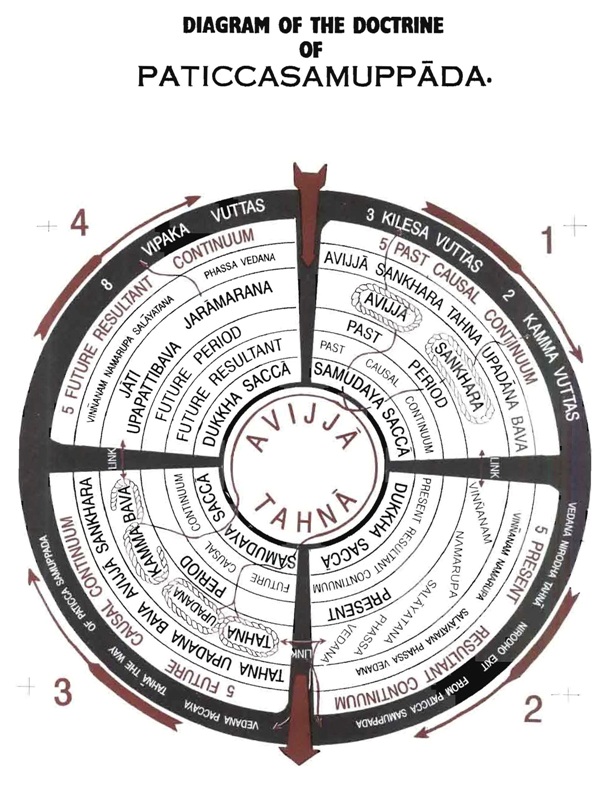
Paticcasamupada
"And what is dependent co-arising?
From ignorance as a requisite condition come
fabrication. (avijja-sankhara)
From fabrications as a requisite
condition comes consciousness. (sankhara-vinnana)
From consciousness as a requisite condition
comes name-&-form. (vinnana-nama rupa)
From name-&-form as a requisite condition
come the six sense media. (nama rupa-salayatana)
From the six sense media as a requisite
condition comes contact. (salayatana-phassa)
From contact as a requisite condition comes
feeling. (phassa-vedana)
From feeling as a requisite condition comes
craving. (vedana-tanha)
From craving as a requisite condition comes
clinging/sustenance. (tanha-upadana)
From clinging/sustenance as a requisite
condition comes becoming. (upadana-bhava)
From becoming as a requisite condition comes
birth. (bhava-jati)
From birth as a requisite condition, then
aging & death,
sorrow, lamentation,
pain, distress, & despair come into play.
(jati-jara-marana)
Such is the origination of this entire mass of stress & suffering.
Dukkha Samudaya Ariya Sacca.
[The Second: Noble Truth of the Origin of Suffering]
(SN 12.2)
...
And what is dependent cessation?
With the complete cessation of
ignorance, fabrications cease.
With the cessation of fabrications,
consciousness ceases.
With the cessation of consciousness, mind and
body cease.
With the cessation of mind and body, the six
sense bases cease.
With the cessation of the six sense bases,
contact ceases.
With the cessation of contact, feeling ceases.
With the cessation of feeling, craving ceases.
With the cessation of craving, clinging
ceases.
With the cessation of clinging, becoming
ceases.
With the cessation of becoming, birth ceases.
With the cessation of birth,
ageing, death, sorrow, lamentation, physical pain,
mental pain, and anguish cease.
Such is the cessation of this entire mass of stress & suffering.
Dukkha Nirodha Ariya Sacca. Nibbana.
[The
Third: Noble Truth of the Cessation of Suffering]
(AN 10.92)
...
When this is, that is.
From the arising of this comes the arising of that.
When this isn't, that isn't.
From the cessation of this comes the cessation of that.
...
HOW DID THE LORD BUDDHA DWELL?
Bhikkhus, Mindfulness of in- and out- Breath (Ānāpānasati)
that one has developed and make much of has great fruit and great benefit.
Even I myself, before awakening, when not yet
enlightened, while still a Bodhisatva (Buddha to be), lived in this
dwelling (way of life) for the most part. When I lived mainly in this
dwelling, the body was not stressed, the eyes were not strained, and my
mind was released from the asava (corruptions, cankers) through
non-attachment.
For this reason, should anyone wish "may my
body be not stressed, may my eyes be not strained, may my mind be released
from the asava through non-attachment," then that person ought to attend
carefully in his heart to this
Mindfulness
of in- and out- Breath meditation.
(Samyutta Nikaya. Samyutta LIV, Sutta 8)
...
The Buddha praises ānāpānasati thus:
Bhikkhus, this concentration through mindfulness of breathing,
when developed and practised much, is both peaceful and sublime.
It is an unadulterated blissful abiding, and
it banishes and stills evil unwholesome thoughts as soon as they arise.
(Samyutta Nikāya)
...
Things to be fully
understood, abandoned, developed & realized
by direct knowledge
And what things should be
fully understood by direct knowledge?
The five aggregates affected by clinging (upadana),
that is the material form affected by clinging, feeling
affected by clinging, perception affected by clinging, mental formation affected
by clinging, consciousness affected by clinging.
These are the things that should be fully understood by direct
knowledge.
"And what things should be
abandoned by direct knowledge?
Ignorance and craving (avijja and tanha).
These are the things that should be abandoned by direct knowledge.
"And what
things should be developed by direct knowledge?
Tranquility and
insight (samatha-vipassana).
These are the things that should be developed by direct
knowledge.
"And what
things should be realized by direct knowledge?
Clear knowing and
release.
These are the things that should be realized by direct
knowledge.
(MN#149)
...
The Four Frames of Reference
"And how is mindfulness of in-&-out breathing developed & pursued so as to
bring the four frames of reference to their culmination?
The Seven Factors for
Awakening
"And how are the four frames of reference developed & pursued so as to
bring the seven factors for awakening to their culmination?
Clear Knowing & Release
"And how are the seven factors for awakening developed & pursued so as to
bring clear knowing & release to their culmination?
(MN 118)
...
"What is the purpose of skillful
virtues? What is their reward?"
"Skillful virtues have freedom from remorse
as their purpose,
Ananda, and freedom from remorse as their reward."
"Freedom from remorse has joy as its
purpose, joy as its reward."
"Joy has rapture as its purpose, rapture as
its reward."
"Rapture has serenity as its purpose,
serenity as its reward."
"Serenity has pleasure as its purpose,
pleasure as its reward."
"Pleasure has concentration as its purpose,
concentration as its reward."
"Concentration has knowledge & vision of
things as they actually are as its purpose,
knowledge & vision of things as they actually are as its reward."
"In this way, Ananda, skillful virtues lead
step-by-step to the consummation of arahantship."
(Kimattha Sutta Anguttara Nikaya 11.1)
...
Samma
Samadhi
(Right
Concentration)
"And what, monks, is
right concentration? (i) There is the case where a monk — quite
withdrawn from sensuality, withdrawn from unskillful (mental) qualities —
enters & remains in the
first jhana: rapture & pleasure born from
withdrawal, accompanied by initial application & sustained application. (ii) With
the stilling of initial application & sustained application, he enters & remains in
the
second jhana: rapture & pleasure born of
concentration, unification of awareness free from directed thought &
evaluation — internal assurance. (iii) With the fading of rapture,
he remains equanimous, mindful, & alert, and senses pleasure with the
body. He enters & remains in the
third jhana, of which the Noble Ones declare,
'Equanimous & mindful, he has a pleasant abiding.' (iv) With the
abandoning of pleasure & pain — as with the earlier disappearance of
elation & distress — he enters & remains in the
fourth jhana: purity of equanimity &
mindfulness, neither pleasure nor pain. This, monks, is called right
concentration."
...
Samma Samadhi
(Right
Concentration)
(www.what-Buddha-said.net)
...
"´This Dhamma is for one with samádhi, not for one without
samádhi.´ So it was said. For what reason was this said? Here a monk
enters and abides in the first jhána … second jhána … third jhána … fourth
jhána."
AN 8.30
...
When the Bodhisatta had the insight that
Jhana was the way to Enlightenment, he then thought, "Why am I
afraid of that pleasure which has nothing to do with the five senses
nor with unwholesome things? I will not be afraid of that pleasure
(of Jhana)!" (MN 36)
...
The Buddha said that one who indulges in
the pleasures of Jhana may expect only one of four
consequences: Stream Winning, Once-returner, Non-returner, or Full
Enlightenment!
In other words, indulging in Jhana leads only to
the four stages of Enlightenment.
(Pasadika Sutta, DN 29,25)
...
"Jhana is to be followed, is to be
developed and is to be made much of. It is not to be feared."
(MN 66)
...
"One trains in the higher virtue (sila), the higher
mind, and the higher wisdom … What is the training in
the higher mind? Here a monk … enters and abides in the
first jhána … second jhána … third jhána … fourth jhána."
(AN
3.84, 88, 89)
...
"That one could perfect samádhi without perfecting
virtue or that one could perfect wisdom without
perfecting samádhi - this is impossible."
(AN 5.22)
...
"It is impossible to abandon the fetters that bind us to
samsára (samyojana) without having perfected samádhi.
And without abandoning those fetters it is impossible to
realize Nibbána."
(AN 6.68)
...
"I
say, monks, that the destruction of the mind's poisons
is dependent on the first jhána … eight jhána."
(AN 9.36)
...
'For a person with right
samádhi there is no need to
arouse the wish,
´May I see things as they truly are.´
It is a natural process, it is in accordance with nature
that someone with right samádhi
will see things as they truly are.' (AN 10.3)
...
'There is no jhána without
wisdom,
there is no wisdom without jhána,
but for someone with both jhána and wisdom,
Nibbána is near.' (Dhp 372)
...
Develop concentration, bhikkhus; concentrated, bhikkhus,
a bhikkhu understands according to reality.
(Samàdhi
Sutta,
S.III.I.i.v)
...
Silenced in body,
silenced in speech,
silenced in mind,
without inner noise,
Blessed with silence is the sage!
He is truly washed of all evil ...
(Itivuttaka 3.67)
...
And as I remained thus
heedful, ardent, & resolute, thinking imbued with
renunciation / non-ill will / harmlessness arose. I
discerned that 'Thinking imbued with renunciation /
non-ill will / harmlessness has arisen in me; and that
leads neither to my own affliction, nor to the
affliction of others, nor to the affliction of both. It
fosters discernment, promotes lack of vexation, & leads
to Unbinding. If I were to think & ponder in line with
that even for a night... even for a day... even for a
day & night, I do not envision any danger that would
come from it, except that thinking
& pondering a long time would tire the body. When the
body is tired, the mind is disturbed; and a disturbed
mind is far from concentration.' So I steadied my
mind right within, settled, unified, & concentrated it.
Why is that? So that my mind would not be disturbed.
... first jhana, second jhana
... "
(Dvedhavitakka
Sutta, MN.019)
...
"A monk intent on heightened
mind should attend periodically to three themes:
he should attend
periodically to the theme of
concentration;
he should attend periodically to the theme of
uplifted energy;
he should attend periodically to the theme of
equanimity.
If the monk intent on
heightened mind were to attend solely to the theme of
concentration, it is possible that his mind would tend
to laziness.
If he were to attend
solely
to the theme of uplifted energy, it is possible that his
mind would tend to restlessness.
If he were to attend
solely
to the theme of equanimity, it is possible that his mind
would not be rightly centered for the
stopping of the fermentations.
But when he attends
periodically to the theme of concentration, attends
periodically to the theme of uplifted energy, attends
periodically to the theme of equanimity,
his mind is
pliant, malleable, luminous, & not brittle. It is
rightly centered for the stopping of the fermentations.
(Nimitta Sutta, AN3.100)
...
The Great Practice of
Right Mindfulness
"Now, if anyone would
develop these four frames of reference [body (kaya),
feeling (vedana), mind (citta), phenomena (dhamma) in
this way for seven years,
one of two fruits can be expected for him: either
arahatship
right here & now, or — if there be
any remnant of clinging-sustenance — non-returner (anagami)."
"Let alone seven years. If anyone would
develop these four frames of reference in this way for
six years... five... four... three... two years...
one year... seven months... six months... five... four... three... two
months... one month... half a month..., seven
days, one of two fruits can be
expected for him: either arahatship right here & now, or — if there be any
remnant of clinging-sustenance — non-returner (anagami)."
(Maha-satipatthana
Sutta)
Ye dhamma hetuppabhava
tesa hetu
tathagato aha ,
tesan ca yo nirodho.
Eva vadi mahasama-o
Of those things that arise from a cause,
the
Tathagata
has told the cause,
and also what their cessation is.
This is the doctrine of the Great Recluse.
...
"Whatever phenomena arise from a
cause:
their cause
& their cessation.
Such is the teaching of the Tathagata,
the Great Contemplative."
(Ven. Assaji)
Dependent Origination
Dependent Arising of Suffering
&
Dependent Arising of Enlightenment
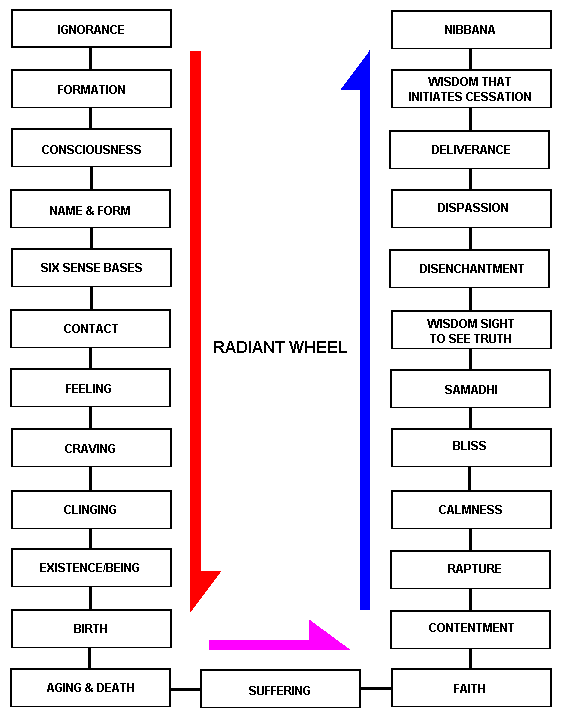
(Upanisa
Sutta, SN 12.23)
"Nothing happens immediately, so in the
beginning we can't see any results from our practice."
...
"In our practice we see this desire as either
sensual indulgence or self-mortification. It's in this very conflict that
our Teacher, the Buddha, was caught up, just this dilemma. He followed
many ways of practice which merely ended up in these two extremes. And
these days we are exactly the same. We are still afflicted by this
duality, and because of it we keep falling from the Way.
However, this is how we must
start out
..."
...
"If you are still following your
likes and dislikes,
you have not even begun to practise Buddhism."
...
"If it isn't good, make it die. If it doesn't
die, make it good."
...
"If you find certainty in that which is
uncertain, you are BOUND to suffer."
...
"If you can learn to make the mind still, it
will be the greatest help to the world."
...
"When sitting in meditation, say, “That’s not
my business!” with every thought that comes
by."
...
"Do not try to become anything.
Do not make yourself into anything.
Do not be a meditator.
Do not become enlightened.
When you sit, let it be.
What you walk, let it be.
Grasp at nothing.
Resist nothing."
...
"When one does not understand death, life can
be very confusing."
...
"Don’t think that only sitting with the eyes
closed is practice. If you do think this way, then quickly change your
thinking. Steady practice is keeping mindful in every posture, whether
sitting, walking, standing or lying down. When coming out of sitting,
don’t think that you’re coming out of meditation, but that you are only
changing postures. If you reflect in this way, you will have peace.
Wherever you are, you will have this attitude of practice with you
constantly. You will have a steady awareness within yourself."
...
"Only one book is worth reading:
the heart."
...
"The Dhamma has to be found by looking into
your own heart and seeing that which is true and that which is not, that
which is balanced and that which is not balanced."
...
"The heart of the path is quite easy. There’s
no need to explain anything at length.
Let go of love and hate and let things be.
That’s all that I do in
my own practice."
...
"We practice to learn how to let go, not how
to increase our holding on to things.
Enlightenment appears when you stop wanting anything."
...
"If you let go a
little, you will have a little peace.
If you let go a lot, you will have a
lot of peace.
If you let go completely, you will have complete peace."
...
"You are your own teacher. Looking for
teachers can’t solve your own doubts.
Investigate yourself to find the
truth - inside, not outside.
Knowing yourself is most important."
...
"Try to be mindful and let things take their
natural course. Then your mind will become still in any surroundings, like
a clear forest pool. All kinds of wonderful, rare animals will come to
drink at the pool, and you will clearly see the nature of all things. You
will see many strange and wonderful things come and go, but you will be
still. This is the happiness of the Buddha."
...
"Our birth
and death are just one thing. You can’t have one without the
other. It’s a little funny to see how at a death people are so tearful and
sad, and at a birth how happy and delighted. It’s delusion.
I think if you really want to cry, then it would be
better to do so when someone’s born. Cry at the root, for if there
were no birth, there would be no death.
Can you understand this?"
...
"All things are just as they are.
They don’t cause suffering to anybody. It’s just like a thorn, a
really sharp thorn. Does it make you suffer?
No, it’s just a thorn.
It doesn’t bother anybody. But if you go and stand on it, you’ll suffer.
Why is there suffering? Because you stepped on the thorn.
The thorn is just minding its
own business.
It doesn’t harm anybody. It’s because
of we ourselves that there is pain.
Form, feeling,
perception, volition, consciousness …
all things in this world are simply as they are. It’s we who pick
fights with them. And if we hit them, they hit us back. If they’re left
alone, they won’t bother anybody. Only
the drunkard gives them trouble."
...
"If those who have studied
the theory hang on to what they have learnt when they sit in meditation,
taking notes on their experience and wondering whether they have reached
jhana yet, their minds will be
distracted right there and turn away from the meditation.
They won’t gain real understanding.
Why is that?
Because there is desire.
As soon
as tanha
(craving) arises, whatever the meditation you are doing,
it won’t
develop because the mind withdraws.
It is essential that you learn how to
give up all thinking
and doubting,
give it up completely,
all of it."
...
"As you contemplate the cause of suffering, you should understand that
when that which we call the mind is still, it's in a state of
normality. As soon as it moves, it becomes
sankhara (that which is fashioned or
concocted).
When attraction arises in the mind, it is
sankhara; when aversion arises, it is sankhara. If there
is desire to go here and there, it is sankhara. As long as you
are not mindful of these sankharas, you will tend to chase
after them and be conditioned by them."
...
"Whenever the mind moves,
it is aniccam (impermanent),
dukkham (suffering) and anatta (not self).
The Buddha
taught us to observe and contemplate this. He taught us to contemplate
sankharas which condition the mind. Contemplate them in light
of the teaching of paticcasamuppada (Dependent Origination):
avijja (ignorance) conditions sankhara (karmic formations);
sankhara conditions vinnana (consciousness); vinnana
conditions nama (mentality) and rupa (materiality); and
so on."
...
"All physical and all mental phenomena and everything that the mind
thinks, are sankharas.
"
...
"Generally, when we
experience a mind-object it stimulates thinking. The thinking is in
reaction to the experience of the mind-object. The nature of ordinary
thinking and
panna is very different.
The nature of ordinary
thinking is to carry on without stopping. The mind-objects you experience
lead you off in different directions and your thoughts just follow along.
The nature of panna
is to stop the proliferation, to still the mind, so that it doesn’t go
anywhere."
...
"The knowing that arises is above and beyond the process of thinking.
It
leads to not being fooled by thinking any more."
"In the beginning we need to work using thinking, even though later on we
go beyond it. When we are doing true contemplation all dualistic thinking
has ceased; although we need to consider dualistically to get started.
Eventually all thinking and pondering comes to an end."
Seeing the Way
...
"If I’d wanted to stop
formal practice, was there any laziness, tiredness or irritation?
None at all. The mind was completely free from
such defilements. What was left was the sense of complete balance or
‘just-rightness’ in the mind.
If I was going to stop, it would just have been to rest the body, not
for anything else."
...
"If you experience
different kinds of nimitta during
meditation, such as visions of heavenly beings, before anything else
it’s important to observe the state of mind very closely. Don’t forget
this basic principle. The mind has to be
calm for you to experience these things. Be careful
not to practice with desire either to experience
nimitta or not to experience them. If they arise,
contemplate them and don’t let them delude you.
Reflect that they are not you and they don’t belong to you.
They are aniccam,
dukkham, anatta,
just like all other mind-objects. If you do experience them, don’t let
your mind become too interested or dwell on them. If they don’t
disappear by themselves, reestablish mindfulness.
Put all your attention on the breath, taking a
few extra deep breaths. If you take at least three extra-long breaths
you should be able to cut out the
nimitta. You must keep
reestablishing awareness in this way as you continue to practice."
...
"Looking for peace is like looking for a turtle with a mustache: You won't
be able to find it.
But when your heart is ready, peace will come looking for you."
...
"There are two kinds of peacefulness :
one is the peace that comes through samådhi,
the other is the peace that comes through paññå.
The mind that is peaceful through samådhi is
still deluded.
The peace that comes through the practice of samådhi alone is
dependent on
the mind being separated from mind-objects."
...
"Some of us start to practise, and even after
a year or two, still don't know what is what. We are still unsure of the
practice. When we are unsure, we don't see that everything around us is
purely Dhamma, and so we turn to teachings from the Ajahns (teachers).
But actually, when we know our own mind, when
there is sati (mindfulness) to look closely at
the mind, there is wisdom."
...
"Let your aim be
Nibbana."
(Ajahn Chah)
Breath subdues pain. Mindfulness
subdues the Hindrances.
...
The in-and-out breath is stress --
the in-breath, the stress of arising; the out-breath, the
stress of passing away.
...
Once you cut off thoughts of past and future, you don't have
to worry about the Hindrances.
...
Some people believe that they don't have to practice centering
the mind, that they can attain release through discernment
(pañña-vimutti) by working at discernment alone.
This simply isn't true.
Both release through discernment and release through stillness
of mind (ceto-vimutti) are based on centering the mind.
They differ only in degree.
Like walking: Ordinarily, a person doesn't walk on one leg
alone. Whichever leg is heavier is simply a matter of personal
habits and traits.
...
You can't
do without concentration. If concentration is lacking, you can
gain nothing but jumbled thoughts and conjectures, without any
sound support.
...
Vedana
1. Watch the arising of
feelings in the present. You don't have to follow them
anywhere else. Tell yourself that whatever may be causing
these feelings, you're going to focus exclusively on what is
present.
2. Focus on the fading of feelings in the present.
3. Focus on the passing away of feelings in the present.
4. Stay with the realization that
feelings do nothing but arise and fall away —
simply flowing away and vanishing in various ways — with
nothing of any substance or worth. When you can do this, you
can say that your frame of reference is firmly established
in feelings in and of themselves — and at that point, the
Path comes together.
...
Letting go has two forms:
(1) Being able to let go of mental objects but not of one's
own mind.
(2) Being able to let go both of the objects of the mind and
of one's self.
To be able to let go both of one's
objects and of one's self is genuine knowing. To be able to
let go of one's objects but not of one's self is counterfeit
knowing. Genuine knowing lets go of both ends: It lets the
object follow its own nature as an object, and lets the mind
follow the nature of the mind. In other words, it lets nature
look after itself. "Object" here refers to the body; "self"
refers to the heart. You have to let go of both.
...
Turmoil comes from our own
defilements, not from other people.
You have to solve the problem within yourself if you want to
find peace.
...
My motto is,
"Make yourself as
good as possible, and everything else will have to turn good
in your wake."
If you don't abandon your own inner goodness
for the sake of outer goodness,
things will have to go well.
...
... we'll see that aging, illness,
and death are simply the shadows of stress and not its true
substance. People lacking discernment will try to do away with the
shadows, which leads only to more suffering and stress. This is
because they aren't acquainted with what the shadows and substance
of stress come from. The essence of stress lies with the mind.
Aging, illness, and death are its shadows or effects that show by
way of the body. When we want to kill our enemy and so take a
knife to stab his shadow, how is he going to die? In the same way,
ignorant people try to destroy the shadows of stress and don't get
anywhere. As for the essence of stress in the heart, they don't
think of remedying it at all. This ignorance of theirs is one form
of avijja, or unawareness.
...
The mind is the only thing that
senses pleasure and pain. The body has no sense of these
things at all. It's like taking a knife to murder someone:
They don't hunt down the knife and punish it. They punish only
the person who used it to commit murder.
...
Don't let defilements inside make
contact with defilements outside. If we have defilements at
the same time that other people do, the result will be
trouble. For instance, if we're angry when they're angry, or
we're greedy when they're greedy, or we're deluded when
they're deluded, it spells ruination for everyone.
...
Results don't come from thinking.
They come from the qualities we build into the mind.
...
If you want to just think buddho,
you can, but it is too light.
Your awareness won't go deep...
The Skills of Jhana
...
People who develop
jhana fall into three classes:
1. Those who attain only the
first level [First
Jhana] and then gain liberating insight right
then and there are said to excel in discernment (paññadhika).
They Awaken quickly, and their release is termed
pañña-vimutti,
release through discernment.
2. Those who develop jhana
to the fourth level
[Fourth Jhana],
there gaining liberating insight into the Noble Truths,
are said to excel in conviction (saddhadhika).
They develop a moderate number of skills, and their
Awakening occurs at a moderate rate. Their release is
the first level of
ceto-vimutti, release
through concentration.
3. Those who become skilled
at the four levels of jhana
[Rupa Jhana]— adept at
entering, staying in place, and withdrawing — and then
go all the way to the four
levels of arupa-jhana, after which they
withdraw back to the first jhana, over and over again,
until finally intuitive knowledge, the cognitive skills,
and liberating discernment arise, giving release from
mental fermentation and defilement: These people are
said to excel in persistence (viriyadhika).
People who practice jhana a great deal, developing
strong energy and bright inner light, can Awaken
suddenly in a single mental instant, as soon as
discernment first arises. Their release is
cetopariyavimutti, release
through mastery of concentration.
These are the results to be
gained by meditators.
But there have to be causes —
our own actions — before the results can come fully
developed.
...
With one exception [Ānāpānassati], all of the
[39] meditation themes mentioned here are simply gocara dhamma —
foraging places for the mind. They're not places
for the mind to stay. If we try to go live in the things we see
when we're out foraging, we'll end up in trouble.
When you practice meditation, you don't have
to go foraging in other [39] themes; you can stay
in the single theme that's the apex of all meditation themes:
Ānāpānassati,
keeping the breath in
mind. This theme, unlike the others, has none of the features or various
deceptions that can upset or disturb the heart.
...
As for the four sublime abodes, if you
don't have jhana as a dwelling for the mind, feelings of good will,
compassion, and appreciation can all cause you to suffer. Only if you have
jhana can these qualities truly become sublime abodes, that is, restful
places for the heart to stay (vihara dhamma)
Basic Themes
...
"To study is to know the texts,
To practice is to know your defilements,
To attain the goal is to know & let go."
...
"If a person isn't true to the Buddha's
teachings, the Buddha's teachings won't be true to that person — and that
person won't be able to know what the Buddha's true teachings are."
(Ajahn Lee Dhammadharo)
When one does what Buddhas do, one is a Buddha.
When one does what Bodhisattvas do, one is a Bodhisattva.
When one does what Arhats do, one is an Arhat.
When one does what ghosts do, one is a ghost.
These are all natural phenomena.
There are no shortcuts in cultivation.
...
If you wish others to know about your
good deeds,
they are not truly good deeds.
If you fear others will find out about your bad deeds,
those are truly bad deeds.
(Master Hsuan Hua)
Things are not what they appear to be: nor are they otherwise.
(Surangama Sutra)
Compassion is a verb.
...
If we are not empty, we become a block of
matter.
We cannot breathe, we cannot think.
To be empty means to be alive, to breathe in and to breathe out.
We cannot be alive if we are not empty.
Emptiness is impermanence, it is change.
We should not complain about impermanence,
because without impermanence, nothing is possible.
...
Meditation is not to escape from society,
but to come back to ourselves and see what is going on.
Once there is seeing, there must be acting.
With mindfulness, we know what to do and what not to do to help.
...
Enlightenment, for a wave in the ocean,
is the moment the wave realises it is water.
...
People have a hard time letting go of their
suffering.
Out of a fear of the unknown, they prefer suffering that is familiar. ...
It is possible to live happily in the here and
now.
So many conditions of happiness are available
- more than enough for you to be happy right now.
You don't have to run into the future in order to get more.
...
There is no way to happiness, happiness is the
way.
You should be happy right in the here and now.
There is no way to
enlightenment.
Enlightenment should be right here and right now.
The
moment when you come back to yourself, mind and body together, fully
present, fully alive, that is already enlightenment.
You are no longer a
sleepwalker.
You are no longer in a dream.
You are fully alive.
You are
awake. Enlightenment is there.
...
People suffer because they are caught in their
views.
As soon as we release those views, we are free and we don't suffer
anymore. ...
Life is available only in the present.
That is why we should walk in such a way that every step can bring us to
the here and the now. ...
When you love someone, the best thing you can
offer is your presence.
How can you love if you are not there?" ...
The Pure Land is found here & now. One does
not need to die before going to Pure Land.
...
The Western Paradise can be experienced
right here at this moment. It is not in the west.
...
Every thought you produce, anything you say,
any action you do, it bears your signature.
...
The purpose of walking meditation is walking
meditation itself.
Going is important, not arriving. Walking meditation is not a means to an
end; it is an end.
Each step is life; each step is peace and joy. That is why we don’t have
to hurry.
That is why we slow down. We seem to move forward, but we don’t go
anywhere; we are not drawn by a goal.
Thus we smile while we are walking.
(Thich Nhat Hanh)
The direction of the walking path when part of practice (in meditation),
is from the east to the west.
Other directions are acceptable if a suitable direction cannot be found,
except avoid the direction
from the north to the south and
from the south to the north.
(Ajaan Mun)
The Buddha taught that during
sitting and walking meditation we should make the knowing converge on
itself,
not allowing it to go outwards.
Thoughts of good and bad are
all exterior matters and are endless.
...
Meditate on every inhalation and exhalation.
Determine to practice right at this moment.
If we don't, the demons of
thought
and
defilement
will lead us away into
old age and death.
We meditate in
order to condense the energies of the mind into this inner knowing.
We put
down
thoughts and
sense-consciousness,
the defiled mind that goes out in search of distractions.
...
In sitting meditation do not be deceived by the thought-demon (sankhara
mara).
Those people who only sit a little or don't sit at all are the ones
who believe in the thought-demon.
...
For instance, we decide to sit before dawn and the
thought-demon tells us it is too early, why
not sit later on. If we believe it then our morning session is lost; we
don't sit.
Later on in the morning and perhaps we forget altogether
but if we do remember, just as we are about to rouse ourselves and do some
sitting meditation, the thought-demon pipes up again. "You don't want to
sit yet. You've just had your breakfast, your stomach is still full. Have
a rest first. You can always do some sitting in the afternoon." If we
believe it, that's delusion.
Before dawn it says meditate later on in the morning. Later
on in the morning it says meditate in the afternoon. "If you digest your
food first you will feel much more comfortable." If we believe it we don't
sit. In the afternoon it starts again. We end up just believing the
thought-demon all day and all night and so get nothing from meditation.
...
In order to clearly know these three characteristics of
aniccam, dukkham and anatta
the mind must be firm. Thus the effort to
bring the mind to a secure and steadfast tranquility,
not allowing it to become fascinated by
forms,
sounds, odors, flavors, physical
sensations and
mental phenomena is the essence of meditation
techniques,
and something we must all develop.
(Looang Boo Sim)
"The Mind sent Outside is the Cause of Suffering.
The Effect of the Mind sent Outside is Suffering.
The Mind seeing the Mind is the Path: The Noble Way!
The Effect of Mind seeing Mind, is the End of Suffering."
...
"No matter how much you think, you won't know.
Only when you stop thinking will you know.
But still, you have to depend on thinking so as to know."
...
"Knowing is the ground state of the empty mind, which is bright,
pure, quiet, calm, not fabricating, not searching, not urging,
and neither possessed, nor attracted by anything at all..."
(Ajahn
Atulo)
Q: Could you please explain
death contemplation, like how to do it and how often? Can one realize the Dhamma by death contemplation, and if so, up to what stage?
We
contemplate death so as to remember not to be heedless in our lives,
therefore attempting to develop and practice virtue to its utmost for as
long as we still have life. So, in the course of our practice of keeping
precepts, developing virtue, meditation and wisdom in our minds,
if we
include death contemplation and we give it a lot of emphasis, we shall be
able to know and see the Dhamma to the level of
sotāpanna,
the first stage of
enlightenment, without having to
contemplate the thirty two parts of the
body, the loathsomeness of the body, or the four elements of the body.
However, if we wish to
go on to a higher attainment, we must revert to contemplating
either the thirty-two
parts of the body, the
loathsomeness of the body,
or the four elements.
There was a time when I was
still a layman, when I contemplated upon death. This actually hastened my
coming to ordain. I thought that if I continued my studies and then
started a career, if it happened that I should suddenly die, either due to
sickness or accident, I would not have developed virtue and goodness to
any real extent. There was this fear that if death came to me, I would not
have done enough wholesome deeds, or cultivated enough virtue in my life.
So finally, having reflected upon my life like this, and having previously
given the possibility of future ordination some thought, it happened that
all by coincidence, late one evening, I picked up a Dhamma book that
opened at the last words of the Buddha. The Buddha said, ‘Take
heed monks, I caution you thus: all things that arise are of a nature to
cease. Therefore, strive on ceaselessly, discerning and alert both for
your own benefit and the benefit of others.’
...
Even the mental formations or
the thinking processes are not the mind:
that which thinks is not the mind; that which does not think is the mind.
This is the Path
(Ajahn
Dtun Thiracitto)
A
Contemplation on the Thirty-Two Parts of the Body
(Dvattimsakara)
There are in this body
:
head-hairs, body-hairs,
nails, teeth, skin,
flesh, sinews, bones, marrow, kidneys,
heart, liver, pleura, spleen, lungs,
intestines, mesentery, stomach, excrement, brain,
bile, phlegm, pus, blood, sweat,
fat, tears, grease, saliva, snot,
synovium (oil lubricating the joints) and urine.
Contemplate &
visualise their foulness and repulsiveness nature
in groups, forward and in reverse
order.
as a direct
antidote for sensual lust
This too will pass.
...
All the cravings and desires, (and thus dukkha) come from a sense of
‘self’...
...
Just bare attention, just
bare perception, is not enough.
The defilements have already been at work and that’s the problem.
We cannot trust even the first experience that comes to our senses.
...
Remember, wanting is that force which takes you away from
whatever you are
experiencing now, into something in
the future, into fantasies or dreams.
...
One cannot will the mind to be still!
...
Remember that the greatest controller of all is
Mara (the doer).
...
Understand that
Mara
is the ‘doer’
inside you.
He’s always trying to push and pull you, saying,
“Come on, don’t get so sleepy”.
“Come on, put forth some effort”.
“Come on, get into a jhana”.
“Come on, who do you think you are?”
“Come on, how long have you been a monk, how long have you got left of
your retreat?”
“Come on, get going.”
That is
Mara!
...
Remember that the
jhanas
are the places that
Mara
(the doer)
can’t go, where Mara
is blindfolded.
...
Mara's Ten Armies
First army : Sensual
Passions.
Second army : Discontent.
Third army : Hunger & Thirst.
Fourth army : Craving.
Fifth army : Sloth & Torpor.
Sixth army : Fear.
Seventh army : Uncertainty.
Eighth army : Conceit & Stubbornness.
Ninth army : Gains, Fame, Honour, & Status wrongly
gained, and
Tenth army : Whoever would praise himself & despises
others.
That, Namuci (Mara), is your army, the Dark
One's commando force. A coward can't defeat it, but one having defeated it
gains bliss. Do I carry muñja grass?
I spit on my life. Death in battle would be better for me than that I,
defeated & survive. Sinking here, they don't appear, some priests &
contemplatives. They don't know the path by which those with good
practices go. Seeing the bannered force on all sides — the troops, Mara
along with his mount — I go into battle. May they not budge me from my
spot. That army of yours, that the world with its devas can't overcome,
I will smash with
discernment — as an unfired pot with a stone. Making my resolve
mastered, mindfulness well-established, I
will go about, from kingdom to kingdom, training many disciples. They —
heedful, resolute doing my bidding — despite your wishes, will go where,
having gone, there's no grief."
Mara:
"For seven years, I've dogged the Blessed
One's steps, but haven't gained an opening in the One Self-awakened &
glorious. A crow circled a stone the color of fat — 'Maybe I've found
something tender here. Maybe there's something delicious' — but not
getting anything delicious there, the crow went away. Like the crow
attacking the rock, I weary myself with Gotama."
As he was overcome with sorrow, his lute
fell from under his arm. Then he, the despondent spirit, right there
disappeared."
(Sutta Nipata: 3.2)
...
Eight Qualities of the True Dhamma
"Gotami, the qualities of which you may
know, 'These qualities lead:
to passion, not to dispassion;
to being fettered, not to being unfettered;
to accumulating, not to shedding;
to self-aggrandizement, not to modesty;
to discontent, not to contentment;
to entanglement, not to seclusion;
to laziness, not to aroused persistence;
to being burdensome, not to being unburdensome':
You may categorically hold,
'This is not the Dhamma, this is not the Vinaya, this is not the Teacher's
instruction.'
"As for the qualities of which you may know, 'These qualities lead:
to dispassion, not to passion;
to being unfettered, not to being fettered;
to shedding, not to accumulating;
to modesty, not to self-aggrandizement;
to contentment, not to discontent;
to seclusion, not to entanglement;
to aroused persistence, not to laziness;
to being unburdensome, not to being burdensome':
You may categorically hold,
'This is the Dhamma, this is the Vinaya, this is the Teacher's
instruction.'" AN 8.53
...
Do absolutely nothing and see how smooth
and beautiful and timeless the breath can appear !
...
The goal of this meditation (Ānāpānasati) is
the beautiful
silence, stillness
and clarity of mind.
...
Ānāpānasati: breathing in long or short, breathing out long or short
- they are descriptive not prescriptive.
Just watch and know the breath & do nothing!
...
Indeed, one is placing faith in the knowing
and taking it away
from the doing.
This is the theme underlying the whole of the
meditation path.
...
The inclination of the mind outwards is called
papanca
in
Pali.
There’s no end to that proliferation or the complexity of that world of
papanca.
On the other hand, the mind that inclines
inwards into the present
moment, the silence, the breath, the
nimmitta,
and the jhanas,
is the mind which
knows the end of
papanca.
...
When we talk we always talk about the past
or the future.
We can never talk about the present.
...
The five
hindrances are the cause for the lack of
samadhi.
The lack of samadhi
is not caused by lack of effort.
...
The five hindrances are Public Enemy Number One.
They stop people from becoming enlightened,
and it’s precisely for this reason that understanding these five
hindrances
and overcoming them is crucial.
Understand them
...
The First Hindrance - Sensory Desire (kama-cchanda)
The Pali word kama means anything pertaining
to the five senses of sight, hearing, smell, taste, and touch.
Chanda means to delight in or agree with. Together the compound
kama-cchanda means “delight, interest, involvement with the world of
the five senses.”
For the new meditator, the most obvious form of
kama-vitakka is sexual fantasy. One can use up many hours, especially
on a long retreat, with this type of kama-vitakka. This obstacle to
progress in meditation is transcended by realizing, through insight or
faith, that total freedom from the five senses (i.e., jhana) is more
ecstatic and profound than the very best of sexual experiences. A monk
or nun gives up their sexuality not out of fear or repression, but out
of recognition of something superior.
...
The Second Hindrance - Ill-will (vyapada)
Maybe you prefer to sit through pain rather than enjoy peace and
happiness.
(This is ill-will)
To overcome ill-will do some loving-kindness
meditation. Give yourself a break. Say to yourself, “The door to my
heart is open to all of me. I allow myself happiness. I allow myself
peace. I have goodwill toward myself, enough goodwill to let myself
become peaceful and to bliss out on this meditation.”
...
The Third Hindrance
- Sloth and Torpor
... the mind is dull. It’s as if there are no lights turned on
inside. It’s all gray and blurry.
The most profound and effective way of overcoming sloth
and torpor is to make peace with the dullness and stop fighting it!
...
The Fourth Hindrance - Restlessness and Remorse/(Regret)
Restlessness in meditation is always a sign of not finding joy in
what’s here.
That’s what restlessness is, going around looking for something
else to do, something else to think about, somewhere else to
go—anywhere but here and now.
Remorse is the result of hurtful things that you may have done or
said.
In other words, it is a result of bad conduct.
...
The Fifth Hindrance - Doubt
more about the hindrances here
...
Kilesas (Defilements)
The biggest of the kilesas
are lobha, dosa,
and moha, which can be translated as
greed, hatred, and delusion.
Delusion is the mind
which thinks it’s doing something right but is actually doing
something wrong. That is, it encourages more defilements, which
encourages more heat in the mind, and that is not conducive to the
path.
The only thing that can really oppose that delusion
is a sense of hiri-ottappa
accompanied by mindfulness.
Hiri-ottappa is the sense of shame. The
shame of doing something that is inappropriate, knowing that it is
going to create suffering for
...
Everyone makes mistakes. The wise are not people
who never make mistakes, but those who forgive themselves and learn
from their mistakes.
...
Silence is so much more productive of wisdom and clarity than
thinking.
...
Give up your thinking, your thoughts; otherwise you get headaches.
...
Great thinkers get great
headaches.
The still, alert
mind sees deeper than any thought.
...
The mind seeks out silence constantly, to the point where it only thinks
if it really has to, only if there is some point to it. Since, at this
stage, you have realized that most of our thinking is really pointless
anyway, that it gets you nowhere, only giving you many headaches, you
gladly and easily spend much time in inner quiet.
...
It is impossible that such a gross activity as thinking can exist
in such a refined state as Jhana. In fact, thinking ceases
a long time prior to Jhana.
...
Thinking is an obstacle to gaining the samadhi which can know those
worlds.
...
The first Twelve Steps of
Ānāpānasati
Step 01 – Experiencing a
Long Breath;
Step 02 – Experiencing a Short Breath;
Step 03 – Experiencing the Whole of the Breath;
Step 04 – Calming the Breath;
Step 05 – Arousing Joy;
Step 06 – Arousing Happiness;
Step 07 – Experiencing the Breath as a Mind-Object;
Step 08 – Stabilizing the Joy and Happiness;
Step 09 – Experiencing the Mind;
Step 10 – Shining the Nimmitta;
Step 11 – Sustaining the Nimmitta;
Step 12 – Freeing the Mind.
...
Basic Method
of Meditation
-
Sustained attention on the
present moment
-
Silent
awareness of the present moment
-
Silent present moment awareness of the
breath
-
Full sustained attention on the breath
-
Full sustained attention on the
beautiful breath
-
Experiencing the beautiful
Nimitta
-
First Jhana
...
The second stage of this meditation, then,
is 'silent awareness of the present moment'. You
may spend the majority of your time just developing these two stages
because if you can get this far then you have gone a long way
indeed in your meditation.
...
The happiness generated by sensual
excitement is hot and stimulating but also agitating and consequently
tiring. It lessens in intensity on repetition.
The happiness caused by personal
achievement is warm and fulfilling but also fades quickly, leaving a
sense of a vacant hole in need of filling.
But the happiness
born of letting go is cool and very long lasting. It is
associated with the sense of real freedom.
...
You can recognize a nimitta by the
following six features:
1. It appears only after the
fifth stage
(above) of the meditation, after the
meditator has been with the beautiful breath for a long time;
2. It appears when the
breath disappears;
3. It only comes when the external
five senses of sight, hearing, smell,
taste and touch are
completely absent;
4. It manifests only in the
silent mind, when descriptive thoughts (inner speech) are
totally absent;
5. It is strange
but powerfully attractive; and
6. It is a
beautifully simple object.
I mention these features so that
you may distinguish real nimittas from imaginary ones.
...
WHAT IF PITlSUKHA
HASN'T APPEARED?
Cultivate Sufficient Joy and Happiness
(Pitisukha).
Putting Energy into Knowing.
Watching Out
for Discontent.
Focus More Sharply in the
Present Moment.
...
When you’re doing the
meditation on the breath, when you are watching the breath, when you have
the breath in mind, don’t just watch any old
ordinary boring breath.
Make a resolution, a gentle
suggestion to the mind,
“May I breathe in just experiencing
pitisukha,
may I breathe out experiencing
pitisukha.”
...
After
those
jhanas
have been achieved, the mind is so powerful,
deep, and profound
and it has the ability to really contemplate fully.
...
SUMMARY OF THE LANDMARKS OF ALL
JHANAS
It is helpful to know,
then, that within a Jhana:
1. There is no
possibility of thought;
2. No decision making process is
available;
3. There is no perception of
time;
4. Consciousness is non-dual,
making comprehension inaccessible;
5. Yet one is very, very aware,
but only of bliss that doesn't move; and
6. The five senses are fully
shut off, and only the sixth sense, mind, is in operation.
...
Don’t use
just your thinking mind and all the ideas you had about
anicca
in the past, because many of those thoughts
will not be capable of releasing the mind from the
asavas,
from the kilesas,
the defilements and the fetters. That would be a superficial
investigation. If you just suggest
anicca
to the mind – it’s amazing, even though these
will be areas which you’ve never seen before, places where the mind has
never gone before – because of the power of the mind you will be able to
penetrate those areas of the
Dhamma
wherein the treasure of Enlightenment lies.
...
When
stillness really takes off it’s the flame of
jhanas.
The mind is so still it generates incredible states of mind and gives you
all the necessary data you need. You understand you got there by stopping
the ‘doing’ – no craving, no
sankharas.
Things have disappeared and consciousness is peaceful. This is bliss. All
this rushing around that I have been doing, all this wanting and craving,
that was the wrong way. You get the message at last about what
renunciation truly is and why people are monks and nuns. When you get that
message, then you are sweet for the rest of this life.
...
All arisings are of the nature not just to cease but to stop once and for
all, to end completely in
Nirodha. When one can see the
actual ceasing of things, in the same way as
Kondanno
saw, one sees that, whether it’s the body,
feelings, perceptions, formations, or consciousness – all the six types of
consciousness – all of these things are of that nature to cease completely
without any remainder. You see that all of these things that we take to be
real, that we take to be hard and solid, are of the nature to disappear
without any remainder. You see
anicca
to that degree ...
...
The Buddha once said to
Upali,
‘Whatever certainly leads to
Nibbida,
to the turning away from the world of the senses, to the
fading away of the world of the six senses,
that is the Dhamma’.
It’s Dhamma if it leads to
cessation, the ending of things, and that beautiful emptiness that comes
with the ending of things.
...
If you read the Theragatha,
you will find that some of the monks, for instance Anuruddha, spent
many, many years practising before they became Stream Winners. It took
them a long time, but they had patience and persistence and
anyone with patience and persistence must
reach the goal eventually. If
you have faith, saddha,
it’s only a matter of time before you see that what the Buddha taught
is true. If you have confidence that there are
Ariyas
in the world, and you have confidence in
them, then you know that if you practise the Eightfold Path it leads
to Nibbana.
If you’re practising the Eightfold Path, and following the
instructions, you know where it leads.
It’s only a matter of time.
...
You have the world outside
and in the middle of that is your body.
... Go into the moment, into the silence ...
Get rid of the body and in the middle of that is the breath.
With the mind going inwards you soon get to the ‘beautiful breath’.
By being with the ‘beautiful breath’, go into the beauty. The beauty is
pitisukha.
You can’t stop there; you have to go right into the
pitisukha,
falling inwards.
That’s the experience of many people who get a
nimmitta.
You fall into the centre of the beautiful light of the
nimmitta,
and then enter a jhana.
You are always inclining
inwards, until you go through all the
jhanas.
You go so far in that you get to the very heart of things, to cessation.
Then you will know that the core
of all this is ‘emptiness’.
There is no ‘self’, there is no ‘doer’, and there is no ‘knower’.
There is only empty phenomena rolling along.
...
This mind, O monks, is luminous, but it is defiled by adventitious* defilements. The uninstructed world
ling does not understand this as it really is;
therefore for him there is no mental development.
This mind, O monks, is luminous, and it is freed from adventitious
defilements. The instructed noble disciple understands this
as it really is; therefore for him there is mental
development.
(AN 1,1-2)
[ * adventitious
: coming from
another source and not inherent ]
...
What I’ve got now is enough, my mind is
good enough and my body is good enough.
It doesn’t matter how old and sick it is, my body is good enough.
‘Good enough’ is a cause for contentment.
...
The only thing you can trust
is either the
suttas
or your own experience
– not other monks, not me, not any other Kruba Ajahns, nobody, just the
suttas
and your own experience.
...
NIBBANA, THE END OF All PERCEPTION
For within the perception of neither perception
nor no-perception
[the 8th Jhana]
lies the end of all perception, the cessation of
all that is felt or perceived, Nibbana. If the mind attends to this,
the mind stops. When the mind starts again one gains the attainment
of Arahant
or Anagami, these are the only possibilities.
...
THE SEQUENCE OF GRADUAL CESSATION
Another way of viewing the
Jhanas and the
Four Immaterial Attainments is by placing them in the sequence of
gradual cessation.
The process that leads into the First Jhana
is the cessation of the world of the five senses together with the
body and all doing. The path from the First Jhana to the
Fourth Jhana
is the cessation of that part of the "mind that recognizes
pleasure and displeasure. The road from the Fourth Jhana to
the Fourth Immaterial Attainment is the cessation, almost, of the
remaining activity or the mind called "knowing." And the last step
is the cessation of the last vestige of knowing. Through Jhanas
and the Immaterial Attainments, first one lets go of the body
and the world of the five senses. Then one lets go of the doer. Then
one lets go of pleasure and displeasure. The one lets go of space
and consciousness. Then one lets go of all knowing. When one lets
go of an object, the object disappears, ceases. If it remains, one
hasn't let go. Through letting go of all knowing, knowing ceases.
This is the cessation of everything, including the mind.
This is
the place where consciousness no longer manifests, where earth,
water, fire and air find no footing, where name-and-form are wholly
destroyed, (DN 11,85). Emptiness. Cessation. Nibbana, The "jewel" in
the heart of the lotus.
(Ajahn Brahm)
Eating after midday makes it
difficult to control one's sexual desires.
(Bhikkhu
Buddha Dhatu)
Strong concentration is
absolutely necessary for liberating insight.
"Without a firm basis in concentration," he often said, "insight is
just concepts."
...
An ideal state
of concentration for giving rise to insight is one that you can analyze in
terms of stress and the absence of stress even while you're in it.
...
To see clearly the
connections between stress and its causes, the mind has to be very steady
and still. And to stay still, it requires the strong sense of well being
that only strong concentration can provide.
...
The best state of concentration for the sake of developing all-around
insight is one that encompasses a whole-body awareness.
...
To gain insight into a state of concentration, you have
to stick with it for a long time.
...
"When you
meditate you're gaining practice in how to die – how to be mindful and
alert, how to endure pain, how to gain control over wayward thoughts and
maybe even reach the deathless –so that when the time comes to die, you'll
do it with skill."
...
"If you're going to teach the Dhamma to people, but they're
not intent on listening, or not ready for what you have to say, then no
matter how fantastic the Dhamma you're trying to teach, it still counts as
idle chatter, because it doesn't serve any purpose."
...
"If you can't have any control over your mouth, how can you
expect to have any control over your mind?"
...
"As soon as we're
born, we're sentenced to death — just that we don't know when our turn will come. So you can't be
complacent. Start right in and develop all your good qualities to the full
while you still have the chance."
...
"We all want happiness, but for the most part we aren't
interested in building the causes for happiness. All we want are the
results. But if we don't take an interest in the causes, how are the
results going to come our way?"
...
"Observing the breath is the cause, the pleasure that
arises is the result. Focus as much as you can on the cause. If you ignore
the cause and get carried away with the result, it'll run out and you'll
end up with nothing at all."
...
"If you go teaching others before your own practice is up
to standard, you do more harm than good."
...
"If the mind is going to think, let it think, but don't
fall for its thoughts."
...
"Even though your views may be right, if you cling to them
you're wrong."
...
Some people are afraid to meditate too seriously, for fear
that they'll go crazy, but as Ajaan Fuang once said, "You have to be crazy
about meditation if you want to meditate well. And as for whatever
problems come up, there are always ways to solve them. What's really
scary is if you don't meditate enough for the problems to come out in the
open in the first place."
...
A young nurse practiced meditation with Ajaan Fuang
several days running, and finally asked him one day, "Why wasn't
today's session as good as yesterday's?"
He answered: "Meditating is like wearing clothes.
Today you wear white, tomorrow red, yellow, blue, whatever. You
have to keep changing. You can't wear the same set of clothes all
the time. So whatever color you're wearing, just be aware of it.
Don't get depressed or excited about it."
...
"When the meditation goes well, don't get excited. When it
doesn't go well, don't get depressed. Simply be observant to see why it's
good, why it's bad. If you can be observant like this, it won't be long
before your meditation becomes a skill."
...
"Good will and compassion, if they aren't backed up by
equanimity, can cause you to suffer. That's why you need the equanimity of
jhana to perfect them."
...
"Make the mind and the breath one and the same. Don't let
them be two."
...
"Ajaan Fuang once told a student who liked to keep in shape
with yoga and aerobic exercises every day: "Use the breath to keep in
shape instead. Sit in meditation and spread the breath throughout the
body, to every part. The mind will get trained and the body will be strong
with no need to tie it into knots or make it jump around."
...
"Tell yourself: The reason I still feel suffering is
because I still have an 'I'."
...
"You don't have to be afraid of death. You'd do better to
be afraid of birth."
...
"Nibbana is subtle and takes a lot of discernment.
It's not
something that the force of desire can reach.
If we could get
there through the force of desire,
everyone in the world would
have gotten there by now."
...
"When they say that nibbana is empty, they mean that it's
empty of defilement."
...
"The breath can take you all the way to nibbana,
you know."
(Ajahn Fuang Jotiko)
Reaching
the Goodness Within
People who are
well-trained in concentration, with their hearts resting on a solid
foundation, will maintain that foundation wherever they are. They
constantly rest in peaceful meditative states whether they are standing,
walking, sitting or lying down. Issues such as tiredness, pain or hunger
will never bother or concern them. So try to keep
sitting straight with legs crossed no matter how tired, painful or hungry
you become while you are meditating. Centering your mind through focused
attention and supervising the whole process with continuous
mindfulness, is the effort required to bring about concentration,
firmness and stability of mind. If you
persist in your efforts until the heart finally passes through the
threshold to concentration, all your previous concerns will
disappear. You will no longer worry
about them because your heart is detached from your body when you are
resting in
concentration
[Jhana].
...
Are memories
or perceptions [sanna] surfacing in your mind? If they are, they should be understood as
enemies that come to destroy your meditation.
So you must cut them off quickly.
...
When practicing Jhana, you
disengage yourselves from the
thinking process so
that a sense of peace, happiness and well-being will naturally arise in
your hearts. You will then be able to appreciate why the Buddha encouraged
his disciples to let go of their concerns and preoccupations, and stay
with pure knowing instead. You will see clearly the
happiness, well-being and freedom arising from practicing
meditative absorptions
(Jhanas)
- among all the knowledge (Nana) to be developed,
you should developed this
first !
...
When you are heedful like this without interruption, pure knowing
will come to the front and become bright and luminous;
thoughts arising in
consciousness will vanish immediately
-
they arise and vanish at the
same time.
...
A heart
infiltrated by greed, anger and delusion is burning and painful day and
night. Provoked by these defiling influences (defilements), one
continues seeking the sights, sounds, smells, tastes, bodily sensations
and mental objects without a break.
What one
obtains in the end, having pursued the rewards promised by the
defilements, are just difficulty, pain and affliction.
...
The things that we need to be watchful of are
many. Forms, sounds, smells, tastes, bodily
sensation and mental objects - all of
them are potential causes of lust once they contact our sense doors,·
any of them can be the origin of craving, defilement
and suffering. But to what extent have you realized the harm latent
in your sense doors? How clearly do you see it as your duty to
watch over them? Your eyes, ears, nose, tongue, body and mind are busy
receiving forms, sounds, smells, tastes, bodily sensations and mental
objects all day every day, but have you realized that the important issue
here, the really meaningful approach to be taken, is to
stay heedful and remain self-controlled
so that you can put out the fire of lust (Ragaggi), the fire of
hatred (Dosaggi), and the fire of delusion (Mohaggi) that
are waiting to flare up at any moment?
...
The Pali word, Sanditthiko, means to know or to see for oneself.
No one
knows better than you do about the affairs of your mind.
Do
not think that it doesn't matter whether you commit wrong-doing if no one
else knows what you have done. Don't entertain such a thought. Whatever
evil you have done, be it significant or trivial, it won't be able to slip
away from your awareness.
...
While you are still young, you have the most suitable conditions for the
practice. As you grow older, the practice will become difficult. You
should take note of this fact and put the Buddha's teachings into practice
before it's
too late.
...
The
Buddha taught that the training of one's mind should be
anchored in
concentration or
Jhana,
which is nothing but a matter of focusing the mind.
If you don't
discipline yourself, creating the causes and conditions for your mind to
become settled and still,
there is no
way you can cut through the flow of wandering thoughts.
...
It is normal for our minds to jump about from one thought
to another when we are just starting out in our practice. It is also
common for our minds to get stuck with this memory or that story. Reaching
peaceful meditative states may seem hopeless - making it so difficult to
find any peace. Nevertheless,
we put our
trust in the Buddha,
who taught that keeping our thoughts, imagination and all other mental
concoctions under control, is the way to freedom, the true happiness. As a
strategy for stopping the aimless activities of the mind, he advised
centering
the mind in a meditation object
and using mindfulness to hold the mind in check, not allowing it to
stray away from the intended
focus of attention (Arammana).
...
... you need to remain alert to the activity of your
perceptions
and memories
- are memories or perceptions surfacing in your mind? If they are,
they should be understood as enemies that come to destroy your meditation.
So you must
cut them off quickly
-
as though wiping them out in the same moment they arise.
These are precisely the work and duties that should be undertaken in your
practice, so train yourselves accordingly and enter the battle.
...
... you abide taking good qualities of
the heart as your principles, upholding the Buddha's teachings as the
vehicle for conveying you to the end of suffering -
the problem of suffering can be solved, and
its remedy starts working right from the moment when you
first resist the
urge to think, instead of obeying the commands of greed, hatred and
delusion.
...
The Buddha warned that, as
long as our hearts are not free from defilements, we should not trust our
thoughts.
...
The one who knows, pure knowing and Buddho are synonymous
with the Pali word Citta.
(Ajahn Uthai Siridharo)
The best weapon for
removing anger is to develop
loving-kindness, and for removing
discursive thought
ānāpānasati
is the best weapon.
When faith
in meditation slackens, and the mind is dull, the best
weapon is to develop
recollection-of-The-Buddha.
When the
sense of urgency is lacking, and you are bored with
striving in meditation, the best weapon is
recollection-of-death.
...
According to this sutta
(Meghiya Sutta), foulness
meditation is the best weapon for removing lust. If you
take a corpse as object, and see it as repulsive, it is called
`foulness of a lifeless body' (avinnànaka
asubha).
To take the
thirty-two parts of the body of a
being, and see them as repulsive (as taught in the `Girimànanda
Sutta' of the Anguttara Nikàya) is called `foulness of
a living body' (savinnànaka asubha).
Both these forms of foulness
meditation are weapons for re-moving lust.
...
Is
it necessary, in meditation, to have a nimitta?
In some meditation subjects
(kammatthàna)
like ànàpànasati (mindfulness-of-breathing), kasina
meditation and repulsiveness meditation
(asubha), a
nimitta is necessary. If one wants to attainjhàna in other meditation
subjects, like recollection-of-The-Buddha
(Buddhànussati),
a nimitta is not
possible. In loving
kindness meditation
(mettà bhàvanà),
breaking down the barriers is called the nimitta.
Only a name, for it is in fact not a nimitta.
...
Differentiating ànàpàna-nimitta and non
ànàpàna-nimitta
Question 1.4 Where does the [ànàpàna]
nimitta come from? What makes it appear?
Answer 1.4 Most mind states that arise
dependent upon the heart-base produce breathing. A real
ànàpàna-nimitta comes from the breath. But not every mind state
produces a nimitta. Only a deeply concentrated mind produces a
nimitta. Therefore, the breath produced by a deep and concentrated
mind makes an ànàpàna-nimitta appear. If the nimitta is far from
the nostrils, it is not a real nimitta. A nimitta may appear
because of concentration, but not necessarily the real
ànàpàna-nimitta. If the nimitta produces jhàna, we call it an
ànàpàna-nimitta. But if it does not produce jhàna, it is not the
real ànàpàna-nimitta. If you concentrate on that nimitta, jhàna
will not arise. Usually the concentration cannot become strong and
powerful. If you meditate on that nimitta, it will very soon
disappear.
...
Mastery
(vasī-bhāva) of the jhānas
-
1. To enter jhāna whenever desired.
-
2. To resolve (adhiññhāna) to stay in jhāna
for a determined duration, and carry out the resolve.
-
3. To emerge from jhāna at the determined time.
-
4. To advert to the jhāna factors.
-
5. To review the jhāna factors.
...
In the ‘Pabbateyyagāvī Sutta’ of the
Anguttara Nikāya, The Buddha says one should
not try going to the second jhāna before mastering the first jhāna.
He explains that if one does not master the first jhāna
completely, and tries to go to higher jhānas, one will lose the first
jhāna, as well as be unable to attain the other jhānas.
One will lose all the jhānas.
...
The purpose of Buddhist meditation
is to attain Nibbàna
...
the cessation of mentality
(nàma)
and materiality
(rupa).
...
If you
... try to do
Vipassanà by contemplating the arising and passing away of
... the
rupa
kalàpas, you will be trying to do Vipassanà on concepts. So you
must analyse the rupa
kalàpas further, until you can see the elements in single ones: in order
to reach ultimate reality.
...
When the breath becomes subtle, that subtle breath is better.
At that time do not make the breath clear. If you try to make the breath
clear, then because of excessive effort, it will make concentration to
decrease.
...
When you are able to discern
your immediate past life ...
you need in the same
way to discern progressively back to the second, third, fourth, and as
many lives back as you can.
...
Whenever one's mind wanders, one brings it calmly back to the breath.
One does not get upset when one's mind
wanders.
...
One does not follow the breath into the body. It is
restlessness. This is very important.
...
Ānāpānassati
The First Tetra in the Practice for the
Jhana
The
Buddha
said
the
bhikkhu breathes
in and
out
understanding
that
his
breath
is long
or short.
As one's
mindfulness
of breathing
develops,
this comes naturally:
one comes naturally to understand that one's
breath is sometimes long, sometimes short.
It is
not important
whether
it is
long
or short;
what is
important
is
that
one
is
calmly aware
that
it is
either
long
or short.
Then
The Buddha
said the
bhikkhu breathes
in and
out experiencing
the
whole
body.
By the
whole
body
(sabbakaya),
The
Buddha means
the whole
body
of
breath.
This understanding
also
comes naturally.
As one's
mindfulness
of breathing
develops
further,
one
becomes
naturally
aware
of the
beginning, middle, and end of each
in-breath and each out-breath as
it passes
by
the
nostrils
or
at
the
upper
lip.
Here
again,
it is
not important
whether
one's
breath
is long or short;
what
is
important
is
that one all the time knows
the
whole
body of each
in
and
out breath:
that
one
knows
the
whole body of
breath
from
beginning
to middle to end.
Lastly,
The
Buddha
said the bhikkhu breathes
in and
out tranquillizing
the
bodily
formation. By
the
bodily
formation (kayasankhara),
The Buddha means
the
breath
passing
in and
out
through
the nose.
Tranquillizing
the breath also comes naturally,
because
as one's
mindfulness
of breathing
develops,
one's
breath becomes
more
and more
subtle,
more
and more
tranquil.
So,
all one does is
to try all the time
mindfully to comprehend the subtle
breath.
...
How to Calm the
Breath? (4th Step of Anapanasati)
1. Concern
................ (àbhoga)
You pay initial attention to the breath, you apprehend the breath, you
advert the mind towards the breath, to the effect: 'I will try to make the
breath calm.'
2.
Reaction ................
(samannàhàra)
You continue to do so, i.e. you pay
sustained attention
to the
breath that way, do
it again and again, keep the breath in the mind, to the effect: 'I will
try to make the breath calm.'
3.
Attention ................
(manasikàra)
Literally 'deciding to make the breath calm'. Attention is the mental
factor that makes the mind advert towards the object. Attention makes the
mind conscious of the breath and know the breath.
4.
Reviewing
................
(paccavekkhana)
You review (vãmamsa)
the breath, make it clear to the mind, to the effect:
'I will
try to make the breath calm.'
...
The jhāna
factors
at the
first access-jhāna suppress physical pain
(kāyika
dukkha vedanā);
at the second, mental
suffering (domanassa vedanā);
at the third, physical
pleasant feeling (kāyika
sukha vedanā);
and
at the fourth, mental
pleasant feeling or happiness
(somanassa vedanā).
This is how we distinguish between the
different levels of access concentration, especially the fourth. At that
level, the breath is the subtlest, and has nearly stopped. It stops
completely at the fourth absorption-jhāna.
...
With the
fourth jhana, one's breath stops: that is how one fully
tranquillizes the bodily formation.
...
How does the Practice of Anapanassati fulfill
the practice of
Satipatthana till Enlightenment?
When one uses anapanassati to practise
vipassana (insight meditation), one is also cultivating the
thirty-seven
requisites of enlightenment including the seven enlightenment factors.
How?
-
To practise vipassana as we have explained
is mindfully to contemplate the three characteristics of impermanence,
suffering and non-self in four things: materiality, feelings, mind, and
dhammas. That is to cultivate the
four foundations of mindfulness
(cattaro satipatthana).
-
-
Furthermore, to make effort to remove
unwholesome things such as the perverted perceptions of permanence,
pleasure, and self; and to make effort to develop wholesome things such
as the perceptions of impermanence, suffering, and non-self, to attain
the vipassana knowledges, is to cultivate the four
right efforts
(cattaro sammappadhana).
-
-
Furthermore, to practise vipassana with
either predominantly zeal, or predominantly effort, or mind, or
investigation, is to cultivate the four bases of
spiritual power
(cattaro iddhipada).
-
-
Furthermore, to have strong faith in
vipassana (which is to have strong faith in the usefulness of knowing
and seeing that the true nature of formations is impermanence, suffering
and non-self); to make continuous effort to know and see the true nature
of formations; to be mindful of their true nature; to concentrate on the
true nature of formations; and to comprehend their true nature, is to
cultivate the five controlling faculties
(panca indriyani). To cultivate them in
this way is also to cultivate the five powers
(panca balani).
-
-
Furthermore, to be mindful of the true
nature of formations (their nature of impermanence, suffering, and
nor-self); to investigate their true nature; to make constant effort to
know and see the true nature of formations; to be rapturous at knowing
and seeing their true nature; to tranquillize one's mind upon the true
nature of formations; to concentrate upon their true nature; and to look
upon their true nature with equanimity, is to cultivate the
seven enlightenment factors (satta
bojjhanga).
-
-
Lastly, rightly to understand the true
nature of formations (their nature of impermanence; suffering, and
non-self) is Right View; to apply one's mind to the true nature of
formations is Right Thought; to abstain from wrong speech, wrong action,
and wrong livelihood by having undertaken the precepts is Right Speech,
Right Action, and Right Livelihood; to make effort to know and see the
true nature of formations is Right Effort; to be mindful of their true
nature is Right Mindfulness; and to concentrate on the true nature of
formations is Right Concentration. To cultivate those eight things is to
cultivate the eight factors corresponding to the
Noble Eightfold Path
(ariyo atthangikomaggo):
at this stage they are only mundane.
That is how to cultivate vipassana using
anapanassati (mindfulness of breathing) is to develop all thirty-seven
requisites of enlightenment including the seven enlightenment factors.
That was the first set of explanations in the
'Anapanassati Sutta'.
Mindfulness of Breathing
...
|
|
...
The Workings of Kamma
... if we do not understand the workings of kamma, we
cannot understand the Noble Truth of the Origin of Suffering
(Dukkha·Samudaya Ariya·Sacca), the
origin of the five aggregates. That means we cannot become a Noble
Disciple (Ariya·Savaka), and escape suffering. Therefore, we must attend
closely to The Buddha’s explanations
of the workings of kamma. But we must always
remember that although we must try to understand The Buddha’s explanations
of the workings of kamma, such explanations cannot provide true
understanding.
To gain true understanding of the workings of kamma, we need, as far as it
is possible for a disciple, to know and see
the workings of kamma for ourselves by practising proper insight
meditation, and attaining the Cause-Apprehending Knowledge (Paccaya-Pariggaha·Ñana)
...
...
... even
though we have a strong desire to put an end to rebirth, it depends on our
parami ...
Parami: ten things
requisite over many lives for the future attainment of Arahantship
(1) offering (dana),
(2) morality (sila),
(3) renunciation (nekkhamma),
(4) wisdom (panna),
(5) energy (viriya),
(6) patience (khanti),
(7) truthfulness (sacca),
(8) resolution (adhitthana),
(9) loving-kindness (metta),
(10) equanimity (upekkha).
...
... for us to succeed in our meditation, we
need to have accomplished much practice of the three
merit-work bases: not only in this life but also in past lives. And
that practice needs to have been of a high quality:
consistent and continuous.
...
The three merit-work bases (puñña·kiriya·vatthu)
are three ways to accomplish wholesome kamma, to develop wholesome
consciousness. They are: offering (dana),
morality (sila), and meditation (bhavana)...
...
The persistent, strongly held
wrong view that alone can lead to rebirth in hell
is the view that somehow denies kamma and its
result: either an annihilation view or
an eternity view.
...
Please do not forget,
stubbornness and pride are defilements.
Defilements do not produce a high birth, they
produce a low birth. Such are the workings of kamma.
...
The Buddha explains the things that
need to be known for insight knowledge to arise:
‘When, Ananda, a bhikkhu is in the
elements skilled, is in the bases
skilled, is in dependent origination skilled,
is in the possible and impossible skilled, in
that way he can be called a wise man and an enquirer.’
And He explains that skill in the
elements is to know and see the eighteen elements (the
elements of eye, ear, nose, tongue, body, and mind, their six objects,
and their six types of consciousness); the
three elements (the three planes of existence:
sensual-, fine-material-, and immaterial element); and the two
elements (all formations: the conditioned element;
Nibbana: the unformed element). He explains that when a bhikkhu
knows and sees these elements: ‘a bhikkhu can be called in the elements
skilled.’
Skill in the bases He
explains as to know and see the six internal and
external bases (eye/ colour, ear/ sounds, nose/ odours, tongue/ flavours,
body/ touches, mind/ other objects).
Skill in dependent origination
He explains as to know the twelve factors of
dependent origination and of dependent
cessation.
And skill in the possible and
impossible He explains as to understand that
certain things are impossible, although their
opposite is possible:
...
The Purification of View (Ditthi-Visuddhi)
To develop the seven stages of purification a meditator must first
develop the
purification of virtue (sila-visuddhi) followed by purification of mind
(citta-visuddhi).
Having achieved purification of mind he can develop the purification of
view (ditthi-visuddhi).
...
WHAT NEEDS TO BE DONE IN SUMMARY
... If any doubt remains, please allow us to
suggest that you see it all with your own direct knowledge.
First undertake morality (sila).
Then develop concentration (samadhi),
- until your mind is full
of bright, brilliant, and radiant light of wisdom. Then use that
light of wisdom systematically to practise
materiality-meditation (rupa·kammatthana) and
mentality-meditation (nama·kammatthana). When it is complete, you
will have attained the Mentality-Materiality-Definition-Knowledge (Nama·Rupa·Pariccheda·Ñana).
Then discern dependent origination
(paticcasamupada),
and attain the Cause-Apprehending Knowledge (Paccaya·Pariggaha·Ñana).
With that knowledge, you will have overcome all and any doubt about the
establishment of consciousness in the three
realms: that is why it is called Doubt-Overcoming Purification (Kankha·Vitarana·Visuddhi).
If you then practise
vipassana on the five aggregates (panca-khandhas)
of
past, future, and
present, internal and external, superior and inferior, gross and subtle,
near and far,
your parami may mature, and you will attain a
Path & Fruit.
Then continue practising until you attain Arahantship:
the defilements Parinibbana. Then at the end of that life, you will attain
the aggregates Parinibbana.
...
Now you know what to do. The very first thing
for you to do is to develop strong and powerful
faith in the workings of kamma as explained by The Buddha. With
that faith and understanding, you may then accomplish
superior wholesome kammas. With the working
of those kammas, you may eventually attain the
unworking of kamma.
The Workings of Kamma
...
Purification of the Mind
(Citta-visuddhi)
According to Rathavinīta Sutta and Visuddhi
Magga, the mind is systematically purified in seven stages:
1. Sīla-visuddhi - purification of morality,
2. Citta-visuddhi - purification of the mind by
concentration,
3. Diṭṭhi-visuddhi - purification of view,
4. Kaṅkhāvitaraṇa-visuddhi - purification by overcoming
doubt,
5. Maggāmagga-ñāṇa-dassana-visuddhi - purification by
knowledge and vision of what is the path and what is not
the path,
6. Paṭipadā-ñāṇadassana-visuddhi - purification by
knowledge and vision of the way,
7. Ñāṇadassana-visuddhi - purification by knowledge and
vision.
(Breakthrough
in Samatha Meditation and Vipassana Meditation)
(Pa Auk Sayadaw)
In this
stage (the first jhana) there is no thinking -
vitaka is not thinking and vicara is not thinking.
...
When memories
& perceptions arise, we can see that they are clouded and hazy, like a
murky and overcast sky, incapable of penetrating to things as they
actually are.
(Ajahn
Anand Akincano)
Perfection is not when we do not have any more to add but
when we do not have any more to remove.
...
When we practise a long time in a peaceful environment,
we say we cannot practise anymore at noisy places.
That’s attachment to the peaceful environment.
Sometimes it is good to “rock the boat” to see where we are attached.
(Ajahn
Karuniko)
Unhappy thought is further away from the jhana.
Happy thought at least is nearer.
But the joy that comes with thinking is not so good.
The joy that comes without thinking is better.
...
Work on the causes. It is impossible not to progress when the causes are
right.
...
As long as the nimitta is changing, not stable, don't look at it.
Because you can never take a changing object to strengthen your
concentration to the point of jhana. It is impossible. It must be a static
object. You must not look at change. Know that it is impossible and give
up hope. If you really take the impossible as impossible
& give up (that) hope ...
listen to talk
(Bhikkhu Mangala)
Awakening cannot occur without the attainment of jhana in the canonical
sense.
Commentaries & The Path of Purification -
a
cause of controversies on the jhanas
...
(In
Breath Meditation) as the mind settles in, its
usual nervous energy begins to dissolve. The body actually needs less and
less oxygen, because the level of your brain activity begins to grow calm,
and so the breath gets more and more refined. It can even grow perfectly
still, for all the oxygen you need is coming in through the pores of your
skin.
As soon as we think, we shrink up the energy
field in certain parts of the body to block them out of our awareness,
which is why there's tension in the body every time a thought occurs.
...
When the
Buddha describes concentration states, he doesn't use images of single-pointedness.
He uses images of whole-body awareness. When a sense of rapture and
pleasure comes from the breath, he tells you to knead that sense of
rapture and pleasure through the whole body, the way you would knead
water into flour to make dough. Another image is of the rapture welling
up from within the body and filling the body just like a spring of cool
water coming up from within a lake, filling the entire lake with its
coolness. Another image is of lotuses standing in a lake: Some of the
lotuses don't go above the water but stay totally immersed in the water,
saturated from their roots to their tips with the stillness and coolness
of the water in the lake. Still another image is of a person wrapped in
white cloth, totally surrounded by the white cloth from head to foot, so
that all of his body is covered by the white cloth.
These are all images of whole-body
awareness, of a sense of rapture, pleasure, or bright awareness filling
the entire body. That's what you want to work on when you get to know
the breath, because the type of awareness that allows insight to arise
is not restricted to one point.
...
Even this refined jhana states are anicca,
dukkha & anatta
What is essential is that one develop a sense of dispassion for the
state of jhana, seeing that even the relatively steady sense of refined
pleasure and equanimity it provides is artificial and willed, inconstant
and stressful, a state fabricated from many different events, and thus not
worth identifying with.
Jhana thus becomes an ideal test case for understanding the workings of
kamma and dependent co-arising in the mind. Its stability gives
discernment a firm basis for seeing clearly; its refined sense of pleasure
and equanimity allow the mind to realize that even the most refined
mundane states involve the inconstancy and stress common to all willed
phenomena.
Wings to
Awakening
...
"And how are the four frames of reference
developed & pursued so as to bring the seven factors for awakening to
their culmination?
"[1] On whatever occasion the monk remains
focused on the body
[kaya] in & of itself — ardent, alert, & mindful —
putting aside greed & distress with reference to the world, on that
occasion his mindfulness is steady & without lapse. When his mindfulness
is steady & without lapse, then
mindfulness (sati) as a factor for awakening becomes aroused.
He develops it, and for him it goes to the culmination of its
development.
"[2] Remaining mindful in this way, he
examines, analyzes, & comes to a comprehension of that quality with
discernment. When he remains mindful in this way, examining, analyzing,
& coming to a comprehension of that quality with discernment, then
analysis of qualities (dhamma-vicaya)
as a factor for awakening becomes aroused.
He develops it, and for him it goes to the culmination of its
development.
"[3] In one who examines, analyzes, & comes
to a comprehension of that quality with discernment, unflagging
persistence is aroused. When unflagging persistence is aroused in one
who examines, analyzes, & comes to a comprehension of that quality with
discernment, then
persistence (viriya) [energy] as a
factor for awakening becomes aroused. He develops it, and for him it
goes to the culmination of its development.
"[4] In one whose persistence is aroused, a
rapture arises. When a rapture not-of-the-flesh arises in one whose
persistence is aroused, then rapture (piti)
not-of-the-flesh
as a factor for awakening becomes aroused. He develops it, and
for him it goes to the culmination of its development.
"[5] For one who is enraptured, the body
grows calm and the mind grows calm. When the body & mind of an
enraptured monk grow calm, then
serenity
(passaddhi)
as a factor for awakening becomes aroused.
He develops it, and for him it goes to the culmination of its
development.
"[6] For one who is at ease — his body
calmed — the mind becomes concentrated. When the mind of one who is at
ease — his body calmed — becomes
concentrated (samadhi) then
concentration as a factor for awakening becomes aroused. He develops
it, and for him it goes to the culmination of its development.
"[7] He oversees the mind thus concentrated
with equanimity. When he oversees the mind thus concentrated with
equanimity, equanimity (upekkha) as
a factor for awakening becomes aroused. He develops it, and for him it
goes to the culmination of its development.
Similarly with the other three frames of reference:
feelings [vedana],
consciousness [citta], & mental qualities [fabrications]
[dhamma]
(Bhikkhu Thanissaro)
The
Meaning of Anatta
Anything
fashioned by conditions, whether physical or mental, is called a sankhara.
All sankharas are unsteady and inconstant (anicca) because they are
continually moving and changing about. All sankharas are incapable
of maintaining a lasting oneness: This is why they are said to be
stressful (dukkha). No sankharas lie under anyone’s control.
They keep changing continually, and no one can prevent them from doing so,
which is why they are said to be not-self (anatta). All
things, whether mental or physical, if they have these characteristics by
nature, are said to be not-self.
Even the quality of deathlessness - which is
a quality or phenomenon free from fashioning conditions, and which is the
only thing in a state of lasting oneness - is also
said to be not-self, because it lies above and beyond everything
else. No one can think it or pull it under his or her control.
Only those of right view, whose conduct lies within the factors of the
path, can enter in to see this natural quality and remove their
attachments to all things - including their attachment to the agent which
goes about knowing those things. In the end, there is no agent
attaining or getting anything. However natural phenomena behave,
that is how they simply keep on behaving at all times.
When meditators practice correctly and have the
discernment to see that quality (of deathlessness) as it really is,
the result is that they can withdraw their attachments from all things
- including their attachment to the discernment
which enters in to see the quality as it really is.
The practice of all things
good and noble is to reach this very point.
(Venerable
Ajahn Tate)
Anapana
sati, the meditation on in-and-out breathing, is the first subject
of meditation expounded by the Buddha in the Maha-satipatthana Sutta,
the Great Discourse on the Foundations of Mindfulness. The Buddha laid
special stress on this meditation, for it is the gateway to
enlightenment and Nibbana adopted by all the Buddhas of the past as the
very basis for their attainment of Buddhahood.
...
The
practitioner of meditation who consciously watches the breath in this
manner should never try to control his breathing or hold back his breath
with effort. For if he controls his breath or holds back his breath with
conscious effort, he will become fatigued and his mental concentration
will be disturbed and broken.
The key to the practice is to
set up mindfulness naturally at the spot where the in-breaths and the
out-breaths are felt entering and leaving the nostrils. Then the meditator has to maintain his awareness of the touch sensation of the
breath, keeping the awareness as steady and consistent as possible.
...
In Anapana Sati, the
Buddha explained the sitting posture. There are four postures which
can be adopted for meditation: standing, sitting, reclining and
walking. Of these the most suitable posture to practice anapana sati
at the beginning is the seated posture.
...
The Eight Steps
To help
practitioners in developing this meditation, the commentators and
meditation masters have indicated eight graduated steps in the practice.
These eight steps will first be enumerated, and then they will be
explained in relation to the actual meditative process.
The eight
steps are named:
counting (ganana);
following (anubandhana);
contact (phusana);
fixing (thapana);
observing (sallakkhana);
turning away (vivattana),
purification (parisuddhi); and
retrospection (patipassana).
These eight cover the whole course
of meditative development up to the attainment of arahatship.
...
At that
time, because of the tranquillity of the mind, the breathing becomes
finer and finer until it seems that it has ceased. At times this
condition lasts for many minutes. This is when breathing ceases to be
felt. At this time some be come alarmed thinking the breathing has
ceased, but it is not so. The breathing exists but in a very delicate
and subtle form. No matter how subtle the breathing becomes, one must
still keep mindful of the contact (phusana) of the breath in the
area of the nostrils, without losing track of it. The mind then becomes
free from the five hindrances -- sensual desire, anger, drowsiness,
restlessness and doubt. As a result one becomes calm and joyful.
...
The learning sign (uggaha-nimitta) is
unsteady, it moves here and there, up and down. But the counterpart sign (patibhaga-nimitta)
appearing at the end of the nostrils is steady, fixed and motionless. At
this time there are no hindrances, the mind is most active and extremely
tranquil.
The arising
of the counterpart sign and the suppression of the five hindrances marks
the attainment of access concentration (upacara-samadhi).
...
There are [three mental] distortions in
unenlightened living beings:
Sannā-vipallāsa - distorted
perception
Citta-vipallāsa - distorted
consciousness
Ditthi-vipallāsa - distorted view
It is to correct the above [mental] distortions that
satipatthāna was taught.
(A. 4:49)
(Mahathera Nauyane Ariyadhamma)
One's own opinion is the weakest authority
of all
...
(Venerable
Buddhaghosa)
Just having a
body is already a heavy burden. To take on the added responsibilities of
relationships and of owning and maintaining material possessions is too
much extra burden for one to carry. It is almost beyond one’s capacity to
bear this extra burden. Expanding clouds of defilements appear to act as a
tonic to aid in supporting that burden.
(Awaken,
Oh World!)
(Sayadaw
U. Revata)
Meditate with the teeth not
biting.
(Sayadaw
U. Kovida)
See with the mind, not with
the eyes.
(Sayadaw
U. Punnananda)
What is and What is Not Path
It is at this stage, as you apply these methods and your insight becomes
stronger, that the ten imperfections of insight may arise. The ten
imperfections are:
1. Light 2. Knowledge 3.
Rapture 4. Tranquility 5. Happiness
6. Confidence 7. Effort 8. Mindfulness 9. Equanimity
10. Attachment
With the exception of attachment, these states are not imperfections in
themselves;
however, when they arise, there is a temptation for the meditator to
think:
“‘Such [powerful] light…knowledge…rapture…tranquility… etc. never arose in
me before. I have surely reached the path, reached fruition [i.e., Nibb ana].’
Thus he takes what is not the path to be the path and what is not fruition
to be fruition.”
If this
happens to you, your progress will be interrupted – you will “drop [your]
basic meditation subject and sit just enjoying the [light, knowledge,
rapture, tranquility, etc.].”
This is where
an experienced teacher can help, by pointing out the imperfection when it
arises and encouraging you to overcome this attachment by seeing it as
impermanent, suffering and without a self.
(Bhikkhu Moneyya)
Strong concentration is
absolutely necessary for liberating insight.
"Without a firm basis in concentration," he often said, "insight is
just concepts." To see clearly the connections between stress and its
causes, the mind has to be very steady and still. And to stay still, it
requires the strong sense of well being that only strong concentration can
provide.
To gain insight
into a state of concentration, you have to
stick with it for a long time. If you
push impatiently from one level of concentration to the next, or if you
try to analyze a new state of concentration too quickly after you've
attained it, you never give it the chance to show its full potential and
you don't give yourself the chance to familiarize yourself with it. So you
have to keep working at it as a skill, something you can tap into in all
situations. This enables you to see it from a variety of perspectives and
to test it over time, to see if it really is as
totally blissful, empty, and effortless
as it may have seemed on first sight.
The best state of
concentration for the sake of developing all-around insight is one that
encompasses a
whole-body awareness. There were two
exceptions to Ajaan Fuang's usual practice of not identifying the state
you had attained in your practice, and both involved states of wrong
concentration. The first was the state that comes when the breath gets so
comfortable that your focus drifts from the breath to the sense of comfort
itself, your mindfulness begins to blur, and your sense of the body and
your surroundings gets lost in a pleasant haze. When you emerge, you find
it hard to identify where exactly you were focused. Ajaan Fuang called
this moha-samadhi, or delusion-concentration.
An ideal state of
concentration for giving rise to insight is one that you can analyze in
terms of stress and the absence of stress even while you're in it.
Once your mind was firmly established in a state of concentration, Ajaan
Fuang would recommend "lifting" it from its object, but not so far that
the concentration was destroyed. From that perspective, you could evaluate
what levels of stress were still present in the concentration and let them
go. In the initial stages, this usually involved evaluating how you were
relating to the breath, and detecting more subtle levels of breath energy
in the body that would provide a basis for deeper levels of stillness.
Once the breath was perfectly
still, and the sense of the body started dissolving into a formless mist,
this process would involve detecting the perceptions of "space,"
"knowing," "oneness," etc., that would appear in place of the body and
could be peeled away like the layers of an onion in the mind. In either
case, the basic pattern was the same: detecting the level of perception or
mental fabrication that was causing the unnecessary stress, and dropping
it for a more subtle level of perception or fabrication until there was
nothing left to drop.
Ajaan Fuang Jotika / Bhikkhu Thanissaro
The 5 Hindrances and The Maggaphala
By the "worldling"
(puthujjana),
however, only a temporary
suspension and partial weakening of the hindrances can be attained.
Their final and complete eradication takes place on the stages of
sanctity (ariyamagga):
•
Doubt is eliminated on the first stage,
the path of stream-entry (sotápatti-magga).
•
Sensual desire, ill
will and remorse are eliminated on the third stage, the path of
nonreturner (anágami-magga)
•
Sloth and torpor and
restlessness are eradicated on the path
of Arahatship (arahattamagga).
Hence the
reward of the fight against the hindrances is not only the limited one
of making possible a shorter or longer spell of meditation, but every
step in weakening these hindrances takes us nearer to the stages of
sanctity where deliverance from these hindrances is unshakable.
...
Contemplation of the Five Threatening Dangers to Promote ZEAL
If, monks, a monk perceives these five threatening
dangers, it is enough for him to live heedful, zealous, with a heart
resolute to achieve the unachieved, to attain the unattained, to
realize the unrealized. Which are these five dangers?
1. Here, monks, a monk reflects thus: "I am now
young, a youth, young in age, black
haired, in the prime of youth, in the first phase of life. But a time
will come when this body will be in the grip of old age. But one who
is overpowered by old age cannot easily contemplate on the Teachings
of the Buddha; it is not easy for him to live in the wilderness or a
forest or jungle, or in secluded dwellings.
Before this undesirable condition, so unpleasant and disagreeable,
approaches me, prior to that, let me muster my energy for achieving
the unachieved, for attaining the unattained, for realizing the
unrealized, so that, in the possession of that state, I shall live
happily even in old age."
2. And further, monks, a monk reflects thus: "I am
now free from sickness, free from
disease, my digestive power functions smoothly, my constitution is not
too cool and not too hot, it is balanced and fit for making effort.
But a time will come when this body will be in the grip of sickness.
And one who is sick cannot easily contemplate upon the Teachings of
the Buddha; it is not easy for him, to live in the wilderness or a
forest or jungle, or in secluded dwellings.
Before this undesirable condition, so unpleasant and disagreeable,
approaches me, prior to that, let me muster my energy for achieving
the unachieved, for attaining the unattained, for realizing the
unrealized, so that, in the possession of that state, shall live
happily even in sickness."
3. And further, monks, a monk reflects thus: "Now
there is an abundance of food, good
harvests, easily obtainable is a meal of alms, it is easy to live on
collected food and offerings. But a time will come when there will be
a famine, a bad harvest, difficult to obtain will be a meal of alms,
it will be difficult to live on collected food and offerings. And in a
famine people migrate to places where food is ample, and there
habitations will be thronged and crowded. But in habitations thronged
and crowded one cannot easily contemplate upon the Teachings of the
Buddha. Before this undesirable condition, so
unpleasant and disagreeable, approaches me, prior to that, let me
muster my energy for achieving the unachieved, for attaining the
unattained, for realizing the unrealized, so that, in the possession
of that state, I shall live happily even in a famine."
4. And further, monks, a monk reflects thus: "Now
people live in concord and amity, in friendly
fellowship as mingled milk and water and look at each other with
friendly eyes. But there will come a time of danger, of unrest
among the jungle tribes when the country people mount their carts and
drive away and fear-stricken people move to a place of safety, and
there habitations will be thronged and crowded. But in habitations
thronged and crowded one cannot easily contemplate upon the Teachings
of the Buddha. Before this undesirable
condition, so unpleasant and disagreeable, approaches me, prior to
that, let me muster my energy for achieving the unachieved, for
attaining the unattained, for realizing the unrealized, so that, in
the possession of that state, I shall live happily even in time of
danger."
5. And further, monks, a monk reflects thus: "Now
the Congregation of Monks lives in concord and
amity, without quarrel, lives happily
under one teaching. But a time will come when there will be a
split in the Congregation. And when the Congregation is split, one
cannot easily contemplate upon the Teachings of the Buddha; it is not
easy to live in the wilderness or a forest or jungle, or in secluded
dwellings. Before this undesirable condition, so
unpleasant and disagreeable, approaches me, prior to that, let me
muster my energy for achieving the unachieved, for attaining the
unattained, for realizing the unrealized, so that, in the possession
of that state, I shall live happily even when the Congregation is
split."
AN 5:78
(Bhikkhu Nyanaponika Thera)
(In meditation) we move
from diversity to duality,
from duality to unity, and
from unity to empty.
(Ajahn Siripañño)
As the mind’s focus grows narrower, the currents sent out
by the mind grow shorter and more limited. Mae Chee Kaew had investigated and understood conceptual phenomena so
thoroughly that the clear, bright essence no longer made conscious contact
with them. Thought and imagination within the mind had come to a complete
halt. The mind’s essential knowing nature stood out alone, on its own.
When strange and unusual things occur in your meditation,
just let them happen. Don’t become attached to them. Such things are
really an external focus and should be let go of. Put them down and move
on — don’t hold on to them. All realms of consciousness originate from the
mind. Heaven and hell originate from the mind. Pretas and devas,
lay people, nuns — all living beings originate from the mind. Because
of that, it is far better to focus exclusively on
your own mind. There you will find the whole universe.
In a perfectly still, crystal-clear pool of water, we can
see everything with clarity. The heart at complete rest is still. When the
heart is still, wisdom appears easily, fluently. When wisdom flows, clear
understanding follows. The world’s impermanent, unsatisfactory and
insubstantial nature is seen in a flash of insight, and we become fed up
with our attachment to this mass of suffering and loosen our grip. In that
moment of coolness, the fires in our heart abate, while freedom from
suffering arises naturally of its own accord.
(Mae
Chee Kaew)
Reading
dhamma text is to put the dhamma into our hearts.
We need to know more about our hearts, to learn about ourselves and
respectfully put dhamma into our hearts, not for
pride but for the benefit of others.
Learn the dhamma, learn to be humble.
You never know how much humility you need in your dhamma practice.
...
Anytime when there is wandering thought, the concentration has already
dropped.
...
The appearing of a nimitta is a sign of concentration.
...
When the anapanasati nimitta is bright, clear, transparent
like water, diamond or crystal,
and has approached around the area where the breath touches the upper lib,
let go of the breath and concentrate on the nimitta.
...
After piti (joy) then only sukha (happiness) can occur.
...
3 Levels of Anapanasati Nimitta
Level
1:
coloured nimitta
e.g
yellow, orange, blue, etc.
Level
2:
white nimitta
As
concentration improves
the white nimitta becomes brighter &
brighter, the nimitta will start to move nearer to the nostril.
Level
3:
clear (translucent) nimitta
As
concentration improves, the clear nimitta becomes transparent like
water or diamond.
When the transparent nimitta at the nostril is stable, then the mind
can do absorption on the nimitta.
...
A clear
and stable nimitta is very important. If the nimitta is not clear, it
is not good for absorption. One has to be patient. Wait for a clear
and stable nimitta before one does absorption. Once one is successful,
when one closes the eyes, as soon as one thinks of the breath, the
clear nimitta will always be there, for your whole life!
...
In the
4th jhana, when sukha disappears, equanimity (upekkha) comes in.
There are 2 factors in the 4th jhana: equanimity (upekkha) and one-pointedness
(ekagatta).
These jhana factors can be discerned
in the heart-base when one comes out from absorption.
...
When one comes out
from absorption, just for a split second be aware of the heart region.
And you will notice that there is a streak of 'light' beaming from the
heart region to the nimitta at the nostril. That is the heart-base.
...
The heart-base is not
in the physical heart. It is somewhere near.
(The Buddha did not mention the exact location of the heart-base
because its exact location would not probably help in the abandoning
of craving for the attainment of Nibbana)
...
3 Types of Emptiness
1)
Emptiness of rupa: mind is there, no body
2) Emptiness of mana:
body is there, no mind
3) Emptiness of mana
and rupa: no mind, no body
Real
emptiness is no mana, no rupa: no suffering, no cause and effect (kamma).
(Sayalay
Dipankara)
Anapanasati takes the
in-
and out- breath as the meditation object.
...
We do not try make the breath longer or
shorter, what is important is to remain mindful on the in-breath and
out-breath.
...
Two possible reasons for those practising a
long time and not seeing progress:
1. The way you observe the object may not be correct.
2. The mind is not powerful enough.
Build up your
concentration first.
...
Defining
Sati (Mindfulness) in Anapanasati
-
Characteristics of sati is
non-superficiality of the breath but sinking into the breath
-
Function of sati is
non-forgetfulness of the breath
-
Manifestation of sati is
confrontation /
face-to-face with the breath
-
Approximate cause of sati is
strong perception on the breath
...
Greed and hatred cannot coexist in the same
mind moment or same cognitive process, as their nature opposes each other.
Greed has the nature of grasping and holding on while hatred has the
nature of pushing away and destroying. Delusion is always present in every
unwholesome state as an underlying root. It is mental blindness
towards
what is good or bad or the ignorance of the nature of conditional
phenomena.
There are two types of consciousness rooted
solely in delusion. One is associated with doubt and the other with
restlessness.
...
The size of one rupa kalapa is smaller
than an atom.
With the strength of access concentration, one can penetrate into each
particle.
...
What is Ultimate Truth?
Ultimate Truth means something that cannot be changed or subdivided
into other things.
It is something that really exists by reason of its own
intrinsic nature (sabhava).
(Sayalay Susila)
"That which can be said is not worth saying, and that which is worth
saying
cannot be said. So there is no way except to become silent."
(Ancient
Sage)
The Twin Truths won by Dual Consideration:
The blessed Buddha
once said:
Friends, the first consideration is:
Whatever Suffering arises, all that is caused
by Mental Construction!
The consequent second consideration is:
Stilling of all Mental Construction thereby
ceases all Suffering completely!
...
The 10 Tricks in the Art of Jhãna
Concentration
1: Making the basis
pure: Means clean body, clean room and clean morality.
2: Balanced abilities = Energy equals concentration. Faith equals
understanding.
3: Skill in the sign: A moment of absorption is remembered exactly
for recollection.
4: One exerts the mind on all occasions, it advantageously should be
pushed forth.
5: One controls the mind on all occasions, it advantageously should
be held back.
6: One encourages mind on occasions it advantageously should be
incited & cheered.
7: One observes the mind with calm equanimity, when things proceed
appropriately.
8: One avoids all distracted, agitated, frantic, unconcentrated, &
stressed persons.
9: One cultivates company with well focused, determined &
concentrated persons.
10: One is resolutely determined upon that absorption level of
jhāna concentration!
...
Stilling of
mental
construction
(sankhāra)
is
Nibbâna!
...
Progressive Dilution of Dosa with Metta Meditation
Meditation on infinite friendliness reduces and evaporates
all hate, anger, irritation, opposition, stubbornness and mental rigidity.
(Bhikkhu Samahita)
Enlightenment is not something you wish for.
It is the state that you end up in when all your wishes come to an end.
/\

|