|
“Inconceivable, bhikkhus, is the beginning of this samsara.
A first point is not known of beings roaming and wandering the round of
rebirth,
hindered by ignorance and fettered by craving."
"Which do you think, bhikkhus, is more:
the stream of tears that you have shed as you roamed
and wandered on through this long course,
weeping and wailing because of being united with the
disagreeable and separated from the agreeable
– this or the water in the four great oceans?
The stream of tears that you have shed as you roamed and wandered
on through this long course
… this alone is greater than the water in the four great oceans …
For such a long time, bhikkhus,
you have experienced suffering, anguish, and disaster, and
swelled the cemeteries.”
(S.15.3 “Assu Sutta”)
...
Furthermore:
“There will come a time when the mighty ocean will
dry up, vanish and be no more.
There will come a time when the mighty earth will
be devoured by fire, perish and be no more.
But yet there will be no end to the suffering
of beings roaming and wandering this round of rebirth,
hindered by ignorance and fettered by craving.”
(S.22.99 “Gaddulabaddha Sutta”)
...
"Through many a birth I wandered in samsara,
Seeking, but not finding the builder of this house.
Painful it is to be born again and again."
“O house-builder! You are seen.
You shall build no house again.
All your rafters are broken.
Your ridgepole is shattered."
"My mind has attained the unconditioned.
Achieved is the end of craving."
[Builder: craving; House: body (the five aggregates);
Rafters: defilements; Ridgepole:
ignorance]
(Dh.153-154 “Udana Vatthu”)
...
And what, bhikkhus, is
craving?
There are these six
classes of craving:
craving for
forms (sights),
craving for sounds,
craving for odours,
craving for tastes,
craving for tactile objects,
craving for mental constructions.
This is called craving.
...
“Monks, there are four (modes of) clinging.
Which four?
Sensuality clinging,
view clinging,
habit-&-practice (rites & rituals) clinging, and
doctrines-of-the-self clinging.”
(MN 11)
...
And what are the five aggregates?
...
And what is ignorance?
Not knowing:
(SN 12.2)
...
and the way to the end of craving,
ignorance, rebirth, suffering & stress
“And what is
the middle way realized by the Tathagata that
— producing vision, producing knowledge —
leads to calm, to direct knowledge, to self-awakening, to unbinding?
Precisely this
Noble Eightfold Path:
right view, right resolve,
right speech, right action,
right livelihood,
right effort, right mindfulness, right concentration.”
(SN
56:11)
...
Defilements or fetters or binders or asavas
The Five Lower Fetters:
1. Personality (Self) View 2.
Skeptical Doubt 3. Attachment to Rites and Rituals
4. Sensual Desire 5.
Ill-Will
The Five Higher Fetters:
6. Craving for Fine-Material
Existence 7. Craving for Immaterial Existence 8. Conceit
9. Restlessness 10. Ignorance
These ten fetters have been
our master since the beginning of samsara.
When the first three are shattered, the Stream Entry is attained.
Release is assured at the most 7 rebirths.
...
Sole dominion over the earth,
going to heaven,
lordship over all worlds:
the
fruit of
stream-entry
excels them.
(Dhp 178)
...
This precious human birth
"Monks,
suppose that this great earth were totally covered with water, and a man
were to toss a yoke with a single hole there. A wind from the east would
push it west, a wind from the west would push it east. A wind from the
north would push it south, a wind from the south would push it north. And
suppose a blind sea-turtle were there. It would come to the surface once
every one hundred years. Now what do you think: would that blind
sea-turtle, coming to the surface once every one hundred years, stick his
neck into the yoke with a single hole?"
"It would be a sheer coincidence, lord, that the blind sea-turtle, coming
to the surface once every one hundred years, would stick his neck into the
yoke with a single hole."
"It's likewise a sheer coincidence that one obtains the human state.
It's likewise a sheer coincidence that a Tathagata, worthy &
rightly self-awakened, arises in the world.
It's likewise a sheer coincidence that a doctrine & discipline
expounded by a Tathagata appears in the world."
"Now, this human state has been obtained.
A Tathagata, worthy & rightly self-awakened, has arisen in the world.
A doctrine & discipline expounded by a Tathagata appears in the world."
(Samyutta Nikaya 56.48 "Chiggala
Sutta")
So do not waste this precious human birth
...
Who knows by
tomorrow, one may still be living or dead.
Thus reflecting, without procrastinating tomorrow or the day
after,
One should incessantly exert right away on this very day.
(Uparipan Bhaddekanatta Sutta 226)
...
I teach one thing and one thing only:
that is, suffering and the end of suffering.
...
Birth is perpetual suffering.
...
True happiness consists in eliminating the false idea of 'I'.
...
Having
searched in all directions with the mind, one cannot find anyone anywhere
whom one loves more than oneself. In this same way do all beings in all
directions love themselves more than anyone else, therefore, one who
desires his own welfare should not harm others.
(Mallikà Sutta)
...
Develop the mind of equilibrium.
You will always be getting praise and blame,
but do not let either affect the poise of the mind:
follow the calmness, the absence of pride.
(Sutta Nipata)
...
Pay no attention to the faults of others,
things done or left undone.
Consider only what by oneself is done or left undone.
...
Someone who is about to admonish another must
realize within himself five qualities
before doing so [that he may be able to say], thus:
"In due season will I speak, not out of season.
In truth I will speak, not in falsehood.
Gently will I speak, not harshly.
To his profit will I speak, not to his loss.
With kindly intent will I speak, not in anger."
...
Your worst enemy cannot harm you as much
as your own unguarded thoughts.
...
In what is seen, there should be just the
seen;
In what is heard, there should be just the heard;
In what is sensed, there should be just the sensed;
In what is thought, there should be just the thought.
(Bahiya Sutta)
...
"Where neither solidity, fluidity, heat nor motion find any footing,
there
no sun, moon nor star ever shines.
There is neither any light, yet nor is
there any darkness !
When the Noble, through stilling of all construction,
through quieting of
all mental formation (sankhara),
directly experiences this,
then is he freed from
both form & formlessness,
then is he released from both pleasure and all pain ..."
(Udana – Inspiration: I - 10)
...
Practice jhana, monks.
Don't be heedless. Don't later fall into regret.
This is our message to you."
(MN 106,
SN 35.145, SN 47.10)
...
"There are these six calmings.
When one has attained the first jhana, speech
has been calmed. (sankhara calmed)
When one has attained the second jhana, initial
application & sustained application have been calmed.
When one has attained the third jhana, rapture
has been calmed.
When one has attained the fourth jhana, in-and-out
breathing has been calmed. (rupa calmed)
When one has attained the cessation of perception & feeling,
perception & feeling have been calmed. (sanna & vedana calmed)
When a monk's effluents have ended, passion has been
calmed, aversion has been calmed, delusion has been calmed."
(vinnana calmed)
(Rahogata Sutta)
...
As
Jambukhadika, the wanderer,
was sitting there he said to Ven. Sariputta:
"'Stress, stress,' it is said, my friend Sariputta. Which type of stress
[are they referring to]?"
"There
are these three forms of stressfulness, my friend:
the stressfulness of pain [dukkha],
the stressfulness of fabrication [sankhara],
the stressfulness of change [anicca].
These are the three forms of stressfulness."
SN 38.14
...
He should not kill a living being, nor cause
it to be killed, nor should he incite another to kill.
Do not injure any being, either strong or weak in the world.
(Sutta Nipata II,14)
...
Conquer the angry man by love.
Conquer the ill-natured man by goodness.
Conquer the miser with generosity.
Conquer the liar with truth.
(The Dhammapada)
...
"If beings knew, as I know, the results of
sharing gifts, they would not enjoy their gifts without sharing them with
others, nor would the taint of stinginess obsess the heart and stay there.
even if it were their last and final bit of food, they would not enjoy its
use without sharing it,
if there were anyone to receive it."
(Itivuttaka 18)
...
"Monks, even if bandits were to savagely sever you, limb by limb, with a
double-handled saw, even then, whoever of you harbors ill will at heart
would not be upholding my Teaching.
Monks, even in such a situation you should train yourselves thus:
'Neither shall our minds be affected by this, nor for this matter shall we
give vent to evil words, but we shall remain full of concern and pity,
with a mind of love, and we shall not give in to hatred. On the contrary,
we shall live projecting thoughts of universal love to those very persons,
making them as well as the whole world the object of our thoughts of
universal love - thoughts that have grown great, exalted and measureless.
We shall dwell radiating these thoughts which are void of hostility and
ill will.'
It is in this way, monks, that you should train yourselves."
"Monks, if you should keep this instruction on the Parable of the Saw
constantly in mind, do you see any mode of speech, subtle or gross, that
you could not endure?"
"No, Lord."
(Kakacupama
Sutta)
...
Anger will never disappear so long as thoughts of resentment are cherished
in the mind.
Anger will disappear just as soon as thoughts of resentment are forgotten
[cease].
...
Just as a mother would protect with her life
her own son, her only son,
so one should cultivate an unbounded mind towards all beings,
and loving-kindness towards all the world.
One should cultivate an unbounded mind, above, below and across,
without obstruction, without enmity, without rivalry.
Standing, or going, or seated, or lying down, as long as one is free from
drowsiness,
one should practice this mindfulness.
This, they say, is the holy state here.
(Sutta Nipata)
...
Thousands of candles can be lit from a single
candle,
and the life of the candle will not be shortened.
Happiness never decreases by being shared.
...
Let your love flow outward through the
universe,
To its height, its depth, its broad extent,
A limitless love, without hatred or enmity.
Then as you stand or walk,
Sit or lie down,
As long as you are awake,
Strive for this with a one-pointed mind;
Your life will bring heaven to earth.
(Sutta Nipata)
...
The fool thinks he has won a battle when he
bullies with harsh speech,
but knowing how to be forbearing alone makes one victorious.
(Samyutta Nikaya I, 163)
...
One day Ananda, who had been thinking deeply
about things for a while,
turned to the Buddha and exclaimed:
"Lord, I've been thinking - spiritual friendship is at least half of the
spiritual life!"
The Buddha replied: "Say not so, Ananda, say not so.
Spiritual friendship is the whole of the spiritual life!"
(Samyutta Nikaya, Verse 2)
...
In Aryans' Discipline, to build a friendship
is to build wealth,
To maintain a friendship is to maintain wealth and
To end a friendship is to end wealth.
(Cakkavatti Sutta, Patika Vagga, Dighanikaya)
...
Solitude is happiness for one who is content,
who has heard the Dhamma and clearly sees.
Non-affliction is happiness in the world - harmlessness towards all living
beings.
(Udana 10)
...
Make an island of yourself,
make yourself your refuge;
there is no other refuge.
Make truth your island,
make truth your refuge;
there is no other refuge.
(Digha Nikaya, 16)
...
These teachings are like a raft, to be
abandoned once you have crossed the flood.
Since you should abandon even good states of mind generated by these
teachings,
How much more so should you abandon bad states of mind!
...
Free from Fear
by Release from all Anxiety
The young deity Subrahma once asked the
Buddha:
"Always frightened is this Mind!
Always troubled is this Mind!
Always agitated is this Mind!
About present problems...
About future problems...
If there is a release from this worry & anxiety,
please then explain it to me right now!"
Whereupon the Blessed Buddha simply declared:
"I see no other real safety for any living being,
except from control of the senses,
except from the relinquishment of all,
except from awakening into Enlightenment!"
...
Factors of
Enlightenment
When the mind is sluggish, it
is not the proper time for cultivating the following
factors of enlightenment:
tranquillity, concentration and equanimity,
because a sluggish mind can hardly be aroused by them.
When
the mind is sluggish, it is the proper time for cultivating the
following
factors of enlightenment:
investigation of phenomena (dhammavicaya), energy (viriya) and rapture (piti),
because a sluggish mind can easily be aroused by them.
When the mind is restless, it
is not the proper time for cultivating the following
factors of
enlightenment:
investigation of the phenomena, energy and rapture,
because
an agitated mind can hardly be quietened by them.
When
the mind is restless, it is the proper time for cultivating the
following
factors of enlightenment:
tranquility (passaddhi), concentration (samadhi) and equanimity (upekkha),
because an agitated mind can easily be quietened by them.
(SN 46:53)
...
"I don't envision a single thing that is as quick to reverse itself as the
mind -
so much so that there is no feasible simile for how quick to reverse
itself it is."
(AN 1.48)
...
A brahmin once asked The Blessed One:
"Are you a God?"
"No, brahmin" said The Blessed One.
"Are you a saint?"
"No, brahmin" said The Blessed One.
"Are you a magician?"
"No, brahmin" said The Blessed One.
"What are you then?"
"I am awake. See the truth, and you will see me."
...
Do not pursue the past.
Do not lose yourself in the future.
The past no longer is.
The future has not yet come.
Looking deeply at life as it is.
In the very here and now, the practitioner dwells in stability and
freedom.
We must be diligent today.
To wait until tomorrow is too late.
Death comes unexpectedly.
How can we bargain with it?
The sage calls a person who knows how to dwell in mindfulness night and
day,
'one who knows the better way to live alone.'
(Bhaddekaratta Sutta)
...
What is this
world condition?
Form (Body) is the world condition.
And with form goes feeling, perception, mental
fabrication, consciousness,
and all the
activities throughout the world.
The arising of form and the ceasing of form--everything that has been
heard, sensed, and known, sought after and reached by the mind--all this
is the embodied world, to be penetrated and realized.
(Khandha Sutta, Samyutta Nikaya)
...
"Form, monks, is not self (anatta).
If form were the self, this form would not lend itself to disease. It
would be possible [to say] with regard to form, 'Let this form be thus.
Let this form not be thus.' But precisely because form is not self, form
lends itself to disease. And it is not possible [to say] with regard to
form, 'Let this form be thus. Let this form not be thus.'
"Feeling is not self...
"Perception is not self...
"[Mental] fabrications are not self...
"Consciousness is not self.
(The Five Aggregates - Form [Rupa], Feeling [Vedana], Perception
[Sanna],
Mental Fabrication [Sankhara], Consciousness [Vinnana])
.........................................................
"What do you think, monks — is form
constant or inconstant?"
"Inconstant (anicca), lord."
"And is that which is inconstant easeful
or stressful?"
"Stressful (dukkha), lord."
"And is it fitting to regard what is
inconstant, stressful, subject to change as: 'This is mine. This is my
self. This is what I am'?"
"No, lord."
"...Is feeling constant or inconstant?"
"Inconstant, lord."...
"...Is perception constant or inconstant?"
"Inconstant, lord."...
"...Are fabrications constant or
inconstant?"
"Inconstant, lord."...
"What do you think, monks — Is
consciousness constant or inconstant?"
"Inconstant, lord."
"And is that which is inconstant easeful
or stressful?"
"Stressful, lord."
"And is it fitting to regard what is
inconstant, stressful, subject to change as: 'This is mine. This is my
self. This is what I am'?"
"No, lord."
"Thus, monks, any form whatsoever that is
past, future, or present; internal or external; blatant or subtle;
common or sublime; far or near: every form is to be seen as it
actually is with right discernment as: 'This is not mine. This is not
my self. This is not what I am.'
"Any feeling whatsoever...
Any perception whatsoever...
Any fabrications whatsoever...
Any consciousness whatsoever...
that is past, future, or present; internal
or external; blatant or subtle; common or sublime; far or near: every
consciousness is to be seen as it actually is with right discernment
as: 'This is not mine. This is not my self. This is not what I am.'
"Seeing thus, the well-instructed disciple
of the noble ones grows disenchanted with form, disenchanted with
feeling, disenchanted with perception, disenchanted with fabrications,
disenchanted with consciousness. Disenchanted, he becomes
dispassionate. Through dispassion, he is fully released. With full
release, there is the knowledge, 'Fully released.' He discerns that 'Birth
is ended, the holy life fulfilled, the task done. There is nothing
further for this world.'"
That is what the Blessed One said.
Gratified, the group of five monks delighted at his words.
And while this explanation was
being given, the hearts of the group of five monks, through not
clinging (not being sustained), were fully released from
fermentation/effluents.
(Anatta-lakkhana Sutta)
...
The cause of defilements and the cause of purification
[Mahali:] “And what, lord, is the cause, what the requisite
condition, for the defilement of beings? How are beings defiled with
cause, with requisite condition?”
[The Buddha:] “Mahali, if form were exclusively
stressful—followed by stress, infused with stress and not infused with
pleasure—beings would not be infatuated with form. But because form is
also pleasurable—followed by pleasure, infused with pleasure and not
infused with stress—beings are infatuated with form. Through infatuation,
they are captivated. Through captivation, they are defiled. This is the
cause, this the requisite condition, for the defilement of beings. And
this is how beings are defiled with cause, with requisite condition.
“If feeling were exclusively stressful….
“If perception were exclusively stressful….
“If fabrications were exclusively stressful….
“If consciousness were exclusively stressful—
followed by stress, infused with stress and not infused
with pleasure—beings would not be infatuated with consciousness. But
because consciousness is also pleasurable—followed by
pleasure, infused with pleasure and not infused with stress—beings are
infatuated with consciousness. Through infatuation,
they are captivated. Through captivation, they are defiled.
This is the cause, this the requisite condition, for the defilement of
beings. And this is how beings
are defiled with cause, with requisite condition.”
“And what, lord, is the cause, what the requisite condition, for the
purification of beings? How are beings purified with cause, with requisite
condition?”
“Mahali, if form were exclusively pleasurable—followed by
pleasure, infused with pleasure and not infused with stress—beings would
not be disenchanted with form. But because form is also stressful—followed
by stress, infused with stress and not infused with pleasure—beings are
disenchanted with form. Through disenchantment, they
grow dispassionate. Through dispassion, they are purified.
This is the cause, this the
requisite condition, for the purification of beings. And this is how
beings are purified with cause, with requisite condition.
“If feeling were exclusively pleasurable….
“If perception were exclusively pleasurable….
“If fabrications were exclusively pleasurable….
“If consciousness were exclusively pleasurable—
followed by pleasure, infused with pleasure and not infused
with stress—beings would not be disenchanted with consciousness. But
because consciousness is also stressful—followed by stress, infused with
stress and not infused with pleasure—beings are disenchanted with
consciousness. Through disenchantment, they grow dispassionate. Through
dispassion, they are purified. This is the cause, this the requisite
condition, for the purification of beings. And this is how beings are
purified with cause, with requisite condition.” —
SN 22:60
...
Again, bhikkhus, how does a bhikkhu abide contemplating
consciousness
as consciousness?
Here, bhikkhus,
[1]
a
bhikkhu understands
(pajànàti)
a consciousness associated with lust as a
consciousness associated with
lust...........................................
[2]
He
understands a consciousness dissociated from
lust as
a consciousness dissociated from
lust.......................................
[3]
He
understands a consciousness associated with
hatred as
a consciousness associated with
hatred......................................
[4]
He
understands a consciousness dissociated from
hatred as
a consciousness dissociated from
hatred..................................
[5]
He
understands a consciousness associated with
delusion as
a consciousness associated with
delusion...................................
[6]
He
understands a consciousness dissociated from
delusion as
a consciousness dissociated from
delusion...................................
[7]
He understands a
contracted
consciousness as
a contracted
consciousness.....................................................
[8]
He
understands a distracted consciousness as
a distracted
consciousness........................................................
[9]
He understands an exalted
consciousness as
an exalted
consciousness.......................................................
[10]
He
understands an unexalted consciousness as
an unexalted
consciousness.................................................
[11]
He understands a
surpassed
consciousness as
a surpassed
consciousness........................................................
[12]
He
understands an unsurpassed consciousness as
an unsurpassed
consciousness...................................................
[13]
He understands a
concentrated
consciousness as
a concentrated
consciousness..................................................
[14]
He
understands an unconcentrated consciousness as
an unconcentrated
consciousness........................................
[15]
He understands a
liberated
consciousness as
a liberated
consciousness.........................................................
[16]
He
understands an unliberated consciousness as
an unliberated
consciousness.................................................
Thus,
he abides contemplating
consciousness as consciousness internally,
or
he abides contemplating
consciousness as consciousness externally,
or
he abides contemplating
consciousness as consciousness both internally
and externally.
(Mahasatipatthana Sutta)
...
Birth is suffering; aging is suffering; sickness is suffering; death is
suffering; sorrow, lamentation, pain, grief, and despair are suffering;
association with the unpleasant is suffering; separation from the pleasant
is suffering; not to get what one wants is suffering;
in brief,
the five aggregates of clinging are
suffering.
...
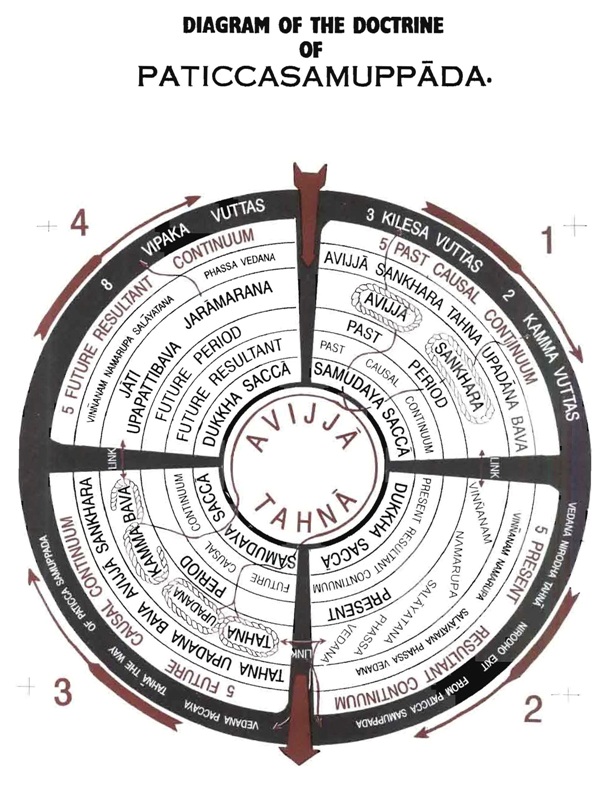
Paticcasamupada
"And what is dependent co-arising?
From ignorance as a requisite condition come
fabrications. (avijja-sankhara)
From fabrications as a requisite
condition comes consciousness. (-vinnana)
From consciousness as a requisite condition
comes name-&-form. (-nama rupa)
From name-&-form as a requisite condition
come the six sense media. (-salayatana)
From the six sense media as a requisite
condition comes contact. (-phassa)
From contact as a requisite condition comes
feeling. (-vedana)
From feeling as a requisite condition comes
craving. (-tanha)
From craving as a requisite condition comes
clinging/sustenance. (-upadana)
From clinging/sustenance as a requisite
condition comes becoming. (-bhava)
From becoming as a requisite condition comes
birth. (-jati)
From birth as a requisite condition, then
aging & death,
sorrow, lamentation,
pain, distress, & despair come into play.
(Jara-marana)
Such is the origination of this entire mass of stress & suffering.
Dukkha Samudaya.
[The Second Noble Truth]
(SN 12.2)
...
And what is dependent cessation?
With the complete cessation of
ignorance, fabrications cease.
With the cessation of fabrications,
consciousness ceases.
With the cessation of consciousness, mind and
body cease.
With the cessation of mind and body, the six
sense bases cease.
With the cessation of the six sense bases,
contact ceases.
With the cessation of contact, feeling ceases.
With the cessation of feeling, craving ceases.
With the cessation of craving, clinging
ceases.
With the cessation of clinging, becoming
ceases.
With the cessation of becoming, birth ceases.
With the cessation of birth,
ageing, death, sorrow, lamentation, physical pain,
mental pain, and anguish cease.
Such is the cessation of this entire mass of stress & suffering.
Dukkha Nirodha. Nibbana.
[The
Third Noble Truth]
(AN 10.92)
...
When this is, that is.
From the arising of this comes the arising of that.
When this isn't, that isn't.
From the cessation of this comes the cessation of that.
...
HOW DID THE LORD BUDDHA DWELL?
Bhikkhus, Mindfulness with Breathing (Anapanasati)
that one has developed and make much of has great fruit and great benefit.
Even I myself, before awakening, when not yet
enlightened, while still a Bodhisatva (Buddha to be), lived in this
dwelling (way of life) for the most part. When I lived mainly in this
dwelling, the body was not stressed, the eyes were not strained, and my
mind was released from the asava (corruptions, cankers) through
non-attachment.
For this reason, should anyone wish "may my
body be not stressed, may my eyes be not strained, may my mind be released
from the asava through non-attachment," then that person ought to attend
carefully in his heart to this
Mindfulness with Breathing meditation.
(Samyutta Nikaya. Samyutta LIV, Sutta 8)
...
The Buddha praises ānāpānasati thus:
Bhikkhus, this concentration through mindfulness of breathing,
when developed and practised much, is both peaceful and sublime.
It is an unadulterated blissful abiding, and
it banishes and stills evil unwholesome thoughts as soon as they arise.
(Samyutta Nikāya)
...
The Four Frames of Reference
"And how is mindfulness of in-&-out breathing developed & pursued so as to
bring the four frames of reference to their culmination?
The Seven Factors for
Awakening
"And how are the four frames of reference developed & pursued so as to
bring the seven factors for awakening to their culmination?
Clear Knowing & Release
"And how are the seven factors for awakening developed & pursued so as to
bring clear knowing & release to their culmination?
(MN 118)
...
"What is the purpose of skillful
virtues? What is their reward?"
"Skillful virtues have freedom from remorse
as their purpose,
Ananda, and freedom from remorse as their reward."
"Freedom from remorse has joy as its
purpose, joy as its reward."
"Joy has rapture as its purpose, rapture as
its reward."
"Rapture has serenity as its purpose,
serenity as its reward."
"Serenity has pleasure as its purpose,
pleasure as its reward."
"Pleasure has concentration as its purpose,
concentration as its reward."
"Concentration has knowledge & vision of
things as they actually are as its purpose,
knowledge & vision of things as they actually are as its reward."
"In this way, Ananda, skillful virtues lead
step-by-step to the consummation of arahantship."
(Kimattha Sutta Anguttara Nikaya 11.1)
...
If
there is any doubt about the necessity of the jhanas, look at ...
Samma
Samadhi
(Right
Concentration)
"And what, monks, is
right concentration? (i) There is the case where a monk — quite
withdrawn from sensuality, withdrawn from unskillful (mental) qualities —
enters & remains in the
first jhana: rapture & pleasure born from
withdrawal, accompanied by directed thought & evaluation. (ii) With
the stilling of directed thoughts & evaluations, he enters & remains in
the
second jhana: rapture & pleasure born of
concentration, unification of awareness free from directed thought &
evaluation — internal assurance. (iii) With the fading of rapture,
he remains equanimous, mindful, & alert, and senses pleasure with the
body. He enters & remains in the
third jhana, of which the Noble Ones declare,
'Equanimous & mindful, he has a pleasant abiding.' (iv) With the
abandoning of pleasure & pain — as with the earlier disappearance of
elation & distress — he enters & remains in the
fourth jhana: purity of equanimity &
mindfulness, neither pleasure nor pain. This, monks, is called right
concentration."
...
Samma Samadhi
(Right
Concentration)
(www.what-Buddha-said.net)
...
"´This Dhamma is for one with samádhi, not for one without
samádhi.´ So it was said. For what reason was this said? Here a monk
enters and abides in the first jhána … second jhána … third jhána … fourth
jhána."
AN 8.30
...
When the Bodhisatta had the insight that
Jhana was the way to Enlightenment, he then thought, "Why am I
afraid of that pleasure which has nothing to do with the five senses
nor with unwholesome things? I will not be afraid of that pleasure
(of Jhana)!" MN 36
...
The Buddha said that one who indulges in
the pleasures of Jhana may expect only one of four
consequences: Stream Winning, Once-returner, Non-returner, or Full
Enlightenment!
In other words, indulging in Jhana leads only to
the four stages of Enlightenment.
(Pasadika Sutta, DN 29,25)
...
"Jhana is to be followed, is to be
developed and is to be made much of. It is not to be feared." MN 66
...
"One trains in the higher virtue (sila), the higher
mind, and the higher wisdom … What is the training in
the higher mind? Here a monk … enters and abides in the
first jhána … second jhána … third jhána … fourth jhána."
AN
3.84, 88, 89
...
"That one could perfect samádhi without perfecting
virtue or that one could perfect wisdom without
perfecting samádhi - this is impossible."
AN 5.22
...
"It is impossible to abandon the fetters that bind us to
samsára (samyojana) without having perfected samádhi.
And without abandoning those fetters it is impossible to
realize Nibbána."
AN 6.68
...
"I
say, monks, that the destruction of the mind's poisons
is dependent on the first jhána … eight jhána."
AN 9.36
...
'For a person with right
samádhi there is no need to
arouse the wish,
´May I see things as they truly are.´
It is a natural process, it is in accordance with nature
that someone with right samádhi
will see things as they truly are.'
AN 10.3
...
'There is no jhána without
wisdom,
there is no wisdom without jhána,
but for someone with both jhána and wisdom,
Nibbána is near.'
Dhp 372
...
Develop concentration, bhikkhus; concentrated, bhikkhus,
a bhikkhu understands according to reality.
(Samàdhi
Sutta,
S.III.I.i.v)
...
Silenced in body,
silenced in speech,
silenced in mind,
without inner noise,
Blessed with silence is the sage!
He is truly washed of all evil ...
(Itivuttaka 3.67)
...
Not even wholesome
thoughts in Jhana
" ... And as I remained thus
heedful, ardent, & resolute, thinking imbued with
renunciation / non-ill will / harmlessness arose. I
discerned that 'Thinking imbued with renunciation /
non-ill will / harmlessness has arisen in me; and that
leads neither to my own affliction, nor to the
affliction of others, nor to the affliction of both. It
fosters discernment, promotes lack of vexation, & leads
to Unbinding. If I were to think & ponder in line with
that even for a night... even for a day... even for a
day & night, I do not envision any danger that would
come from it, except that thinking
& pondering a long time would tire the body. When the
body is tired, the mind is disturbed; and a disturbed
mind is far from concentration.' So I steadied my
mind right within, settled, unified, & concentrated it.
Why is that? So that my mind would not be disturbed.
... first jhana, second jhana
... "
(Dvedhavitakka
Sutta, MN.019)
...
The Great Practice of
Right Mindfulness
"Now, if anyone would
develop these four frames of reference [body (kaya),
feeling (vedana), mind (citta), phenomena (dhamma) in
this way for seven years,
one of two fruits can be expected for him: either gnosis
right here & now, or — if there be
any remnant of clinging-sustenance — non-return."
"Let alone seven years. If anyone would
develop these four frames of reference in this way for
six years... five... four... three... two years...
one year... seven months... six months... five... four... three... two
months... one month... half a month..., seven
days, one of two fruits can be
expected for him: either gnosis right here & now, or — if there be any
remnant of clinging-sustenance — non-return."
(Maha-satipatthana
Sutta)
"Whatever phenomena arise from a
cause:
their cause
& their cessation.
Such is the teaching of the Tathagata,
the Great Contemplative."
(Ven. Assaji)
Whatever is subject to origination is all subject to cessation.
[And there arose the dustless, stainless
Dhamma eye]
(Ven. Sariputta)
A Dependent Arising
Within Dependent Arising
Dependent Arising of Suffering
&
Dependent Arising of Enlightenment
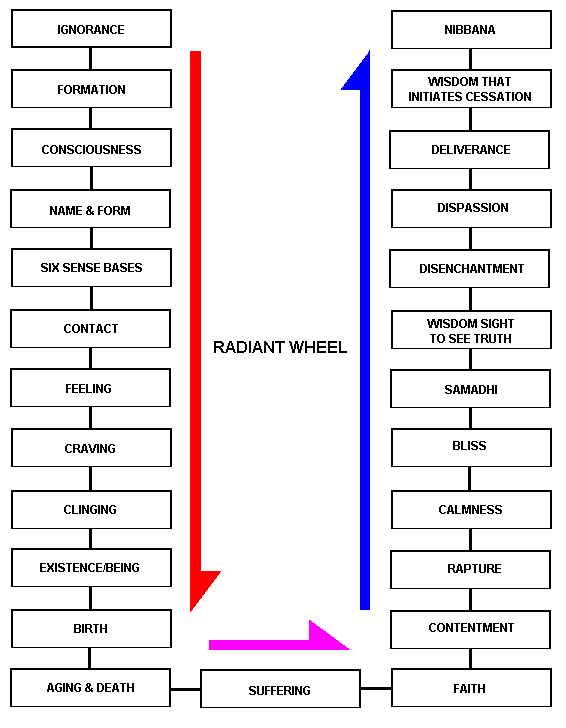
(SN 12.23)
...
"Nothing whatsoever should be clung to."
To hear this point is to hear all points.
(Buddhadasa
Bhikkhu)
Nothing happens immediately, so in the
beginning we can't see any results from our practice.
...
In our practice we see this desire as either
sensual indulgence or self-mortification. It's in this very conflict that
our Teacher, the Buddha, was caught up, just this dilemma. He followed
many ways of practice which merely ended up in these two extremes. And
these days we are exactly the same. We are still afflicted by this
duality, and because of it we keep falling from the Way.
However, this is how we must
start out
...
...
"When sitting in meditation, say, “That’s not
my business!” with every thought that comes
by."
...
Do not try to become anything.
Do not make yourself into anything.
Do not be a meditator.
Do not become enlightened.
When you sit, let it be.
What you walk, let it be.
Grasp at nothing.
Resist nothing.
...
"When one does not understand death, life can
be very confusing."
...
"Don’t think that only sitting with the eyes
closed is practice. If you do think this way, then quickly change your
thinking. Steady practice is keeping mindful in every posture, whether
sitting, walking, standing or lying down. When coming out of sitting,
don’t think that you’re coming out of meditation, but that you are only
changing postures. If you reflect in this way, you will have peace.
Wherever you are, you will have this attitude of practice with you
constantly. You will have a steady awareness within yourself."
...
"Only one book is worth reading:
the heart."
...
"The Dhamma has to be found by looking into
your own heart and seeing that which is true and that which is not, that
which is balanced and that which is not balanced."
...
"The heart of the path is quite easy. There’s
no need to explain anything at length.
Let go of love and hate and let things be.
That’s all that I do in
my own practice."
...
"We practice to learn how to let go, not how
to increase our holding on to things.
Enlightenment appears when you stop wanting anything."
...
"If you let go a
little, you will have a little peace.
If you let go a lot, you will have a
lot of peace.
If you let go completely, you will have complete peace."
...
"You are your own teacher. Looking for
teachers can’t solve your own doubts.
Investigate yourself to find the
truth - inside, not outside.
Knowing yourself is most important."
...
"Try to be mindful and let things take their
natural course. Then your mind will become still in any surroundings, like
a clear forest pool. All kinds of wonderful, rare animals will come to
drink at the pool, and you will clearly see the nature of all things. You
will see many strange and wonderful things come and go, but you will be
still. This is the happiness of the Buddha."
...
"Our birth
and death are just one thing. You can’t have one without the
other. It’s a little funny to see how at a death people are so tearful and
sad, and at a birth how happy and delighted. It’s delusion.
I think if you really want to cry, then it would be
better to do so when someone’s born. Cry at the root, for if there
were no birth, there would be no death.
Can you understand this?"
...
All things are just as they are.
They don’t cause suffering to anybody. It’s just like a thorn, a
really sharp thorn. Does it make you suffer?
No, it’s just a thorn.
It doesn’t bother anybody. But if you go and stand on it, you’ll suffer.
Why is there suffering? Because you stepped on the thorn.
The thorn is just minding its
own business.
It doesn’t harm anybody. It’s because
of we ourselves that there is pain.
Form, feeling,
perception, volition, consciousness …
all things in this world are simply as they are. It’s we who pick
fights with them. And if we hit them, they hit us back. If they’re left
alone, they won’t bother anybody. Only
the drunkard gives them trouble.
...
If those who have studied
the theory hang on to what they have learnt when they sit in meditation,
taking notes on their experience and wondering whether they have reached
jhana yet, their minds will be
distracted right there and turn away from the meditation.
They won’t gain real understanding.
Why is that?
Because there is desire.
As soon
as tanha
(craving) arises, whatever the meditation you are doing,
it won’t
develop because the mind withdraws.
It is essential that you learn how to
give up all thinking
and doubting,
give it up completely,
all of it.
...
As you contemplate the cause of suffering, you should understand that
when that which we call the mind is still, it's in a state of
normality. As soon as it moves, it becomes
sankhara (that which is fashioned or
concocted).
When attraction arises in the mind, it is
sankhara; when aversion arises, it is sankhara. If there
is desire to go here and there, it is sankhara. As long as you
are not mindful of these sankharas, you will tend to chase
after them and be conditioned by them.
...
Whenever the mind moves,
it is aniccam (impermanent),
dukkham (suffering) and anatta (not self).
The Buddha
taught us to observe and contemplate this. He taught us to contemplate
sankharas which condition the mind. Contemplate them in light
of the teaching of paticcasamuppada (Dependent Origination):
avijja (ignorance) conditions sankhara (karmic formations);
sankhara conditions vinnana (consciousness); vinnana
conditions nama (mentality) and rupa (materiality); and
so on.
...
All physical and all mental phenomena and everything that the mind
thinks, are sankharas.
...
Generally, when we
experience a mind-object it stimulates thinking. The thinking is in
reaction to the experience of the mind-object. The nature of ordinary
thinking and
panna is very different.
The nature of ordinary
thinking is to carry on without stopping. The mind-objects you experience
lead you off in different directions and your thoughts just follow along.
The nature of panna
is to stop the proliferation, to still the mind, so that it doesn’t go
anywhere.
...
If I’d wanted to stop
formal practice, was there any laziness, tiredness or irritation?
None at all. The mind was completely free from
such defilements. What was left was the sense of complete balance or
‘just-rightness’ in the mind.
If I was going to stop, it would just have been to rest the body, not
for anything else.
...
If you experience
different kinds of nimitta during
meditation, such as visions of heavenly beings, before anything else
it’s important to observe the state of mind very closely. Don’t forget
this basic principle. The mind has to be
calm for you to experience these things. Be careful
not to practice with desire either to experience
nimitta or not to experience them. If they arise,
contemplate them and don’t let them delude you.
Reflect that they are not you and they don’t belong to you.
They are aniccam,
dukkham, anatta,
just like all other mind-objects. If you do experience them, don’t let
your mind become too interested or dwell on them. If they don’t
disappear by themselves, reestablish mindfulness.
Put all your attention on the breath, taking a
few extra deep breaths. If you take at least three extra-long breaths
you should be able to cut out the
nimitta. You must keep
reestablishing awareness in this way as you continue to practice.
...
Looking for peace is like looking for a turtle with a mustache: You won't
be able to find it.
But when your heart is ready, peace will come looking for you.
...
There are two kinds of peacefulness :
one is the peace that comes through samådhi,
the other is the peace that comes through paññå.
The mind that is peaceful through samådhi is
still deluded.
The peace that comes through the practice of samådhi alone is
dependent on
the mind being separated from mind-objects.
...
"Let your aim be
Nibbana."
(Ajahn Chah)
Anapanasati
There are seven basic steps:
1. Start
out with three or seven long in-and-out breaths, thinking bud-
with the in-breath, and dho with the out. Keep the meditation
syllable as long as the breath.
2. Be
clearly aware of each in-and-out breath.
3.
Observe the breath as it goes in and out, noticing whether it's
comfortable or uncomfortable, broad or narrow, obstructed or
free-flowing, fast or slow, short or long, warm or cool. If the breath
doesn't feel comfortable, change it until it does. For instance, if
breathing in long and out long is uncomfortable, try breathing in short
and out short. As soon as you find that your breathing feels
comfortable, let this comfortable breath sensation spread to the
different parts of the body.
To begin with, inhale the breath sensation
at the base of the skull and let it flow all the way down the spine.
Then, if you are male, let it spread down your right leg to the sole of
your foot, to the ends of your toes, and out into the air. Inhale the
breath sensation at the base of the skull again and let it spread down
your spine, down your left leg to the ends of your toes, and out into
the air. If you are female, begin with the left side first, because the
male and female nervous systems are different.
Then let the breath from the base of the
skull spread down over both shoulders, past your elbows and wrists, to
the tips of your fingers, and out into the air.
Let the breath at the base of the throat
spread down the central nerve at the front of the body, past the lungs
and liver, all the way down to the bladder and colon.
Inhale the breath right at the middle of the
chest and let it go all the way down to your intestines.
Let all these breath sensations spread so
that they connect and flow together, and you'll feel a greatly improved
sense of well-being.
4. Learn
four ways of adjusting the breath:
i. in
long and out long,
ii. in long and out short,
iii. in short and out long,
iv. in short and out short.
Breathe whichever way is most comfortable
for you. Or, better yet, learn to breathe comfortably all four ways,
because your physical condition and your breath are always changing.
5. Become
acquainted with the bases or focal points
for the mind — the resting
spots of the breath — and center your awareness on whichever one seems
most comfortable. A few of these bases are:
a. the
tip of the nose,
b. the middle of the head,
c. the palate,
d. the base of the throat,
e. the breastbone (the tip of the sternum),
f. the navel (or a point just above it).
If you suffer from frequent headaches or
nervous problems, don't focus on any spot above the base of the throat.
And don't try to force the breath or put yourself into a trance. Breathe
freely and naturally. Let the mind be at ease with the breath — but not
to the point where it slips away.
6. Spread
your awareness — your sense of conscious feeling — throughout the entire
body.
7. Unite
the breath sensations throughout the body, letting them flow together
comfortably, keeping your awareness as broad as possible. Once you are
fully aware of the aspects of the breath you already know in your body,
you'll come to know all sorts of other aspects as well. The breath, by
its nature, has many facets: breath sensations flowing in the nerves,
those flowing around and about the nerves, those spreading from the
nerves to every pore. Beneficial breath sensations and harmful ones are
mixed together by their very nature.
...
The common breath is long and slow. The refined breath is
short and light.
It can penetrate into every blood vessels. It's a breath of
extremely high quality.
...
Breath subdues pain. Mindfulness
subdues the Hindrances.
...
The in-and-out breath is stress --
the in-breath, the stress of arising; the out-breath, the
stress of passing away.
...
Once you cut off thoughts of past and future, you don't have
to worry about the Hindrances.
...
Some people believe that they don't have to practice centering
the mind, that they can attain release through discernment
(pañña-vimutti) by working at discernment alone.
This simply isn't true.
Both release through discernment and release through stillness
of mind (ceto-vimutti) are based on centering the mind.
They differ only in degree.
Like walking: Ordinarily, a person doesn't walk on one leg
alone. Whichever leg is heavier is simply a matter of personal
habits and traits.
...
You can't
do without concentration. If concentration is lacking, you can
gain nothing but jumbled thoughts and conjectures, without any
sound support.
...
When you see that a nimitta has appeared, mindfully focus your
awareness on it -- but be sure to focus on only one at a time,
choosing whichever one is most comfortable. Once you've got
hold of it, expand it so that it's as large as your head. The
bright white nimitta is useful to the body and
mind: It's a pure breath that can cleanse the blood in the
body, reducing or eliminating feelings of physical pain.
When you have this white light as large as the head, bring it
down to The Fifth Base, the center of the chest. Once it's
firmly settled, let it spread out to fill the chest. Make this
breath as white and as bright as possible, and then let both
the breath and the light spread throughout the body, out to
every pore, until different parts of the body appear on their
own as pictures. If you don't want
the pictures, take two or three long breaths and they'll
disappear.
Keep your awareness still and expansive. Don't let it
latch onto or be affected by any nimitta that may happen to
pass into the brightness of the breath. Keep careful watch
over the mind. Keep it one. Keep it intent on a single
preoccupation, the refined breath, letting this refined breath
suffuse the entire body.
When you've reached this point, knowledge will gradually begin
to unfold. The body will be light, like fluff. The mind will
be rested and refreshed -- supple, solitary, and
self-contained. There will be an extreme sense of physical
pleasure and mental ease.
...
If you don't want the nimitta to appear,
breathe
deep and long, down into the heart,
and it will immediately go away.
...
Vedana
1. Watch the arising of
feelings in the present. You don't have to follow them
anywhere else. Tell yourself that whatever may be causing
these feelings, you're going to focus exclusively on what is
present.
2. Focus on the fading of feelings in the present.
3. Focus on the passing away of feelings in the present.
4. Stay with the realization that
feelings do nothing but arise and fall away —
simply flowing away and vanishing in various ways — with
nothing of any substance or worth. When you can do this, you
can say that your frame of reference is firmly established
in feelings in and of themselves — and at that point, the
Path comes together.
...
Letting go has two forms:
(1) Being able to let go of mental objects but not of one's
own mind.
(2) Being able to let go both of the objects of the mind and
of one's self.
To be able to let go both of one's
objects and of one's self is genuine knowing. To be able to
let go of one's objects but not of one's self is counterfeit
knowing. Genuine knowing lets go of both ends: It lets the
object follow its own nature as an object, and lets the mind
follow the nature of the mind. In other words, it lets nature
look after itself. "Object" here refers to the body; "self"
refers to the heart. You have to let go of both.
...
Turmoil comes from our own
defilements, not from other people.
You have to solve the problem within yourself if you want to
find peace.
...
My motto is,
"Make yourself as
good as possible, and everything else will have to turn good
in your wake."
If you don't abandon your own inner goodness
for the sake of outer goodness,
things will have to go well.
...
The mind is the only thing that
senses pleasure and pain. The body has no sense of these
things at all. It's like taking a knife to murder someone:
They don't hunt down the knife and punish it. They punish only
the person who used it to commit murder.
...
Don't let defilements inside make
contact with defilements outside. If we have defilements at
the same time that other people do, the result will be
trouble. For instance, if we're angry when they're angry, or
we're greedy when they're greedy, or we're deluded when
they're deluded, it spells ruination for everyone.
...
Results don't come from thinking.
They come from the qualities we build into the mind.
...
If you want to just think buddho,
you can, but it is too light.
Your awareness won't go deep...
The Skills of Jhana
...
People who develop
jhana fall into three classes:
1. Those who attain only the
first level [First
Jhana] and then gain liberating insight right
then and there are said to excel in discernment (paññadhika).
They Awaken quickly, and their release is termed
pañña-vimutti,
release through discernment.
2. Those who develop jhana
to the fourth level
[Fourth Jhana],
there gaining liberating insight into the Noble Truths,
are said to excel in conviction (saddhadhika).
They develop a moderate number of skills, and their
Awakening occurs at a moderate rate. Their release is
the first level of
ceto-vimutti, release
through concentration.
3. Those who become skilled
at the four levels of jhana
[Rupa Jhana]— adept at
entering, staying in place, and withdrawing — and then
go all the way to the four
levels of arupa-jhana, after which they
withdraw back to the first jhana, over and over again,
until finally intuitive knowledge, the cognitive skills,
and liberating discernment arise, giving release from
mental fermentation and defilement: These people are
said to excel in persistence (viriyadhika).
People who practice jhana a great deal, developing
strong energy and bright inner light, can Awaken
suddenly in a single mental instant, as soon as
discernment first arises. Their release is
cetopariyavimutti, release
through mastery of concentration.
These are the results to be
gained by meditators.
But there have to be causes —
our own actions — before the results can come fully
developed.
...
Uggaha nimittas
When the mind becomes still,
uggaha nimittas can appear in either of two ways:
— from mental notes made in
the past;
— on their own, without our ever having thought of the
matter.
Uggaha
nimittas of both sorts can be either beneficial or
harmful, true or false, so we
shouldn't place complete trust in them. If
we're thoroughly mindful and alert, they can be
beneficial. But if our powers of reference are weak or if
we lack strength of mind, we're likely to follow the drift
of whatever images appear, sometimes losing our bearings
to the point where we latch on to the images as being
real.
...
Patibhaga nimittas
So when sensation-images or
thought-images arise in one way or another, you should then
practice adjusting and analyzing them (patibhaga
nimitta). In other words, when a visual image arises, if
it's large, make it small, far, near, large, small, appear,
and disappear. Analyze it into its various parts and then let
it go. Don't let these images influence the mind. Instead,
have the mind influence the images, as you will. If you aren't
able to do this, then don't get involved with them. Disregard
them and return to your original practice with the breath.
...
With one exception [anapanassati], all of the
[39] meditation themes mentioned here are simply gocara dhamma —
foraging places for the mind. They're not places
for the mind to stay. If we try to go live in the things we see
when we're out foraging, we'll end up in trouble.
When you practice meditation, you don't have
to go foraging in other [39] themes; you can stay
in the single theme that's the apex of all meditation themes:
anapanassati, keeping the breath in
mind. This theme, unlike the others, has none of the features or various
deceptions that can upset or disturb the heart.
...
As for the four sublime abodes, if you
don't have jhana as a dwelling for the mind, feelings of good will,
compassion, and appreciation can all cause you to suffer. Only if you have
jhana can these qualities truly become sublime abodes, that is, restful
places for the heart to stay (vihara dhamma)
Basic Themes
...
"To study is to know the texts,
To practice is to know your defilements,
To attain the goal is to know & let go."
...
"If a person isn't true to the Buddha's
teachings, the Buddha's teachings won't be true to that person — and that
person won't be able to know what the Buddha's true teachings are."
(Ajahn Lee Dhammadharo)
When one does what Buddhas do, one is a Buddha.
When one does what Bodhisattvas do, one is a Bodhisattva.
When one does what Arhats do, one is an Arhat.
When one does what ghosts do, one is a ghost.
These are all natural phenomena.
There are no shortcuts in cultivation.
...
If you wish others to know about your
good deeds,
they are not truly good deeds.
If you fear others will find out about your bad deeds,
those are truly bad deeds.
(Master Hsuan Hua)
Things are not what they appear to be: nor are they otherwise.
(Surangama Sutra)
Compassion is a verb.
...
If we are not empty, we become a block of
matter.
We cannot breathe, we cannot think.
To be empty means to be alive, to breathe in and to breathe out.
We cannot be alive if we are not empty.
Emptiness is impermanence, it is change.
We should not complain about impermanence,
because without impermanence, nothing is possible.
...
Meditation is not to escape from society,
but to come back to ourselves and see what is going on.
Once there is seeing, there must be acting.
With mindfulness, we know what to do and what not to do to help.
...
Enlightenment, for a wave in the ocean,
is the moment the wave realises it is water.
...
People have a hard time letting go of their
suffering.
Out of a fear of the unknown, they prefer suffering that is familiar. ...
It is possible to live happily in the here and
now.
So many conditions of happiness are available
- more than enough for you to be happy right now.
You don't have to run into the future in order to get more.
...
There is no way to happiness, happiness is the
way.
You should be happy right in the here and now.
There is no way to
enlightenment.
Enlightenment should be right here and right now.
The
moment when you come back to yourself, mind and body together, fully
present, fully alive, that is already enlightenment.
You are no longer a
sleepwalker.
You are no longer in a dream.
You are fully alive.
You are
awake. Enlightenment is there.
...
People suffer because they are caught in their
views.
As soon as we release those views, we are free and we don't suffer
anymore. ...
Life is available only in the present.
That is why we should walk in such a way that every step can bring us to
the here and the now. ...
When you love someone, the best thing you can
offer is your presence.
How can you love if you are not there?" ...
The Pure Land is found here & now. One does
not need to die before going to Pure Land.
...
The Western Paradise can be experienced
right here at this moment. It is not in the west.
...
Every thought you produce, anything you say,
any action you do, it bears your signature.
...
The purpose of walking meditation is walking
meditation itself.
Going is important, not arriving. Walking meditation is not a means to an
end; it is an end.
Each step is life; each step is peace and joy. That is why we don’t have
to hurry.
That is why we slow down. We seem to move forward, but we don’t go
anywhere; we are not drawn by a goal.
Thus we smile while we are walking.
(Thich Nhat Hanh)
This too will pass.
...
All the cravings and desires, (and thus dukkha) come from a sense of
‘self’...
...
Just bare attention, just
bare perception, is not enough.
The defilements have already been at work and that’s the problem.
We cannot trust even the first experience that comes to our senses.
...
Remember, wanting is that force which takes you away from
whatever you are
experiencing now, into something in
the future, into fantasies or dreams.
...
One cannot will the mind to be still!
...
Remember that the greatest controller of all is
Mara (the doer).
...
Understand that
Mara
is the ‘doer’
inside you.
He’s always trying to push and pull you, saying,
“Come on; don’t get so sleepy”.
“Come on, put forth some effort”.
“Come on, get into a jhana”.
“Come on, who do you think you are?”
“Come on, how long have you been a monk, how long have you got left of
your retreat?”
“Come on, get going.”
That is
Mara!
...
Remember that the
jhanas
are the places that
Mara
(the doer)
can’t go, where Mara
is blindfolded.
...
Do absolutely nothing and see how smooth
and beautiful and timeless the breath can appear !
...
Anapanasati : breathing in long or short, breathing out long or short
- they are descriptive not prescriptive.
Just watch and know the breath & do nothing!
...
Indeed, one is placing faith in the knowing
and taking it away
from the doing.
This is the theme underlying the whole of the
meditation path.
...
The inclination of the mind outwards is called
papanca
in
Pali.
There’s no end to that proliferation or the complexity of that world of
papanca.
On the other hand, the mind that inclines
inwards into the present
moment, the silence, the breath, the
nimmitta,
and the jhanas,
is the mind which
knows the end of
papanca.
...
When we talk we always talk about the past
or the future.
We can never talk about the present.
...
The five
hindrances are the cause for the lack of
samadhi.
The lack of samadhi
is not caused by lack of effort.
...
The five hindrances are Public Enemy Number One.
They stop people from becoming enlightened,
and it’s precisely for this reason that understanding these five
hindrances
and overcoming them is crucial.
Understand them
...
The First Hindrance - Sensory Desire (kama-cchanda)
For the new meditator, the most obvious form of
kama-vitakka is sexual fantasy. One can use up many hours, especially
on a long retreat, with this type of kama-vitakka. This obstacle to
progress in meditation is transcended by realizing, through insight or
faith, that total freedom from the five senses (i.e., jhana) is more
ecstatic and profound than the very best of sexual experiences. A monk
or nun gives up their sexuality not out of fear or repression, but out
of recognition of something superior.
...
The Second Hindrance - Ill-will (vyapada)
Maybe you prefer to sit through pain rather than enjoy peace and
happiness.
(This is ill-will)
To overcome ill-will do some loving-kindness
meditation. Give yourself a break. Say to yourself, “The door to my
heart is open to all of me. I allow myself happiness. I allow myself
peace. I have goodwill toward myself, enough goodwill to let myself
become peaceful and to bliss out on this meditation.”
more about hindrances here
...
Everyone makes mistakes. The wise are not people
who never make mistakes, but those who forgive themselves and learn
from their mistakes.
...
Silence is so much more productive of wisdom and clarity than
thinking.
...
Give up your thinking, your thoughts; otherwise you get headaches.
...
Great thinkers get great
headaches.
The still, alert
mind sees deeper than any thought.
...
The mind seeks out silence constantly, to the point where it only thinks
if it really has to, only if there is some point to it. Since, at this
stage, you have realized that most of our thinking is really pointless
anyway, that it gets you nowhere, only giving you many headaches, you
gladly and easily spend much time in inner quiet.
...
It is impossible that such a gross activity as thinking can exist
in such a refined state as Jhana. In fact, thinking ceases
a long time prior to Jhana.
...
Thinking is an obstacle to gaining the samadhi which can know those
worlds.
...
Basic Method
of Meditation
-
Sustained attention on the
present moment
-
Silent
awareness of the present moment
-
Silent present moment awareness of the
breath
-
Full sustained attention on the breath
-
Full sustained attention on the
beautiful breath
-
Experiencing the beautiful
Nimitta
-
First Jhana
...
...
The happiness generated by sensual
excitement is hot and stimulating but also agitating and consequently
tiring. It lessens in intensity on repetition.
The happiness caused by personal
achievement is warm and fulfilling but also fades quickly, leaving a
sense of a vacant hole in need of filling.
But the happiness
born of letting go is cool and very long lasting. It is
associated with the sense of real freedom.
...
You can recognize a nimitta by the
following six features:
1. It appears only after the
fifth stage
(above) of the meditation, after the
meditator has been with the beautiful breath for a long time;
2. It appears when the
breath disappears;
3. It only comes when the external
five senses of sight, hearing, smell,
taste and touch are
completely absent;
4. It manifests only in the
silent mind, when descriptive thoughts (inner speech) are
totally absent;
5. It is strange
but powerfully attractive; and
6. It is a
beautifully simple object.
I mention these features so that
you may distinguish real nimittas from imaginary ones.
...
WHAT IF PITlSUKHA
HASN'T APPEARED?
Cultivate Sufficient Joy and Happiness
(Pitisukha).
Putting Energy into Knowing.
Watching Out
for Discontent.
Focus More Sharply in the
Present Moment.
...
When you’re doing the
meditation on the breath, when you are watching the breath, when you have
the breath in mind, don’t just watch any old
ordinary boring breath.
Make a resolution, a gentle
suggestion to the mind,
“May I breathe in just experiencing
pitisukha,
may I breathe out experiencing
pitisukha.”
...
After
those
jhanas
have been achieved, the mind is so powerful,
deep, and profound
and it has the ability to really contemplate fully.
...
SUMMARY OF THE LANDMARKS OF ALL
JHANAS
It is helpful to know,
then, that within a Jhana:
1. There is no
possibility of thought;
2. No decision making process is
available;
3. There is no perception of
time;
4. Consciousness is non-dual,
making comprehension inaccessible;
5. Yet one is very, very aware,
but only of bliss that doesn't move; and
6. The five senses are fully
shut off, and only the sixth sense, mind, is in operation.
...
Don’t use
just your thinking mind and all the ideas you had about
anicca
in the past, because many of those thoughts
will not be capable of releasing the mind from the
asavas,
from the kilesas,
the defilements and the fetters. That would be a superficial
investigation. If you just suggest
anicca
to the mind – it’s amazing, even though these
will be areas which you’ve never seen before, places where the mind has
never gone before – because of the power of the mind you will be able to
penetrate those areas of the
Dhamma
wherein the treasure of Enlightenment lies.
...
When
stillness really takes off it’s the flame of
jhanas.
The mind is so still it generates incredible states of mind and gives you
all the necessary data you need. You understand you got there by stopping
the ‘doing’ – no craving, no
sankharas.
Things have disappeared and consciousness is peaceful. This is bliss. All
this rushing around that I have been doing, all this wanting and craving,
that was the wrong way. You get the message at last about what
renunciation truly is and why people are monks and nuns. When you get that
message, then you are sweet for the rest of this life.
...
All arisings are of the nature not just to cease but to stop once and for
all, to end completely in
Nirodha. When one can see the
actual ceasing of things, in the same way as
Kondanno
saw, one sees that, whether it’s the body,
feelings, perceptions, formations, or consciousness – all the six types of
consciousness – all of these things are of that nature to cease completely
without any remainder. You see that all of these things that we take to be
real, that we take to be hard and solid, are of the nature to disappear
without any remainder. You see
anicca
to that degree ...
...
If you read the Theragatha,
you will find that some of the monks, for instance Anuruddha, spent
many, many years practising before they became Stream Winners. It took
them a long time, but they had patience and persistence and
anyone with patience and persistence must
reach the goal eventually. If
you have faith, saddha,
it’s only a matter of time before you see that what the Buddha taught
is true. If you have confidence that there are
Ariyas
in the world, and you have confidence in
them, then you know that if you practise the Eightfold Path it leads
to Nibbana.
If you’re practising the Eightfold Path, and following the
instructions, you know where it leads.
It’s only a matter of time.
...
You have the world outside
and in the middle of that is your body.
... Go into the moment, into the silence ...
Get rid of the body and in the middle of that is the breath.
With the mind going inwards you soon get to the ‘beautiful breath’.
By being with the ‘beautiful breath’, go into the beauty. The beauty is
pitisukha.
You can’t stop there; you have to go right into the
pitisukha,
falling inwards.
That’s the experience of many people who get a
nimmitta.
You fall into the centre of the beautiful light of the
nimmitta,
and then enter a jhana.
You are always inclining
inwards, until you go through all the
jhanas.
You go so far in that you get to the very heart of things, to cessation.
Then you will know that the core
of all this is ‘emptiness’.
There is no ‘self’, there is no ‘doer’, and there is no ‘knower’.
There is only empty phenomena rolling along.
...
What I’ve got now is enough, my mind is
good enough and my body is good enough.
It doesn’t matter how old and sick it is, my body is good enough.
‘Good enough’ is a cause for contentment.
(Ajahn Brahm)
The flavor of the Dhamma will begin to
appear when the mind is centered in concentration.
...
The blessings of meeting a good spiritual
master
Only those who practise meditation can truly
understand the spiritual path. Learning meditation properly requires the
guidance of a gifted teacher. The teacher cannot afford to make even the
slightest mistakes especially when his disciple is meditating at a very
high level. The teacher must know more than the disciple so that the
disciple can respectfully follow his lead. It is wrong for the teacher to
teach above his level of understanding. The disciple will not benefit from
such instruction. But when the teaching is based on a direct experience of
the truth gained through meditation, the disciple will progress very
quickly.
...
We will be able truly to see things as they
are -- without a doubt -- once we can remove the counterfeit things that
conceal them. For example, beauty: Where, exactly, is the body beautiful?
What is there about it that you can claim to be beautiful? If you speak in
terms of the principles of the truth, how can you even look at the human
body? It's entirely filled with filthiness, both within and without, which
is why we have to keep washing it all the time. Even the clothing and
other articles on which the body depends have to be dirty because the main
part -- the body -- is a well of filth within and without. Whatever it
comes into contact with -- robes, clothing, dwelling, bedding -- has to
become dirty as well. Wherever human beings live becomes dirty, but we
don't see the truth, mainly because we aren't interested in looking.
...
Ãn ãpãnasati
Bhãvanã
uses the breath as
the objective support of the heart and
consists in knowing and mindfulness (sati) of in and out breathing.
In becoming aware of breathing, one should at
first fix attention on the feeling of the
breath at the nose or the palate (roof of the
mouth), as it suits one, because this is where the breath initially makes
contact, and one may use this as a marker point for holding one’s
attention. Having done this until one has become skilled, and the in and
out breathing becomes finer and finer, one will progressively come to know
and understand the nature of the contact of in and out breathing, until it
seems that the breathing is located either in the
middle of the chest or the solar plexus. [chakras]
After this
one must just fix one’s attention on breathing at that place and one must
no longer be concerned about fixing attention on the breathing at the tip
of the nose or the palate, or about following it in and out with
awareness.
...
After having
become skilled with the breath, every time one attends to the breathing
process, one should fix attention at the point in the middle of the chest
or the solar plexus. In particular, it is important to have mindfulness
established. One must establish mindfulness to control the heart so that
one feels the breath at every moment while it is entering or leaving,
whether short or long, until one knows clearly that the breathing is
becoming progressively finer with every breath – and until finally it
becomes apparent that the finest and most subtle breath and the heart have
converged and become one.
At this stage
one should fix attention on the breath exclusively within the heart, and
there is no need to worry about the preparatory repetition, for in
becoming aware of the breath as entering and leaving, and as short or
long, the preparatory repetition is only for the purpose of making the
citta become more subtle.
When one has
attained the most subtle level of breathing, the
citta will be bright, cool, calm,
happy, and just knowing
the heart – and there will be no connection with any disturbing
influence. Even if finally at that time, the breath gives up its
relationship with oneself, there will be no anxiety because the citta
will have let go of the burden and will just have knowledge of the
heart alone. In other words, it will be non-dual
(ekaggatãrammana).
This is the
result that comes from developing the practice of
Anãpãnasati
kammatthãna. But it should also be
understood that which ever kammatthãna (40 types of meditation) is
practised, and whoever practises it, this is the kind of result that
should be attained.
...
The waning and complete
extinction of these Sankharas (formation) is happiness.
And this greatest happiness does not die away and depart from one.
(Maha Boowa)
Life is uncertain. Death is certain.
(Ven K Sri Dhammananda)
"When you
meditate you're gaining practice in how to die – how to be mindful and
alert, how to endure pain, how to gain control over wayward thoughts and
maybe even reach the deathless –so that when the time comes to die, you'll
do it with skill."
...
"If you're going to teach the Dhamma to people, but they're
not intent on listening, or not ready for what you have to say, then no
matter how fantastic the Dhamma you're trying to teach, it still counts as
idle chatter, because it doesn't serve any purpose."
...
"If you can't have any control over your mouth, how can you
expect to have any control over your mind?"
...
"As soon as we're
born, we're sentenced to death — just that we don't know when our turn will come. So you can't be
complacent. Start right in and develop all your good qualities to the full
while you still have the chance."
...
"We all want happiness, but for the most part we aren't
interested in building the causes for happiness. All we want are the
results. But if we don't take an interest in the causes, how are the
results going to come our way?"
...
"Observing the breath is the cause, the pleasure that
arises is the result. Focus as much as you can on the cause. If you ignore
the cause and get carried away with the result, it'll run out and you'll
end up with nothing at all."
...
"If you go teaching others before your own practice is up
to standard, you do more harm than good."
...
"If the mind is going to think, let it think, but don't
fall for its thoughts."
...
"Even though your views may be right, if you cling to them
you're wrong."
...
Some people are afraid to meditate too seriously, for fear
that they'll go crazy, but as Ajaan Fuang once said, "You have to be crazy
about meditation if you want to meditate well. And as for whatever
problems come up, there are always ways to solve them. What's really
scary is if you don't meditate enough for the problems to come out in the
open in the first place."
...
A young nurse practiced meditation with Ajaan Fuang
several days running, and finally asked him one day, "Why wasn't
today's session as good as yesterday's?"
He answered: "Meditating is like wearing clothes.
Today you wear white, tomorrow red, yellow, blue, whatever. You
have to keep changing. You can't wear the same set of clothes all
the time. So whatever color you're wearing, just be aware of it.
Don't get depressed or excited about it."
...
"When the meditation goes well, don't get excited. When it
doesn't go well, don't get depressed. Simply be observant to see why it's
good, why it's bad. If you can be observant like this, it won't be long
before your meditation becomes a skill."
...
"Good will and compassion, if they aren't backed up by
equanimity, can cause you to suffer. That's why you need the equanimity of
jhana to perfect them."
...
"Make the mind and the breath one and the same. Don't let
them be two."
...
"Ajaan Fuang once told a student who liked to keep in shape
with yoga and aerobic exercises every day: "Use the breath to keep in
shape instead. Sit in meditation and spread the breath throughout the
body, to every part. The mind will get trained and the body will be strong
with no need to tie it into knots or make it jump around."
...
"Tell yourself: The reason I still feel suffering is
because I still have an 'I'."
...
"You don't have to be afraid of death. You'd do better to
be afraid of birth."
...
"Nibbana is subtle and takes a lot of discernment.
It's not
something that the force of desire can reach.
If we could get
there through the force of desire,
everyone in the world would
have gotten there by now."
...
"When they say that nibbana is empty, they mean that it's
empty of defilement."
...
"The breath can take you all the way to nibbana,
you know."
(Ajahn Fuang Jotiko)
Reaching
the Goodness Within
People who are
well-trained in concentration, with their hearts resting on a solid
foundation, will maintain that foundation wherever they are. They
constantly rest in peaceful meditative states whether they are standing,
walking, sitting or lying down. Issues such as tiredness, pain or hunger
will never bother or concern them. So try to keep
sitting straight with legs crossed no matter how tired, painful or hungry
you become while you are meditating. Centering your mind through focused
attention and supervising the whole process with continuous
mindfulness, is the effort required to bring about concentration,
firmness and stability of mind. If you
persist in your efforts until the heart finally passes through the
threshold to concentration, all your previous concerns will
disappear. You will no longer worry
about them because your heart is detached from your body when you are
resting in
concentration
[Jhana].
...
Are memories
or perceptions [sanna] surfacing in your mind? If they are, they should be understood as
enemies that come to destroy your meditation.
So you must cut them off quickly.
...
When practicing Jhana, you
disengage yourselves from the
thinking process so
that a sense of peace, happiness and well-being will naturally arise in
your hearts. You will then be able to appreciate why the Buddha encouraged
his disciples to let go of their concerns and preoccupations, and stay
with pure knowing instead. You will see clearly the
happiness, well-being and freedom arising from practicing
meditative absorptions
(Jhanas)
- among all the knowledge (Nana) to be developed,
you should developed this
first !
...
When you are heedful like this without interruption, pure knowing
will come to the front and become bright and luminous;
thoughts arising in
consciousness will vanish immediately
-
they arise and vanish at the
same time.
...
A heart
infiltrated by greed, anger and delusion is burning and painful day and
night. Provoked by these defiling influences (defilements), one
continues seeking the sights, sounds, smells, tastes, bodily sensations
and mental objects without a break.
What one
obtains in the end, having pursued the rewards promised by the
defilements, are just difficulty, pain and affliction.
...
The things that we need to be watchful of are
many. Forms, sounds, smells, tastes, bodily
sensation and mental objects - all of
them are potential causes of lust once they contact our sense doors,·
any of them can be the origin of craving, defilement
and suffering. But to what extent have you realized the harm latent
in your sense doors? How clearly do you see it as your duty to
watch over them? Your eyes, ears, nose, tongue, body and mind are busy
receiving forms, sounds, smells, tastes, bodily sensations and mental
objects all day every day, but have you realized that the important issue
here, the really meaningful approach to be taken, is to
stay heedful and remain self-controlled
so that you can put out the fire of lust (Ragaggi), the fire of
hatred (Dosaggi), and the fire of delusion (Mohaggi) that
are waiting to flare up at any moment?
...
The Pali word, Sanditthiko, means to know or to see for oneself.
No one
knows better than you do about the affairs of your mind.
Do not think that it doesn't matter whether you commit wrong-doing if no
one else knows what you have done. Don't entertain such a thought.
Whatever evil you have done, be it significant or trivial, it won't be
able to slip away from your awareness.
...
While you are still young, you have the most suitable conditions for the
practice. As you grow older, the practice will become difficult. You
should take note of this fact and put the Buddha's teachings into practice
before it's
too late.
...
The
Buddha taught that the training of one's mind should be
anchored in
concentration or
Jhana,
which is nothing but a matter of focusing the mind.
If you don't
discipline yourself, creating the causes and conditions for your mind to
become settled and still,
there is no
way you can cut through the flow of wandering thoughts.
...
It is normal for our minds to jump about from one thought
to another when we are just starting out in our practice. It is also
common for our minds to get stuck with this memory or that story. Reaching
peaceful meditative states may seem hopeless - making it so difficult to
find any peace. Nevertheless,
we put our
trust in the Buddha,
who taught that keeping our thoughts, imagination and all other mental
concoctions under control, is the way to freedom, the true happiness. As a
strategy for stopping the aimless activities of the mind, he advised
centering
the mind in a meditation object
and using mindfulness to hold the mind in check, not allowing it to
stray away from the intended
focus of attention (Arammana).
...
... you need to remain alert to the activity of your
perceptions
and memories
- are memories or perceptions surfacing in your mind? If they are,
they should be understood as enemies that come to destroy your meditation.
So you must
cut them off quickly
-
as though wiping them out in the same moment they arise.
These are precisely the work and duties that should be undertaken in your
practice, so train yourselves accordingly and enter the battle.
...
... you abide taking good qualities of
the heart as your principles, upholding the Buddha's teachings as the
vehicle for conveying you to the end of suffering -
the problem of suffering can be solved, and
its remedy starts working right from the moment when you
first resist the
urge to think, instead of obeying the commands of greed, hatred and
delusion.
...
The Buddha warned that, as
long as our hearts are not free from defilements, we should not trust our
thoughts.
...
The one who knows, pure knowing and Buddho are synonymous
with the Pali word Citta.
(Ajahn Uthai Siridharo)
Is
it necessary, in meditation, to have a nimitta?
In some meditation subjects
(kammatthàna)
like ànàpànasati (mindfulness-of-breathing), kasina
meditation and repulsiveness meditation
(asubha), a
nimitta is necessary. If one wants to attainjhàna in other meditation
subjects, like recollection-of-The-Buddha
(Buddhànussati),
a nimitta is not
possible. In lovingkindness meditation
(mettà bhàvanà),
breaking down the barriers is called the nimitta.
Only a name, for it is in fact not a nimitta.
...
Mastery
(vasī-bhāva) of the jhānas
-
To enter jhāna whenever desired.
-
To resolve (adhiññhāna) to stay in jhāna
for a determined duration, and carry out the resolve.
-
To emerge from jhāna at the determined time.
-
To advert to the jhāna factors.
-
To review the jhāna factors.
...
In the ‘Pabbateyyagāvī Sutta’ of the
Anguttara Nikāya, The Buddha says one should
not try going to the second jhāna before mastering the first jhāna.
He explains that if one does not master the first jhāna
completely, and tries to go to higher jhānas, one will lose the first
jhāna, as well as be unable to attain the other jhānas.
One will lose all the jhānas.
...
The purpose of Buddhist meditation
is to attain Nibbàna
...
the cessation of mentality
(nàma)
and materiality
(råpa).
...
If you
... try to do
Vipassanà by contemplating the arising and passing away of
... the
rupa
kalàpas, you will be trying to do Vipassanà on concepts. So you
must analyse the rupa
kalàpas further, until you can see the elements in single ones: in order
to reach ultimate reality.
...
When the breath becomes subtle, that subtle breath is better.
At that time do not make the breath clear. If you try to make the breath
clear, then because of excessive effort, it will make concentration to
decrease.
...
When you are able to discern
your immediate past life ...
you need in the same
way to discern progressively back to the second, third, fourth, and as
many lives back as you can.
...
Whenever one's mind wanders, one brings it calmly back to the breath.
One does not get upset when one's mind
wanders.
...
Anapanassati
The First Tetra in the Practice for the
Jhana
The
Buddha
said
the
bhikkhu breathes
in and
out
understanding
that
his
breath
is long
or short.
As one's
mindfulness
of breathing
develops,
this comes naturally:
one comes naturally to understand that one's
breath is sometimes long, sometimes short.
It is
not important
whether
it is
long
or short;
what is
important
is
that
one
is
calmly aware
that
it is
either
long
or short.
Then
The Buddha
said the
bhikkhu breathes
in and
out experiencing
the
whole
body.
By the
whole
body
(sabbakaya),
The
Buddha means
the whole
body
of
breath.
This understanding
also
comes naturally.
As one's
mindfulness
of breathing
develops
further,
one
becomes
naturally
aware
of the
beginning, middle, and end of each
in-breath and each out-breath as
it passes
by
the
nostrils
or
at
the
upper
lip.
Here
again,
it is
not important
whether
one's
breath
is long or short;
what
is
important
is
that one all the time knows
the
whole
body of each
in
and
out breath:
that
one
knows
the
whole body of
breath
from
beginning
to middle to end.
Lastly,
The
Buddha
said the bhikkhu breathes
in and
out tranquillizing
the
bodily
formation. By
the
bodily
formation (kayasankhara),
The Buddha means
the
breath
passing
in and
out
through
the nose.
Tranquillizing
the breath also comes naturally,
because
as one's
mindfulness
of breathing
develops,
one's
breath becomes
more
and more
subtle,
more
and more
tranquil.
So,
all one does is
to try all the time
mindfully to comprehend the subtle
breath.
...
How to Calm the
Breath?
1. Concern
................ (àbhoga)
You pay initial attention to the breath, you apprehend the breath, you
advert the mind towards the breath, to the effect: 'I will try to make the
breath calm.'
2.
Reaction ................
(samannàhàra)
You continue to do so, i.e. you pay sustained
attention
to the
breath that way, do
it again and again, keep the breath in the mind, to the effect: 'I will
try to make the breath calm.'
3.
Attention ................
(manasikàra)
Literally 'deciding to make the breath calm'. Attention is the mental
factor that makes the mind advert towards the object. Attention makes the
mind conscious of the breath and know the breath.
4.
Reviewing
................
(paccavekkhana)
You review (vãmamsa)
the breath, make it clear to the mind, to the effect:
'I will
try to make the breath calm.'
...
With the
fourth jhana, one's breath stops: that is how one fully
tranquillizes the bodily formation.
...
How does the Practice of Anapanassati fulfill
the practice of
Satipatthana till Enlightenment?
When one uses anapanassati to practise
vipassana (insight meditation), one is also cultivating the
thirty-seven
requisites of enlightenment including the seven enlightenment factors.
How?
-
To practise vipassana as we have explained
is mindfully to contemplate the three characteristics of impermanence,
suffering and non-self in four things: materiality, feelings, mind, and
dhammas. That is to cultivate the
four foundations of mindfulness
(cattaro satipatthana).
-
Furthermore, to make effort to remove
unwholesome things such as the perverted perceptions of permanence,
pleasure, and self; and to make effort to develop wholesome things such
as the perceptions of impermanence, suffering, and non-self, to attain
the vipassana knowledges, is to cultivate the four
right efforts
(cattaro sammappadhana).
-
Furthermore, to practise vipassana with
either predominantly zeal, or predominantly effort, or mind, or
investigation, is to cultivate the four bases of
spiritual power
(cattaro iddhipada).
-
Furthermore, to have strong faith in
vipassana (which is to have strong faith in the usefulness of knowing
and seeing that the true nature of formations is impermanence, suffering
and non-self); to make continuous effort to know and see the true nature
of formations; to be mindful of their true nature; to concentrate on the
true nature of formations; and to comprehend their true nature, is to
cultivate the five controlling faculties
(panca indriyani). To cultivate them in
this way is also to cultivate the five powers
(panca balani).
-
Furthermore, to be mindful of the true
nature of formations (their nature of impermanence, suffering, and
nor-self); to investigate their true nature; to make constant effort to
know and see the true nature of formations; to be rapturous at knowing
and seeing their true nature; to tranquillize one's mind upon the true
nature of formations; to concentrate upon their true nature; and to look
upon their true nature with equanimity, is to cultivate the
seven enlightenment factors (satta
bojjhanga).
-
Lastly, rightly to understand the true
nature of formations (their nature of impermanence; suffering, and
non-self) is Right View; to apply one's mind to the true nature of
formations is Right Thought; to abstain from wrong speech, wrong action,
and wrong livelihood by having undertaken the precepts is Right Speech,
Right Action, and Right Livelihood; to make effort to know and see the
true nature of formations is Right Effort; to be mindful of their true
nature is Right Mindfulness; and to concentrate on the true nature of
formations is Right Concentration. To cultivate those eight things is to
cultivate the eight factors corresponding to the
Noble Eightfold Path
(ariyo atthangikomaggo):
at this stage they are only mundane.
That is how to cultivate vipassana using
anapanassati (mindfulness of breathing) is to develop all thirty-seven
requisites of enlightenment including the seven enlightenment factors.
That was the first set of explanations in the
'Anapanassati Sutta'.
Mindfulness of Breathing
...
|
|
...
The Workings of Kamma
... if we do not understand the workings of kamma, we
cannot understand the Noble Truth of the Origin of Suffering
(Dukkha·Samudaya Ariya·Sacca), the
origin of the five aggregates. That means we cannot become a Noble
Disciple (Ariya·Savaka), and escape suffering. Therefore, we must attend
closely to The Buddha’s explanations
of the workings of kamma. But we must always
remember that although we must try to understand The Buddha’s explanations
of the workings of kamma, such explanations cannot provide true
understanding.
To gain true understanding of the workings of kamma, we need, as far as it
is possible for a disciple, to know and see
the workings of kamma for ourselves by practising proper insight
meditation, and attaining the Cause-Apprehending Knowledge (Paccaya-Pariggaha·Ñana)
...
...
... even
though we have a strong desire to put an end to rebirth, it depends on our
parami ...
Parami: ten things
requisite over many lives for the future attainment of Arahantship
(1) offering (dana),
(2) morality (sila),
(3) renunciation (nekkhamma),
(4) wisdom (panna),
(5) energy (viriya),
(6) patience (khanti),
(7) truthfulness (sacca),
(8) resolution (adhitthana),
(9) loving-kindness (metta),
(10) equanimity (upekkha).
...
... for us to succeed in our meditation, we
need to have accomplished much practice of the three
merit-work bases: not only in this life but also in past lives. And
that practice needs to have been of a high quality:
consistent and continuous.
...
The three merit-work bases (puñña·kiriya·vatthu)
are three ways to accomplish wholesome kamma, to develop wholesome
consciousness. They are: offering (dana),
morality (sila), and meditation (bhavana)...
...
The persistent, strongly held
wrong view that alone can lead to rebirth in hell
is the view that somehow denies kamma and its
result: either an annihilation view or
an eternity view.
...
Please do not forget,
stubbornness and pride are defilements.
Defilements do not produce a high birth, they
produce a low birth. Such are the workings of kamma.
...
The Buddha explains the things that
need to be known for insight knowledge to arise:
‘When, Ananda, a bhikkhu is in the
elements skilled, is in the bases
skilled, is in dependent origination skilled,
is in the possible and impossible skilled, in
that way he can be called a wise man and an enquirer.’
And He explains that skill in the
elements is to know and see the eighteen elements (the
elements of eye, ear, nose, tongue, body, and mind, their six objects,
and their six types of consciousness); the
three elements (the three planes of existence:
sensual-, fine-material-, and immaterial element); and the two
elements (all formations: the conditioned element;
Nibbana: the unformed element). He explains that when a bhikkhu
knows and sees these elements: ‘a bhikkhu can be called in the elements
skilled.’
Skill in the bases He
explains as to know and see the six internal and
external bases (eye/ colour, ear/ sounds, nose/ odours, tongue/ flavours,
body/ touches, mind/ other objects).
Skill in dependent origination
He explains as to know the twelve factors of
dependent origination and of dependent
cessation.
And skill in the possible and
impossible He explains as to understand that
certain things are impossible, although their
opposite is possible:
...
Do you want to be like a lotus?
Now you know what to do. The very first thing
for you to do is to develop strong and powerful
faith in the workings of kamma as explained by The Buddha. With
that faith and understanding, you may then accomplish
superior wholesome kammas. With the working
of those kammas, you may eventually attain the
unworking of kamma.
p352/504 The Workings of Kamma
(Pa Auk Sayadaw)
In this
stage (the first jhana) there is no thinking -
vitaka is not thinking and vicara is not thinking.
...
When memories
& perceptions arise, we can see that they are clouded and hazy, like a
murky and overcast sky, incapable of penetrating to things as they
actually are.
(Ajahn
Anand Akincano)
Unhappy thought is further away from the jhana.
Happy thought at least is nearer.
But the joy that comes with thinking is not so good.
The joy that comes without thinking is better.
...
Work on the causes. It is impossible not to progress when the causes are
right.
...
As long as the nimitta is changing, not stable, don't look at it.
Because you can never take a changing object to strengthen your
concentration to the point of jhana. It is impossible. It must be a static
object. You must not look at change. Know that it is impossible and give
up hope. If you really take the impossible as impossible
& give up (that) hope ...
listen to talk
(Ven
Bhikkhu Mangala)
Awakening cannot occur without the attainment of jhana in the canonical
sense.
Commentaries & The Path of Purification -
a
cause of controversies on the jhanas
...
(In
Breath Meditation) as the mind settles in, its
usual nervous energy begins to dissolve. The body actually needs less and
less oxygen, because the level of your brain activity begins to grow calm,
and so the breath gets more and more refined. It can even grow perfectly
still, for all the oxygen you need is coming in through the pores of your
skin.
As soon as we think, we shrink up the energy
field in certain parts of the body to block them out of our awareness,
which is why there's tension in the body every time a thought occurs.
...
When the
Buddha describes concentration states, he doesn't use images of single-pointedness.
He uses images of whole-body awareness. When a sense of rapture and
pleasure comes from the breath, he tells you to knead that sense of
rapture and pleasure through the whole body, the way you would knead
water into flour to make dough. Another image is of the rapture welling
up from within the body and filling the body just like a spring of cool
water coming up from within a lake, filling the entire lake with its
coolness. Another image is of lotuses standing in a lake: Some of the
lotuses don't go above the water but stay totally immersed in the water,
saturated from their roots to their tips with the stillness and coolness
of the water in the lake. Still another image is of a person wrapped in
white cloth, totally surrounded by the white cloth from head to foot, so
that all of his body is covered by the white cloth.
These are all images of whole-body
awareness, of a sense of rapture, pleasure, or bright awareness filling
the entire body. That's what you want to work on when you get to know
the breath, because the type of awareness that allows insight to arise
is not restricted to one point.
...
Even this refined jhana states are anicca,
dukkha & anatta
What is essential is that one develop a sense of dispassion for the
state of jhana, seeing that even the relatively steady sense of refined
pleasure and equanimity it provides is artificial and willed, inconstant
and stressful, a state fabricated from many different events, and thus not
worth identifying with.
Jhana thus becomes an ideal test case for understanding the workings of
kamma and dependent co-arising in the mind. Its stability gives
discernment a firm basis for seeing clearly; its refined sense of pleasure
and equanimity allow the mind to realize that even the most refined
mundane states involve the inconstancy and stress common to all willed
phenomena.
Wings to
Awakening
...
"And how are the four frames of reference
developed & pursued so as to bring the seven factors for awakening to
their culmination?
"[1] On whatever occasion the monk remains
focused on the body
[kaya] in & of itself — ardent, alert, & mindful —
putting aside greed & distress with reference to the world, on that
occasion his mindfulness is steady & without lapse. When his mindfulness
is steady & without lapse, then
mindfulness (sati) as a factor for awakening becomes aroused.
He develops it, and for him it goes to the culmination of its
development.
"[2] Remaining mindful in this way, he
examines, analyzes, & comes to a comprehension of that quality with
discernment. When he remains mindful in this way, examining, analyzing,
& coming to a comprehension of that quality with discernment, then
analysis of qualities (dhamma-vicaya)
as a factor for awakening becomes aroused.
He develops it, and for him it goes to the culmination of its
development.
"[3] In one who examines, analyzes, & comes
to a comprehension of that quality with discernment, unflagging
persistence is aroused. When unflagging persistence is aroused in one
who examines, analyzes, & comes to a comprehension of that quality with
discernment, then
persistence (viriya) [energy] as a
factor for awakening becomes aroused. He develops it, and for him it
goes to the culmination of its development.
"[4] In one whose persistence is aroused, a
rapture arises. When a rapture not-of-the-flesh arises in one whose
persistence is aroused, then rapture (piti)
not-of-the-flesh
as a factor for awakening becomes aroused. He develops it, and
for him it goes to the culmination of its development.
"[5] For one who is enraptured, the body
grows calm and the mind grows calm. When the body & mind of an
enraptured monk grow calm, then
serenity
(passaddhi)
as a factor for awakening becomes aroused.
He develops it, and for him it goes to the culmination of its
development.
"[6] For one who is at ease — his body
calmed — the mind becomes concentrated. When the mind of one who is at
ease — his body calmed — becomes
concentrated (samadhi) then
concentration as a factor for awakening becomes aroused. He develops
it, and for him it goes to the culmination of its development.
"[7] He oversees the mind thus concentrated
with equanimity. When he oversees the mind thus concentrated with
equanimity, equanimity (upekkha) as
a factor for awakening becomes aroused. He develops it, and for him it
goes to the culmination of its development.
Similarly with the other three frames of reference:
feelings [vedana],
consciousness [citta], & mental qualities [fabrications]
[dhamma]
(Bhikkhu Thanissaro)
The
Meaning of Anatta
Anything
fashioned by conditions, whether physical or mental, is called a sankhara.
All sankharas are unsteady and inconstant (anicca) because they are
continually moving and changing about. All sankharas are incapable
of maintaining a lasting oneness: This is why they are said to be
stressful (dukkha). No sankharas lie under anyone’s control.
They keep changing continually, and no one can prevent them from doing so,
which is why they are said to be not-self (anatta). All
things, whether mental or physical, if they have these characteristics by
nature, are said to be not-self.
Even the quality of deathlessness - which is
a quality or phenomenon free from fashioning conditions, and which is the
only thing in a state of lasting oneness - is also
said to be not-self, because it lies above and beyond everything
else. No one can think it or pull it under his or her control.
Only those of right view, whose conduct lies within the factors of the
path, can enter in to see this natural quality and remove their
attachments to all things - including their attachment to the agent which
goes about knowing those things. In the end, there is no agent
attaining or getting anything. However natural phenomena behave,
that is how they simply keep on behaving at all times.
When meditators practice correctly and have the
discernment to see that quality (of deathlessness) as it really is,
the result is that they can withdraw their attachments from all things
- including their attachment to the discernment
which enters in to see the quality as it really is.
The practice of all things
good and noble is to reach this very point.
(Venerable
Ajahn Tate)
One's own opinion is the weakest authority
of all
...
(Venerable
Buddhaghosa)
about what the Buddha taught
The greatest achievement is selflessness.
The greatest worth is self-mastery.
The greatest quality is seeking to serve others.
The greatest precept is continual awareness.
The greatest medicine is the emptiness of everything.
The greatest action is not conforming with the world's ways.
The greatest magic is transmuting the passions.
The greatest generosity is non-attachment.
The greatest goodness is a peaceful mind.
The greatest patience is humility.
The greatest effort is not concerned with results.
The greatest meditation is a mind that lets go.
The greatest wisdom is seeing through appearances.
Atisha
(11th century Tibetan Buddhist master)
What is and What is Not Path
It is at this stage, as you apply these methods and your insight becomes
stronger, that the ten imperfections of insight may arise. The ten
imperfections are:
1. Light 2. Knowledge 3.
Rapture 4. Tranquility 5. Happiness
6. Confidence 7. Effort 8. Mindfulness 9. Equanimity
10. Attachment
With the exception of attachment, these states are not imperfections in
themselves;
however, when they arise, there is a temptation for the meditator to
think:
“‘Such [powerful] light…knowledge…rapture…tranquility… etc. never arose in
me before. I have surely reached the path, reached fruition [i.e., Nibb ana].’
Thus he takes what is not the path to be the path and what is not fruition
to be fruition.”
If this
happens to you, your progress will be interrupted – you will “drop [your]
basic meditation subject and sit just enjoying the [light, knowledge,
rapture, tranquility, etc.].”
This is where
an experienced teacher can help, by pointing out the imperfection when it
arises and encouraging you to overcome this attachment by seeing it as
impermanent, suffering and without a self.
(Bhikkhu Moneyya)
Strong concentration is
absolutely necessary for liberating insight.
"Without a firm basis in concentration," he often said, "insight is
just concepts." To see clearly the connections between stress and its
causes, the mind has to be very steady and still. And to stay still, it
requires the strong sense of well being that only strong concentration can
provide.
To gain insight
into a state of concentration, you have to
stick with it for a long time. If you
push impatiently from one level of concentration to the next, or if you
try to analyze a new state of concentration too quickly after you've
attained it, you never give it the chance to show its full potential and
you don't give yourself the chance to familiarize yourself with it. So you
have to keep working at it as a skill, something you can tap into in all
situations. This enables you to see it from a variety of perspectives and
to test it over time, to see if it really is as
totally blissful, empty, and effortless
as it may have seemed on first sight.
The best state of
concentration for the sake of developing all-around insight is one that
encompasses a
whole-body awareness. There were two
exceptions to Ajaan Fuang's usual practice of not identifying the state
you had attained in your practice, and both involved states of wrong
concentration. The first was the state that comes when the breath gets so
comfortable that your focus drifts from the breath to the sense of comfort
itself, your mindfulness begins to blur, and your sense of the body and
your surroundings gets lost in a pleasant haze. When you emerge, you find
it hard to identify where exactly you were focused. Ajaan Fuang called
this moha-samadhi, or delusion-concentration.
An ideal state of
concentration for giving rise to insight is one that you can analyze in
terms of stress and the absence of stress even while you're in it.
Once your mind was firmly established in a state of concentration, Ajaan
Fuang would recommend "lifting" it from its object, but not so far that
the concentration was destroyed. From that perspective, you could evaluate
what levels of stress were still present in the concentration and let them
go. In the initial stages, this usually involved evaluating how you were
relating to the breath, and detecting more subtle levels of breath energy
in the body that would provide a basis for deeper levels of stillness.
Once the breath was perfectly
still, and the sense of the body started dissolving into a formless mist,
this process would involve detecting the perceptions of "space,"
"knowing," "oneness," etc., that would appear in place of the body and
could be peeled away like the layers of an onion in the mind. In either
case, the basic pattern was the same: detecting the level of perception or
mental fabrication that was causing the unnecessary stress, and dropping
it for a more subtle level of perception or fabrication until there was
nothing left to drop.
Ajaan Fuang Jotika / Bhikkhu Thanissaro
The 5 Hindrances and The Maggaphala
By the "worldling"
(puthujjana),
however, only a temporary
suspension and partial weakening of the hindrances can be attained.
Their final and complete eradication takes place on the stages of
sanctity (ariyamagga):
•
Doubt is eliminated on the first stage,
the path of stream-entry (sotápatti-magga).
•
Sensual desire, ill
will and remorse are eliminated on the third stage, the path of
nonreturner (anágami-magga)
•
Sloth and torpor and
restlessness are eradicated on the path
of Arahatship (arahattamagga).
Hence the
reward of the fight against the hindrances is not only the limited one
of making possible a shorter or longer spell of meditation, but every
step in weakening these hindrances takes us nearer to the stages of
sanctity where deliverance from these hindrances is unshakable.
...
Contemplation of the Five Threatening Dangers to Promote ZEAL
If, monks, a monk perceives these five threatening
dangers, it is enough for him to live heedful, zealous, with a heart
resolute to achieve the unachieved, to attain the unattained, to
realize the unrealized. Which are these five dangers?
1. Here, monks, a monk reflects thus: "I am now
young, a youth, young in age, black
haired, in the prime of youth, in the first phase of life. But a time
will come when this body will be in the grip of old age. But one who
is overpowered by old age cannot easily contemplate on the Teachings
of the Buddha; it is not easy for him to live in the wilderness or a
forest or jungle, or in secluded dwellings.
Before this undesirable condition, so unpleasant and disagreeable,
approaches me, prior to that, let me muster my energy for achieving
the unachieved, for attaining the unattained, for realizing the
unrealized, so that, in the possession of that state, I shall live
happily even in old age."
2. And further, monks, a monk reflects thus: "I am
now free from sickness, free from
disease, my digestive power functions smoothly, my constitution is not
too cool and not too hot, it is balanced and fit for making effort.
But a time will come when this body will be in the grip of sickness.
And one who is sick cannot easily contemplate upon the Teachings of
the Buddha; it is not easy for him, to live in the wilderness or a
forest or jungle, or in secluded dwellings.
Before this undesirable condition, so unpleasant and disagreeable,
approaches me, prior to that, let me muster my energy for achieving
the unachieved, for attaining the unattained, for realizing the
unrealized, so that, in the possession of that state, shall live
happily even in sickness."
3. And further, monks, a monk reflects thus: "Now
there is an abundance of food, good
harvests, easily obtainable is a meal of alms, it is easy to live on
collected food and offerings. But a time will come when there will be
a famine, a bad harvest, difficult to obtain will be a meal of alms,
it will be difficult to live on collected food and offerings. And in a
famine people migrate to places where food is ample, and there
habitations will be thronged and crowded. But in habitations thronged
and crowded one cannot easily contemplate upon the Teachings of the
Buddha. Before this undesirable condition, so
unpleasant and disagreeable, approaches me, prior to that, let me
muster my energy for achieving the unachieved, for attaining the
unattained, for realizing the unrealized, so that, in the possession
of that state, I shall live happily even in a famine."
4. And further, monks, a monk reflects thus: "Now
people live in concord and amity, in friendly
fellowship as mingled milk and water and look at each other with
friendly eyes. But there will come a time of danger, of unrest
among the jungle tribes when the country people mount their carts and
drive away and fear-stricken people move to a place of safety, and
there habitations will be thronged and crowded. But in habitations
thronged and crowded one cannot easily contemplate upon the Teachings
of the Buddha. Before this undesirable
condition, so unpleasant and disagreeable, approaches me, prior to
that, let me muster my energy for achieving the unachieved, for
attaining the unattained, for realizing the unrealized, so that, in
the possession of that state, I shall live happily even in time of
danger."
5. And further, monks, a monk reflects thus: "Now
the Congregation of Monks lives in concord and
amity, without quarrel, lives happily
under one teaching. But a time will come when there will be a
split in the Congregation. And when the Congregation is split, one
cannot easily contemplate upon the Teachings of the Buddha; it is not
easy to live in the wilderness or a forest or jungle, or in secluded
dwellings. Before this undesirable condition, so
unpleasant and disagreeable, approaches me, prior to that, let me
muster my energy for achieving the unachieved, for attaining the
unattained, for realizing the unrealized, so that, in the possession
of that state, I shall live happily even when the Congregation is
split."
AN 5:78
(Bhikkhu Nyanaponika Thera)
(In meditation) we move
from diversity to duality,
from duality to unity, and
from unity to empty.
(Ajahn Siripañño)
As the mind’s focus grows narrower, the currents sent out
by the mind grow shorter and more limited. Mae Chee Kaew had investigated and understood conceptual phenomena so
thoroughly that the clear, bright essence no longer made conscious contact
with them. Thought and imagination within the mind had come to a complete
halt. The mind’s essential knowing nature stood out alone, on its own.
When strange and unusual things occur in your meditation,
just let them happen. Don’t become attached to them. Such things are
really an external focus and should be let go of. Put them down and move
on — don’t hold on to them. All realms of consciousness originate from the
mind. Heaven and hell originate from the mind. Pretas and devas,
lay people, nuns — all living beings originate from the mind. Because
of that, it is far better to focus exclusively on
your own mind. There you will find the whole universe.
In a perfectly still, crystal-clear pool of water, we can
see everything with clarity. The heart at complete rest is still. When the
heart is still, wisdom appears easily, fluently. When wisdom flows, clear
understanding follows. The world’s impermanent, unsatisfactory and
insubstantial nature is seen in a flash of insight, and we become fed up
with our attachment to this mass of suffering and loosen our grip. In that
moment of coolness, the fires in our heart abate, while freedom from
suffering arises naturally of its own accord.
(Mae
Chee Kaew)
When the nimitta is bright, clear, transparent,
like a diamond or water,
and has approached around the area where the breath touches the upper lib,
let go of the breath and concentrate on the nimitta.
...
Penetrate ultimate reality when one withdraws from the fourth jhana.
(Sayalay
Dipankara)
Greed and hatred cannot coexist in the same
mind moment or same cognitive process, as their nature opposes each other.
Greed has the nature of grasping and holding on while hatred has the
nature of pushing away and destroying. Delusion is always present in every
unwholesome state as an underlying root. It is mental blindness
towards
what is good or bad or the ignorance of the nature of conditional
phenomena.
There are two types of consciousness rooted
solely in delusion. One is associated with doubt and the other with
restlessness.
(Sayalay Susila)
How sure are you that you have the opportunity
to continue your practice next life ? All your faculties may be different
by then even if you do have the opportunity to practise by then. And as
long as we are not at any stage of Ariya; the door to any of the 4 woeful
state of existence remains open to us all in the next birth. So do you
want to postpone your practise further ?
...
We just have to get out from samsara; must try
our level best; because no amount of good that has been done and no amount
of cultivation is going to guarantee us that we will not fall into any of
the 4 woeful state if at all we kick the bucket any moment simply because
we are not an Ariya yet. The moment, if at all, we fall into any of the 4
woeful state; we really have no idea when we will come into contact and
practise the dhamma again; it's going to be a tedious lengthy prolong
existence in samsara.
...
Metta is a verb.
(Sayalay
Paramacari)
"That which can be said is not worth saying, and that which is worth
saying
cannot be said. So there is no way except to become silent."
(Ancient
Sage)
The Twin Truths won by Dual Consideration:
The blessed Buddha
once said:
Friends, the first consideration is:
Whatever Suffering arises, all that is caused
by Mental Construction!
The consequent second consideration is:
Stilling of all Mental Construction thereby
ceases all Suffering completely!
(Bhikkhu Samahita)
Enlightenment is not something you wish for.
It is the state that you end up in when all your wishes come to an end.
The best way to make the Buddha-Dhamma last longer is
to practice diligently & realize it for oneself. Strive to be an
Ariyasangha.
One can then be sure the Dhammacakka is
still turning
if one has indeed tasted the releasing Dhamma for oneself.
...
When the Ariyasangha is no more in existence,
the Dhammacakka would have slowly stopped turning. ...
One is genuinely only a Buddhist when one is at least a stream-enterer,
Sotapanna.
...
1. Association with people of
integrity is a factor for stream-entry.
2. Listening to the true Dhamma is a factor for stream-entry.
3. Appropriate attention is a factor for stream-entry.
4. Practice in accordance with the Dhamma is a factor for
stream-entry.
(SN 55.5)
...
Right view starts with the confidence, the
saddhā, that Nibbana and
release from samsara can still happen at this very present moment.
... Ven. Sariputta
once said:
"There
are these three forms of stressfulness:
the stressfulness of pain [dukkha],
the stressfulness of fabrication [sankhara],
the stressfulness of change [anicca].
These are the three forms of stressfulness."
(SN 38.14)
...
Thoughts are fabrications, mental constructions, sankhara ... stressful,
dukkha.
...
Paticcasamupada: The first link ...
Conditioned by ignorance (avijja), mental
construction (sankhara) arises ...
Whenever there are thoughts, there is
already ignorance.
Even wholesome thoughts are accompanied by ignorance
because they result
in continuing births, although good desired births.
...
All thoughts, wholesome and unwholesome, need to be let go of
if one aspires to achieve stillness. Movement of the constructing mind is unstillness.
...
There is the Cluster of
Clinging
to Mental Construction (Sankhāra):
There are six kinds of mental construction dealing with
-
visual objects,
-
hearable objects,
-
smellable,
-
tastable,
-
touchable objects, or
-
thinkable objects.
Whatever there is of mental construction,
whether past, present or future, internal or external, fine or gross, high
or low, far or near, all that belongs to this mental construction group.
Desire, craving for and clinging to these objectives, is the cluster of
clinging to construction!
...
When one meditates, one is not going for a battle, not even in battling the
defilements.
If one has the view that one goes on a battle against the defilements,
then one is using the defilements to fight against the defilements.
This
view is not right. This battle can never be won.
This is the nature of the samsaric world outside
that is a reflection of the nature of the samsaric world inside.
Do not fight the mind. Understand it.
...
If one goes on a battle against the defilements,
then all one gets is dukkha, suffering, here & now.
The right practice is to attain peace, here & now.
...
Meditation is to learn how to be one's best friend.
We do not win a best of friend by fighting. It is won only by
understanding and love-kindness.
...
Know and understand our thoughts. Their arising and ceasing.
If one can't yet, then just do the ground work on the breath. In due time,
these thoughts will fade and cease for moments to longer durations, on their
own natural ways.
These thoughts do not fade on want, demand or command.
Do not force them to stop. If one does, one is in for much discomfort and
stress.
Because forcing is a delusive play of tanha, the cause of stress, dukkha.
...
Whenever a thought arises, the object is lost. Cloudiness and unawareness
increases.
...
Dreams are the same as thoughts, sankhara.
We are affected in wake as well as in sleep.
...
Bud-dho, in-out, long-short, 1-2-3- are all commentaries, concepts,
internal speech, verbal.
To enable progress in mindfulness & deeper levels of concentration and
stillness,
eventually
all these need to be let go of. However these are useful tools.
Like any tools, they are only used when there is work to be done.
When the work is done, these tools are just put aside.
...
When one does nothing but just minding and knowing, even this physical body stills.
The movement of this physical body results from this moving mind, fueled
by wanting.
When one stills one's mind, one's physical body will have to come to
stillness, naturally.
Just mind the breath and do nothing !
...
There is a force, an energy in the chest, in the heart where wanting
starts. The craving.
Observe and let it go. Ease the energy, by calming the breath.
...
If one can live with thoughts while living so far,
then one can live even much better without thoughts.
Do not entertain any doubts that may arise about this.
Practice and the truth of this practice will be known.
Even while driving, a dangerous living(!),
one is constantly occupied with thoughts
of the future and the past,
and still one manages although ever
so dangerously,
then how more possible without thoughts when one is occupied with the very
presence of driving, a much safer living.
...
Meditation is for the living, peaceful.
Meditation is not only when the eyes are closed. Our eyes are closed only
to reduce distraction from a dominant sense in the practice of samadhi.
Meditation is truly considered successful when it is embedded in all
postures,
even when the eyes are opened.
...
In practising anapanasati,
do not underestimate the subtle pleasant vedana from the
touch of the breath around
the nostrils.
It has a purifying, clarifying, energising, relaxing, cooling, releasing,
unbinding, straightening, soothing, tranquilising effect on the body as well as the
mind.
...
The subtle pleasantness from the touch of the breath can even ease the
grey matter in one's head. Experience it and you will know for yourself
the efficacy and miraculous anapanasati as expounded by a Sammasambuddha,
beyond the reach of those who do not practise.
...
Peace is a constant companion of progress in letting go.
...
Signs of progress:
goodness,
calmness, peacefulness, harmlessness, quietness, silentness, soothing,
cooling, relieving, easing, releasing, evenness, balancing, harmonising,
centeredness, stability, stilling, unwavering, undisturbing, unperturbing,
pacifying, gentleness, flexible,
lightness, brightness, clarity, uplifting, composed, abiding, openness, unhiddenness, detaching, dispassioning, disenchanting,
abandoning, unbinding,
unbending, undistorting, straightening, presentness, contentedness, enoughness, rapturous,
joy, serene,
tranquilizing, settling, fading, ceasing, converging, stillness, equanimous.
...
Goodness! Calmness is not enough. Stillness is not enough.
One has yet to arrive. One has yet to be calm & still. To be good.
All the -ness and -ing are not enough.
They are yet to be.
... tranquil, settled, faded, ceased, converged, still, equanimity.
...
Stilling of the mind is a better description of
right samadhi than concentrated mind.
When there is frowning, the tightening of the forehead in concentration,
it is already not right.
...
The illusion of compactness of the body (rupa)
If the individual particles with its protons and electrons,
which make up the whole physical body, are ever continuously moving & changing,
garnering & dissipating,
how could the whole be not !
...
The incompactness of the mind (nama)
The mind even more so !
Anicca.
Nothing stays even for a moment.
The vedana, the sanna, the sankhara, the vinnana.
...
All of our present understanding of all the
text here will change in time.
...
Knowing only the five senses is not enough.
Each of this sense knows only its own domain:
the eye-visual, the ear-audio, tongue-taste, nose-odour & body-touch.
However, the sixth sense, the mind, knows a few domains:
the mind-kaya (body), mind-vedana (feelings), mind-sanna (perceptions),
mind-sankkhara (constructions like thoughts) and mind-vinnana
(consciousness).
Even the body, only the mind knows. The body does not.
...
Lust is but a very powerful desire for sense pleasure.
The sense of touch.
...
Even having a gastric pain is the result of the sense of touch.
The acid touching and irritating the stomach walls.
...
There is a price to pay, side effects, for indulging in the
sense pleasures.
Sex results in sloth, dullness and lethargy.
Partaking food results in the corrosion of the digestive system. The teeth
wear and tear.
The pleasure of the Jhanas has no side effects. Harmless.
...
Every session in meditation is never the same.
Every moment in meditation is never the same.
One cannot step into the same river twice.
...
In Jhanas, the protons and electrons merging becoming neutrons?
The attraction and repulsion neutralised?
Becoming neither attracting nor repelling?
The matter becoming indestructible?
...
Access concentration (Upacara samadhi) is neighbourhood concentration.
A state accessing to a jhana, in the neighbourhood of a jhana.
A state about to open the door to a jhana.
In order to know if one is actually experiencing an upacara samadhi, one must have opened the door
and experienced that very jhana. Without that experience of the jhana, one
can never know whether that state is actually upacara samadhi.
This is because of the play of moha, delusion.
One is most probably safer to say one has
not experienced an access concentration if one has not experienced that
jhana.
...
Try making every moment a practice.
Our practice will never be complete if we only wait for future occasions, retreats &
renunciations,
tonight & tomorrow, next year, because ultimately the practice is still for the living at the very
present moment, every moment.
For those who are resolved to attain release in whatever Noble levels this
life time need to resolve making every moment a practice, from this
moment.
This life time may not be enough if one does not. Do not wait.
The next birth
is too uncertain and may come too unexpectedly, and too soon.
Try making every moment a practice.
Whatever we do while sitting in meditation, we do in other postures, ever
more abiding. This is the full culmination of Sammasati, Rightly MindFull.
There is no more -ness.
...
Can a full time unremitting release from samsara be attained with
a part-time mindfulness of the presence?
...
One needs to develop total confidence that a full time release can be
attained
at any moment in the very present moment.
During the Buddha's time, there were the 4 types of noble ones:
the upasakas & upasikas who were rajas, merchants, householders, ...
living on right livelihood,
and the bhikkhus & bhikkhunis.
Do not wait to be someone else.
Do not wait for conditions to change for the better so that one can start
or continue to practice.
That's the delusion of living in the future.
...
Whatever condition at the present is good
enough for practice.
...
Knowing there are even now, upasakas and
upasikas who have indeed attained the jhanas, then nibbana is not afar.
What more the bhikkhus & bhikkhunis whose livelihood is clearly
defined for.
...
For upasakas and upasikas, the true lay Dhamma
practitioners,
one may want to consider
taking the eight precepts ever more.
They promote and help much the peaceful abiding of the mind in stillness.
...
For upasakas and upasikas, the true lay Dhamma
practitioners,
one may want to consider refining on the precepts
that can assist in one's practice.
From kamesu to abrahmacariya can reduce sloth, torpor and delusion.
Viriya and piti easily aroused.
From non-killing to harmlessness, in breaking the barrier with
universal kindness &
compassion.
From non-lying to timely, gentle, harmonious & useful speech.
From non-stealing to taking only the given.
...
The lion's posture :
Try reclining on the right side, if you are able.
Covering foot on foot provides the most stability and ease.
The left arm along on the body.
...
Try reclining on the right side.
Reclining on the left suppresses the heart giving rise to tenseness & unease.
...
The heart beat is intrinsically dukkha.
The body shakes as a result, trembles, vibrates, wobbles, ...
The very muscles tense and tense, alternately.
Unlike the lungs which tense and relax, alternately.
For the heart, there is no relaxing moment.
For the lungs, we simply can't have only the relaxing moment.
In jhana, all
these stop.
In the fourth jhana, the whole physical body stops, stills and calms.
Heart beat &
breathing ceased.
...
Released through discernment (panna
or wisdom) the jhana is necessary.
AN 9.44
...
We should constantly
straighten our views to harmonise with the Truth
and not to bend the Truth to suit our views.
...
There are dhammas as many as the leaves in the forest that can be known
and realized.
Let there be only the knowing & realisation of the handful of leaves,
the Supreme Dhamma sufficient for Nibbana, before anything else.
By the power of the Buddha, Dhamma & Sangha,
let there be only the knowing and realisation of the essentials till
Release is attained.
And what are the essentials?
the 4 Noble Truths
...
What the Buddha had taught is the knowing and seeing of just this handful
of leaves.
May there be success in just this, before anything else.
...
May what is Path and what is not Path be known and seen.
...
Transient are all compounded things.
Strive on with diligence.
...
Even this Noble Eightfold Path is a Compound of Eight Elements, transient.
When the window for this Compound of Eight Elements coming together passes,
the next window may be too far away.

|